


I want to say something that a veterinarian is not supposed to say out loud, so let me say it carefully, because I spent thirty years on the other side of that exam room table.
For most healthy dogs, you are not required to consult a veterinarian before you buy an ordinary probiotic, a joint supplement, a multivitamin, a shampoo or an antiseptic rinse. You would not book a doctor’s appointment before buying yourself the same sorts of things.
That is not an argument against veterinary medicine. I practiced it, I refer to it, and there are situations where nothing else will do. It is an argument about where the line sits, and about what happens to a dog whose owner is actually involved in its daily care.
The balance
There are two true things here, and most advice online only tells you one of them.
The first is that bulldogs and French bulldogs need more routine maintenance than most breeds. Folds, ears, tail pockets, teeth, nails, skin. Left alone, those are the places that turn into problems.
The second is that almost none of that maintenance requires a veterinarian. It requires knowing what to do, having the right thing to hand, and doing it consistently. That is a teaching problem, not a medical one, which is why this site is full of free guides and how-to videos rather than a booking form.
Think of it like your own car. You do not call a mechanic to check the tire pressure or top up the washer fluid. You do call one when the noise is new, keeps coming back, or is getting worse. Nobody thinks that is anti-mechanic.
What routine care actually looks like
This is the everyday maintenance an informed owner can reasonably handle at home for a healthy dog:
- Cleaning and drying the facial folds and wrinkles
- Tail pocket and nose rope care
- Routine ear cleaning
- Bathing with an appropriate shampoo
- Daily dental care and hygiene
- Basic over the counter antiseptic care for a minor surface scrape or a mildly irritated fold
- Nails, paws and pads
- Handling and looking over your dog regularly, which matters more than any of the above
Every one of those has a guide or a video on this site, written so you can follow it without a medical dictionary. The goal is not to turn every bottle of shampoo into a consultation. The goal is to make routine care something you can actually do, and keep doing.
Why doing it yourself is the preventive care
This is the part most owners underestimate, and it is the real argument of this page.
When you handle your dog every week, you are running a repeated physical examination without realizing it. You develop a baseline for your dog specifically, not for the breed in general, and a baseline is the only thing that lets you detect a change.
Over time you stop seeing a fold and start seeing this fold, the way it normally looks and smells on this dog. Then one week something is slightly red where it usually is not. The odor is a little different. The skin feels thicker than it did. The gait is a fraction off. The appetite, the energy, the way they settle at night, all slightly not themselves.
Those small changes are where this breed gives you your warning, and they are almost impossible to notice if the first time anyone looks closely is at an annual visit. The owner is the one with the sample size. A veterinarian seeing your dog for fifteen minutes once a year is working from a single snapshot. You have fifty-two.
That is the part I could never supply from the exam room, no matter how good the exam was. Repetition turns an owner into the world expert on one dog, and that dog is yours.
Where the products fit
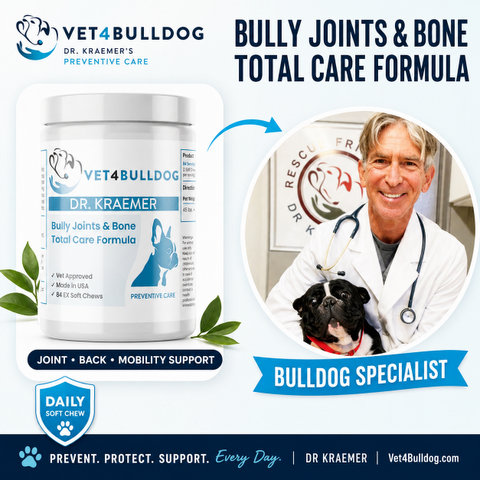
The honest version is this. A supplement or a topical is a tool, not a substitute for veterinary medicine, and anyone who tells you otherwise is selling something.
But there is a second effect that gets ignored. An owner who is giving a daily chew or doing a weekly rinse is an owner who is paying attention. They are more likely to be looking, more likely to notice whether something is helping, and more likely to catch the moment it stops helping. The product keeps them in the loop. That engagement is worth something on its own, independently of what is in the bottle.
That is also why every formula on this site has to be easy and affordable. A perfect product used twice is worth less than a good one used every week.
When the vet matters, and why it is not black and white
Everything above is about routine maintenance on a healthy dog. The picture changes, and it changes for reasons of circumstance rather than for reasons of product.
Bring in your veterinarian when the situation is one of these:
- The problem is not improving
- It is getting worse
- It keeps coming back
- It is beyond routine maintenance, or you are not sure what you are looking at
- Your dog is unwell, or is medically compromised in some way
- Your dog is on medication, where an interaction or a contraindication could matter
That is a list about circumstances, not a list of permissions. Nothing on it says you need professional clearance to buy a rinse.
Now the uncomfortable part, and I say this as a veterinarian rather than at veterinarians. Medicine is not always black and white, and that includes mine. A veterinarian is often working under real uncertainty, under time pressure, and with a worried owner in front of them who wants something done today. Add the fear of a missed diagnosis, a complaint or a bad review, and the path of least resistance is to prescribe or to test rather than to say “this can probably be managed conservatively at home, let us watch it for a bit.” There are also practices, corporate owned and privately owned alike, where production targets are part of the environment. None of that makes anyone a villain. It makes the system one you should understand before you walk into it.
I have written about that at length in are veterinarians overprescribing medication, including what to ask when something is being prescribed for your dog.
My approach to routine problems has always been the same: start with the simplest, most practical thing that makes sense, watch what happens, and escalate when the problem earns it. Most everyday maintenance does not need to be complicated. It needs to be consistent.
Straight talk
Do I need to ask my vet before giving my dog a supplement?
Can I clean an irritated fold at home, or does that need a visit?
Is this just a way of telling me not to go to the vet?
How do I know what is normal for my dog?
What should I bring to a veterinary appointment?
Are supplements and topicals safer than prescription medication?
The short version
Use common sense. Routine preventive and maintenance care can usually be handled by a well informed owner, and doing it yourself is worth more than the task itself, because it teaches you your own dog. More advanced, persistent or medically complicated problems deserve professional evaluation, and you will be far better at that conversation for having paid attention all year.
Given good information, the right tools and clear instructions, an owner stops being a customer waiting for the next appointment and becomes part of their dog’s healthcare team. That has always been the point of this site.
Where to start
Pick the thing that is actually bothering you and read that guide first: skin, folds and coat, breathing and airways, or joints and back. If you have a question of your own, the Exam Room Q and A is where owners send them. And if you want the prevention reminders as they come round, sign up for the free monthly bully newsletter.
Explore Dr. Kraemer’s V4B Bully Therapeutics →
About the author
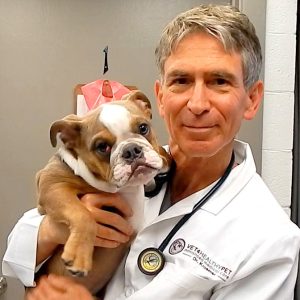
Roy Kraemer, DVM, is a bulldog specialist with 20 years of breed specific clinical experience. His educational work emphasizes prevention over prescription, starting routine care before there is damage to undo, and giving owners the information and the tools to be an active part of their dog’s healthcare team.
Trusted by Vets ~ Recommended by Owners ~ Approved by Bulldogs
Important: this page is educational and is not a diagnosis or a treatment plan for your own dog. It is not a substitute for a veterinary examination, diagnosis or treatment. Supplements are not prescription medication and do not treat infection. If your dog is unwell, is being treated for a condition, or is already on medication, talk to your veterinarian.