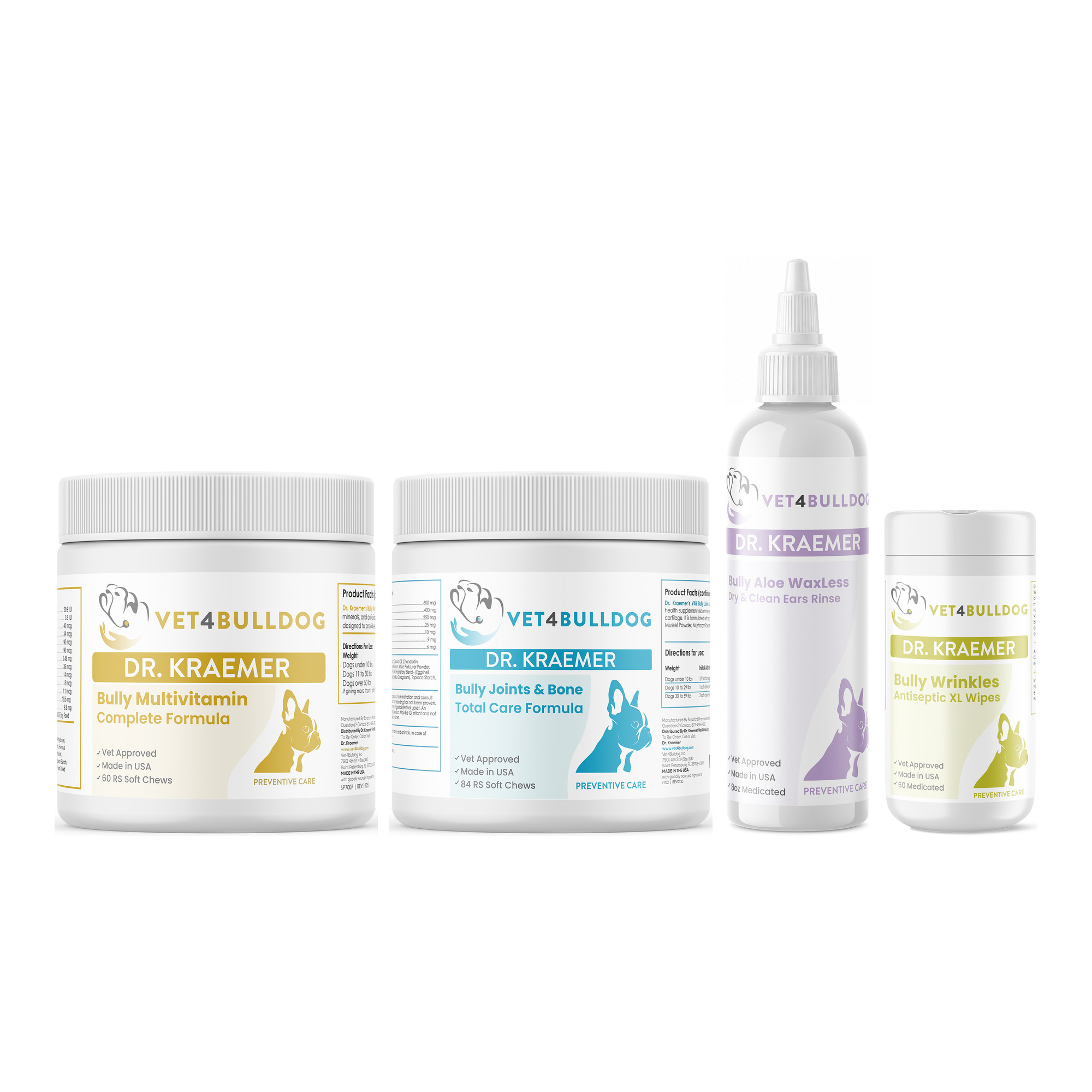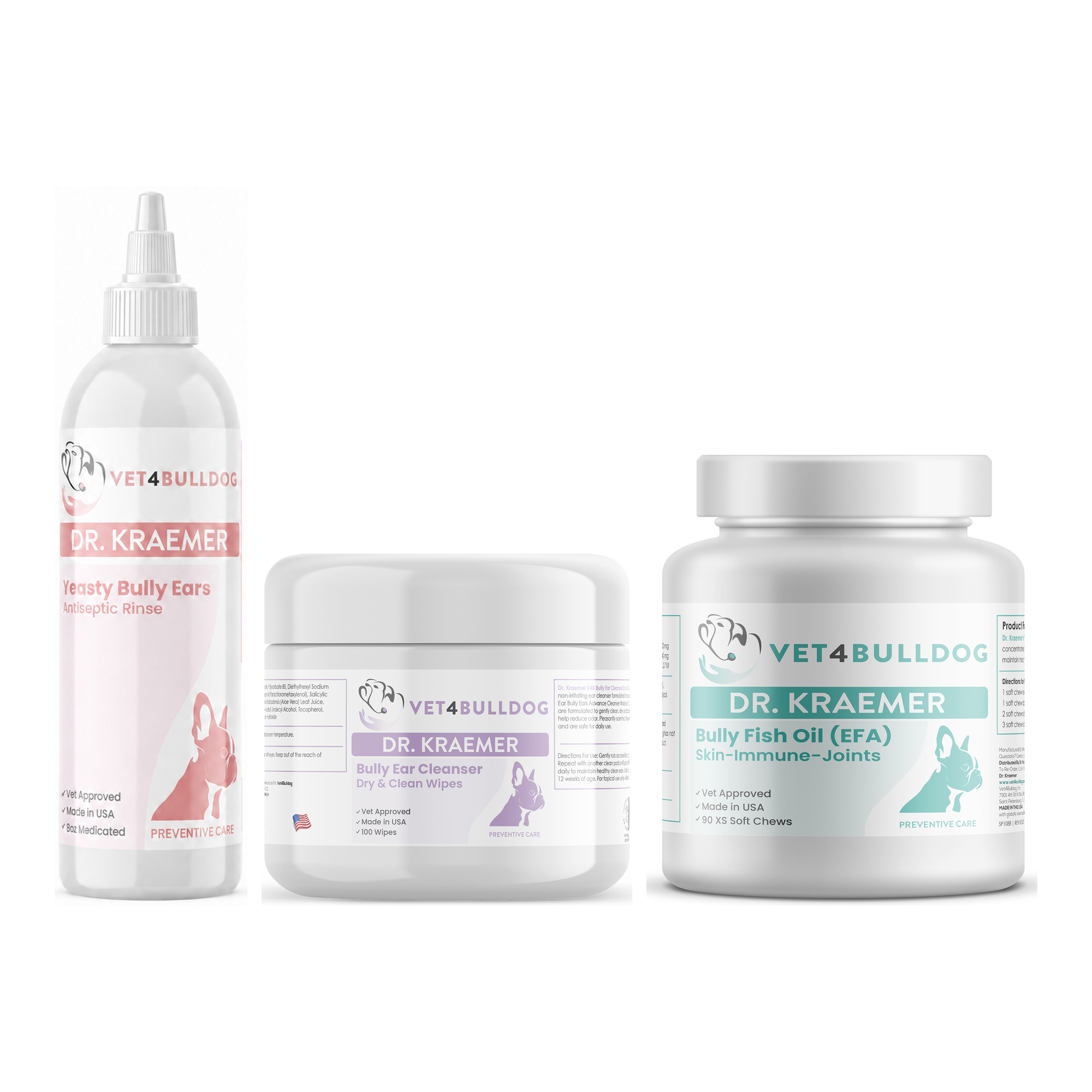


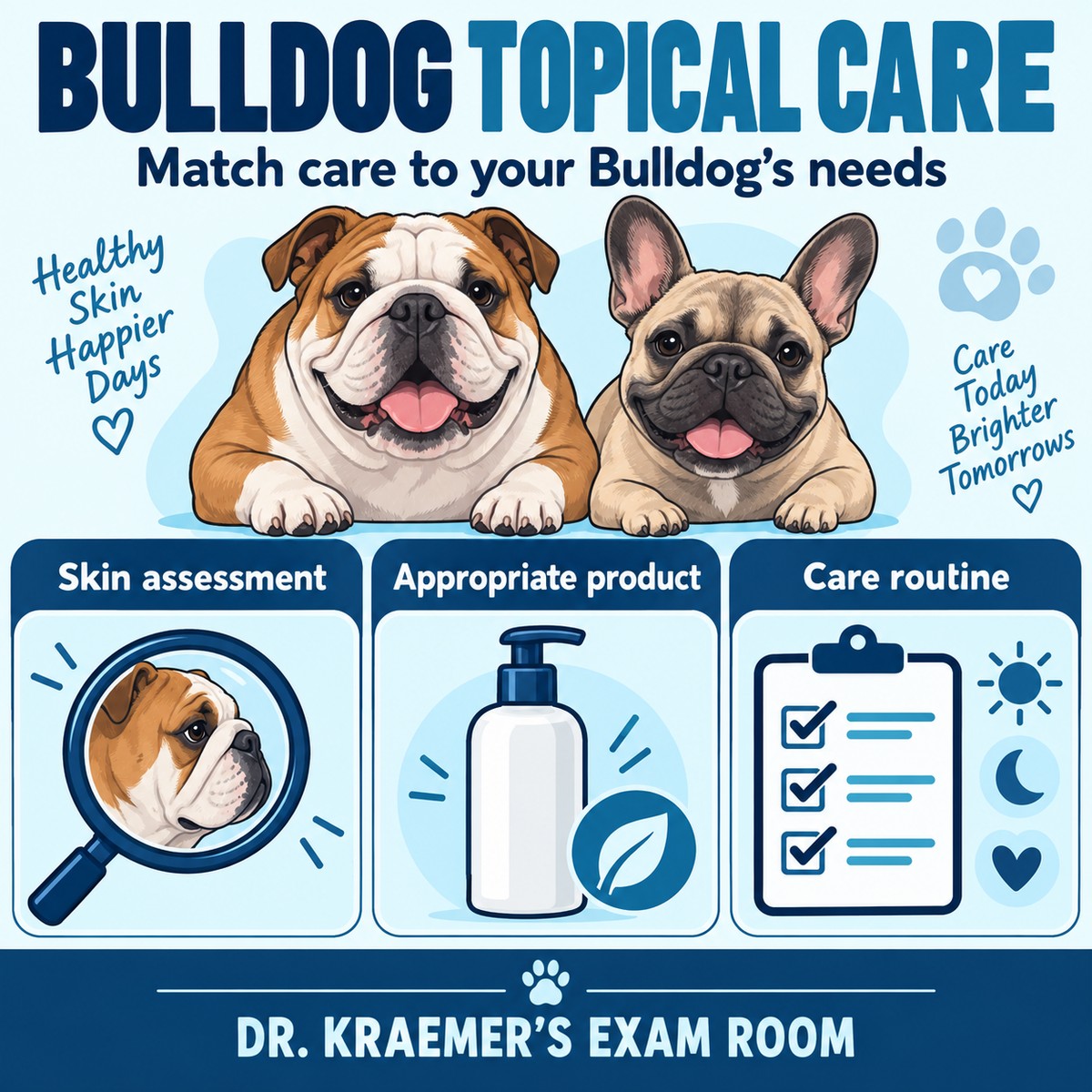
Nonprescription Topical Therapies for Bulldogs and French Bulldogs are numerous and critical for your bulldog’s wellness & care.
When it comes to bulldog care, topical therapies aren’t optional, they’re essential. From itchy paws and yeasty wrinkles to funky tails and hot spots, Frenchies are walking skin stories. The good news? You don’t need a prescription to prevent the drama.

Combined with our therapeutic nonprescription supplements, they serve as the backbone of our “bulldog prevention & care” teaching.
The most common veterinary nonprescription bully topicals are :
- SKIN & COAT
- SKINFOLDS
- EARS & EAR CANAL
- MOUTH & TEETH (oral hygiene)

Topical Therapy Formulations for Bulldogs and French Bulldogs
We offer a wide range of bulldog and French bulldog topical therapeutics:
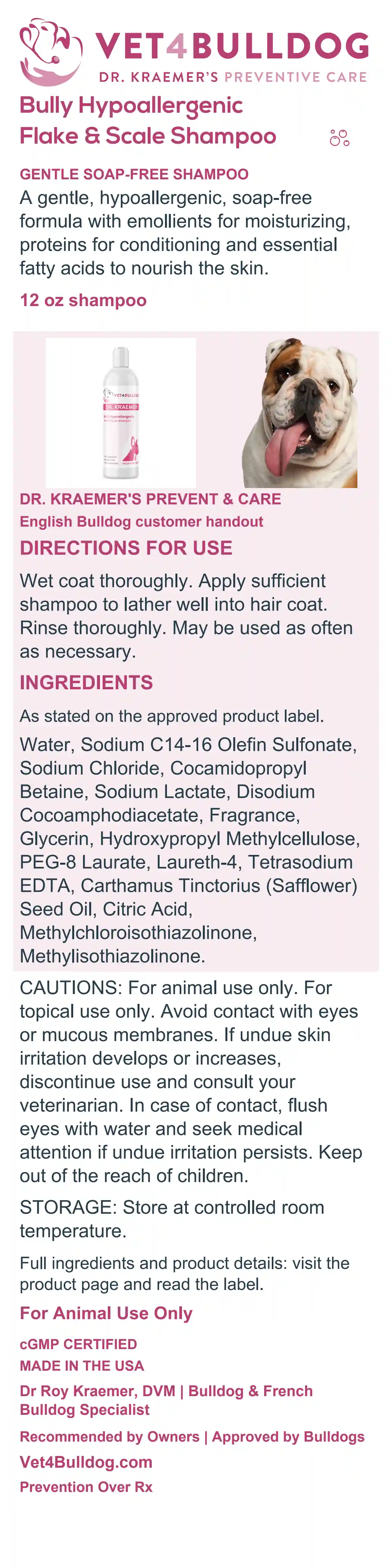
Topical Bulldog Therapeutics: Prevent and Care
- MEDICATED SHAMPOOS: Antiseptic, ItchLess, degreasing, etc.
- HYDRATING SHAMPOOS: Hydrating, Soothing, Pre-Bath, Cleansing, etc.
- NO-RINSE GELS: Waterless Shampoos, No-Rinse Gels
- CONDITIONERS: After Shampoo Cream-Rinse
- WIPES: Tearstain, Ear Pinna
- SPRAY & RINSE


Wrinkles and Skinfolds: Nonprescription Topicals
- WIPES: Antiseptic Wipes
- RINSE: Antiseptic Rinses
- LOTION: Antiseptic Lotions
- SPRAY: Antiseptic Spray

Topical Ear Therapeutics for Bulldogs
- WIPES: Advanced Ear Cleansing Wipes
- ANTISEPTIC RINSE: Priming for yeast & bacteria treatment
- WAXLESS RINSE: For ear maintenance, Low PH & Drying

Dental Therapeutics for Bulldogs
- ORAL RINSE: Water addetive dental splash
- ORAL ANTISPEITC WIPE
Fair question, and the honest answer is that the difference is not the active ingredient, it is where it can go and how long it stays. A shampoo treats the whole dog but needs a bath and rinses away. A rinse stays behind after the bath. A gel goes on a spot and does not run. A spray reaches a back you cannot get your hands to. A wipe gets into a fold on a Tuesday evening with no water, no mess and no argument, which is the one that actually gets used daily and therefore the one that prevents the most. Pick by the job: whole dog, one spot, or a fold you need to do every day. And all of these sit alongside whatever your veterinarian has prescribed, as part of the same plan, not instead of it.
Benefits of Topical Therapies for Bulldogs
- ECONOMIC: Very low cost.
- PREVENTIVE & TREATMENT: Can be used as a preventive measure, or as an alternative to prescription Rx, and if needed, in conjunction with Rx.
- @HOME: Done from the convenience of your home.
- NON-RX: Can be used without a Dr. visit (prescription).
- SAFE: No known side effects, nor long-term bacteria resistance (mutated resistant microorganism).


Dr. Kraemer’s V4B Bully Formulation
- AUTHORITATIVE: Dr. Kraemer is known worldwide for his bulldog clinical experience and vast knowledge of the breed.
- COLOR-CODED: For safety and ease of use, all V4B topical products are color-coded by mode of action.
- FRIENDLY LABELING: The label’s emphasis is on clarity, safety, and ease of understanding.
- VISUAL & WRITTEN SUPPORT: User handouts, how-to videos, photos, and diagrams are available.
- BULLDOG CUSTOMIZED: Ideal size and formulation.
- cGMP: Certified Good Manufacturer Certified
- 100% MONEY-BACK GUARANTEE
- MADE IN THE USA
- % GOES TO RESCUE: A percentage of all sales goes to bulldog rescue.
Insider tip
What Bully Topicals May Help Treat Medical Problems?
These are only some of the common bulldog and French bulldog medical conditions you should and can treat with Dr. Kraemer’s nonprescription bully therapeutic topicals:
Bulldog and French Bulldog Skin and Coat
- BULLDOG ATOPIC ALLERGIC ITCH DERMATITIS: Allergies related to the environment (pollen, grass, weed, dust mites, mold, etc).
- BULLDOG FOLD ALLERGY ITCH DERMATITIS: Allergies related to your bulldog’s diet with the protein source being the main allergen.
- BULLDOG SKIN MITES: Bulldog demodectic red mite and bulldog sarcoptic mange.
- BULLDOG PYODERMA: Bulldog bacteria and yeast dermatitis.
- BULLDOG TEAR STAINS: Related mostly to the face and lower limb/paw licking sites.
- BULLDOG INTERDIGITAL DERMATITIS & PODODERMATITIS: Allergies of the paws and digital spaces.
Bulldog and French Bulldog Wrinkles and Skinfolds
- BULLDOG NASAL SKINFOLD MOIST DERMATITIS
- BULLDOG TAIL SKINFOLD MOIST DERMATITIS
- BULLDOG INTERDIGITAL SKINFOLD MOIST DERMATITIS
- BULLDOG VAGINAL SKINFOLD MOIST DERMATITIS
Bulldog and French Bulldog Ears and Ear Canal
- BULLDOG BACTERIA OTITIS/BULLDOG YEAST OTITIS
- BULLDOG END STAGE EARS: Ears that eventually will need total ear canal resection (TECA w BO).
- BULLDOG ALLERGIC OTITIS: Think of ears as an extension of the skin.


Bulldog and French Bulldog Dental Disease
- BULLDOG GINGIVITIS
- BULLDOG PERIODONTAL DISEASE
- BULLDOG SUBGINGIVAL HAIR
How to Use Each Formulation, Properly
Same active ingredients, five different jobs. Think of it the way you would think about cleaning a kitchen: you do not use the mop on the worktop or the cloth on the floor. Pick by where it has to reach and how long it has to stay there.
Medicated shampoo: the whole dog
What it is for: a problem that covers a lot of surface, or a coat that needs a reset.
How to use it: wet the coat thoroughly first, because a dry coat drinks the product and wastes most of it. Work the lather down to the skin, not just over the top of the fur. Then leave it on. This is the step everybody skips. Give it several minutes of contact while you talk to your dog, scratch an ear, check your phone. Then rinse until the water runs clear, because residue left behind is a common cause of the itch that starts two days later.
The mistake: on and straight off. A shampoo rinsed away in thirty seconds has done roughly nothing, and you will conclude the product does not work when what did not work was the bath.
No-rinse gel and lotion: one spot, staying put
What it is for: a defined area you want treated and left alone. A fold, a hot spot, a patch between the toes.
How to use it: clean and dry the area first, apply a thin film, and rub it in rather than leaving a blob sitting on the hair. A thin layer in contact with skin beats a thick layer sitting on fur every time.
The mistake: applying it to a wet or dirty fold. Gel on top of yesterday’s debris is treating the debris.
Antiseptic rinse: after the bath, and into the places you cannot see
What it is for: leaving something behind once the shampoo has gone, and for folds and crevices a cloth cannot reach into.
How to use it: after rinsing the shampoo out, apply the rinse and do not wash it off. That is the whole point of it. For folds, let it run in and then gently blot, never scrub.
The mistake: rinsing the rinse. If you wash it away you have bought a very expensive bottle of water.
Antiseptic spray: reach and frequency
What it is for: a back, a rump, a chest, anywhere your hands are awkward, and for topping up between baths.
How to use it: part the coat and spray at the skin, not at the fur. Hold the nozzle close. A bulldog who dislikes the hiss will accept it sprayed onto a cotton pad and wiped on instead, and that works just as well.
The mistake: misting the dog from a distance like a houseplant. Pretty, useless.
Antiseptic wipes: the one that actually gets used
What it is for: daily maintenance of folds, the tail pocket, paws after a walk, under the eyes. No water, no mess, no bathroom.
How to use it: one wipe, one area, then throw it away rather than going back round the dog with the same one. Into the fold, along it, and then dry it. Wet is the enemy of a bulldog fold.
The mistake: cleaning the fold and leaving it damp, which hands the yeast exactly the conditions it wanted.
Ear rinse: a different anatomy
What it is for: routine ear maintenance in a breed built with a canal that bends and holds moisture.
How to use it: fill the canal, massage the base of the ear until you hear it squelch, then let your dog shake. The shake is the part that brings the debris up. Wipe out what arrives at the opening and never push anything down into the canal.
The mistake: cotton buds down the ear. You are packing the problem deeper, not removing it.
Dental rinse, splash and wipes: the mouth counts as a surface
What it is for: the one bulldog surface nobody thinks of as skin, and the one with the most going on. Daily matters here more than strength does.
How to use it: a water additive asks nothing of the dog at all, which is why it is the one that gets kept up. A wipe along the outer surface of the teeth takes under a minute. The inside surfaces matter far less than people think, because the tongue does most of that work.
The mistake: starting with a toothbrush on an adult bulldog who has never had anything near his mouth, getting bitten or ignored, and giving up on the whole idea.
The Bulldog Map: Where Topicals Earn Their Keep
A bulldog is not a dog with skin problems, it is a dog with a lot of folded, warm, damp real estate and skin problems are what happens in it. Knowing the map tells you where to spend the ten minutes.
The nose rope and face folds
Warm, dark, damp and in constant contact with food, water and tears. This is the single highest-value fold on the dog and the one most often left to its own devices. Daily wipe, then dry.
The tail pocket
The fold almost nobody knows exists until it goes wrong, because on many bulldogs you have to lift the tail to find it. It is a sealed, airless pocket that collects everything. Daily wipe, then dry, and it will rarely trouble you. Neglected, it becomes one of the more miserable problems this breed gets.
Paws and between the toes
Bulldogs walk on what the pavement offers and then lick it off. The webbing between the toes stays damp and takes the brunt of allergy flares. A wipe after a walk is thirty seconds and prevents a great deal.
Ears
A canal shaped to trap moisture, in a breed prone to allergy. Routine rinsing is maintenance, not treatment, and maintenance is cheaper than treatment every single time.
The vulvar fold
In females, a recessed fold sits close to the urinary opening and stays damp. Routine care here heads off a surprising amount of recurring trouble further up.
The coat as a whole
Short, dense and close to the skin, which means anything on the skin stays on the skin. This is where the medicated wash belongs, on a schedule rather than in a panic.
Formulation at a Glance
| Formulation | Best for | Stays on? | Typical rhythm |
|---|---|---|---|
| Medicated shampoo | Whole dog, whole coat | No, rinsed out | On the schedule your vet sets |
| No-rinse gel or lotion | One defined spot | Yes | As directed, usually daily at first |
| Antiseptic rinse | After the bath, and folds | Yes | With every medicated bath |
| Antiseptic spray | Hard to reach areas, top-ups | Yes | Between baths |
| Antiseptic wipes | Folds, tail pocket, paws | Yes | Daily, and it is the daily one that matters |
| Ear rinse | Ear canal maintenance | Flushed, then shaken out | Routine, and after swimming or bathing |
| Dental rinse and wipes | Teeth and gum line | Yes | Daily, lightly, forever |
Why Topical First Is Not a Compromise
Owners sometimes hear “topical” and assume it means mild, or second best, or what you do when the real treatment has not worked. It is none of those things. Four reasons it belongs at the front.
It arrives where the problem is, at full strength
A tablet has to be swallowed, absorbed, carried round the whole body by the blood and then delivered to the skin, with everything diluting along the way. A medicated wash lands on the skin at full concentration. For a surface problem, that is simply a better delivery route, the way a plaster beats a tablet for a graze.
It does not teach bacteria anything
This is the one that matters most and is least understood. Antiseptics work by physically disrupting the organism rather than by a single biochemical mechanism, so bacteria do not learn their way round them the way they learn their way round an antibiotic. Every course of antibiotics is a lesson. A medicated wash is not.
The side effects stay on the outside
Nothing that goes on the coat is working on the liver, the kidneys or the gut. For a dog who is older, on other medication, or who has had a rough time with something systemic, that matters a great deal, and it is one reason topical care tends to suit the dogs who have the fewest options left.
It is cheaper, and the arithmetic is not close
A bottle that lasts months against repeat consultations and repeat prescriptions. Prevention is almost always the cheaper line item, which is the whole argument this site was built on.
Building a Routine That Actually Happens
Here is the honest problem with everything above: it only works if it happens, and the most common reason a bulldog’s skin goes wrong is not the wrong product, it is a good product in a cupboard.
Attach it to something you already do
Fold care after the evening meal. Paws by the door when the leash comes off. Nobody keeps a new habit because they intended to. They keep it because it is bolted to an old one.
Small and daily beats big and occasional
Two minutes a day on the folds will do more over a year than an hour of heroics once a month. The folds are a maintenance job, like brushing teeth, not a project.
Keep it where you will trip over it
Wipes by the door or beside the food bin get used. Wipes in the bathroom cabinet upstairs do not. This sounds trivial. It is the single biggest predictor of whether an owner keeps it up.
Learn what your own dog’s normal looks like
Ten seconds a day with your hands on the folds teaches you what this particular dog feels like when everything is fine. That is what lets you notice early, and noticing early is most of the game.
Six Mistakes That Waste a Good Product
- No contact time. A medicated wash needs minutes on the skin, not seconds. More than any other single thing, this is why a product “did not work”.
- Treating the fur instead of the skin. Part the coat, get down to the surface. The problem does not live on the hair.
- Leaving a fold damp. Clean it, then dry it. A clean wet fold is better conditions for yeast than a dirty dry one.
- Stopping the moment it looks better. It looks better before it is better. Finish the course your veterinarian set, then move to maintenance rather than to nothing.
- Reaching for a human product. Different skin, different pH, different outcome. There is a whole section above on why.
- Changing three things at once. New shampoo, new food and a new supplement in the same week tells you nothing about any of them. Change one thing, give it a good few weeks, then judge it.
Straight talk
Shampoo, gel, rinse, spray or wipe. Which do I use?
How long should a medicated shampoo stay on?
Can a topical replace what my vet prescribed?
Can I use a human product?
Do I need a vet before I use any of this?
How often?
To be clear: medicated topicals are part of the multimodal plan your veterinarian sets and are used alongside anything prescribed, not instead of it, with the treatment decision left to your vet. This page is educational and is not a diagnosis or a treatment plan for your own dog.
Veterinary Care and Supportive Products
Routine topical care is a job a well-informed owner can run, and that is the point of this page. When a problem is not improving, keeps coming back, or your dog is unwell in other ways, that is a conversation for your veterinarian.
More Help from Dr. Kraemer
Topicals get used for specific jobs. These guides cover the jobs:
- Skin and coat preventive care
- Skin fold and wrinkle dermatitis
- Yeast infection, skin and ears
- Superbugs and resistant infection
- Dental disease, plaque and tartar
- What you can handle at home, and when to see the vet
About the Author
Roy Kraemer, DVM, is a veterinarian with extensive clinical experience caring for Bulldogs and French Bulldogs. His educational work emphasizes prevention, early recognition, appropriate at-home care, responsible medication use, and veterinary evaluation when a problem is persistent or severe.
Trusted by Vets ~ Recommended by Owners ~ Approved by Bulldogs
References
- World Association for Veterinary Dermatology. Guidelines on topical antimicrobial therapy in dogs
- Merck Veterinary Manual. Topical therapy of the skin in small animals
- AAHA. Guidelines on judicious therapeutic use in companion animals
Related Products