


We moved house last spring and in the chaos our Bulldog’s heartworm prevention lapsed for about four months before I realized. He has just tested positive. I have read what the treatment involves and I feel sick about it. The vet has been kind but I can see this is going to be months of keeping him quiet, and he is a dog who lives to charge around the yard. I did this to him.
Stop there. You did not do this to him. A house move is one of the few events reliably capable of eating four months, and a lapse in a monthly medication during one is close to the most ordinary thing that happens to a responsible owner. The dogs I worried about were the ones whose owners never started, not the ones who noticed and acted.
On the treatment, since you have already read about it and are bracing: the restriction is the hard part and it is not optional. The reason your veterinarian keeps repeating it is that as the worms die they have to be cleared through the lungs, and an excited dog with a racing heart moves that debris around faster than his body can cope with. The rest is not comfort for him, it is the treatment working safely. A Bulldog already has less respiratory reserve than most, which makes it matter here more than it would in another breed.
What that looks like in practice is your problem to solve creatively rather than heroically. A dog who lives to charge around the yard needs his brain tired instead of his body. Food puzzles, scent games on a mat, short sessions of training he already knows, chewing. Several short lead walks only if your vet allows them at all. Expect him to be frustrated and expect to feel like the villain. The owners who got through this well were the ones who planned the boredom rather than fighting it each day.
The last thing, and I mean it kindly. When he is through this he will still need prevention, probably for the rest of his life, and it will feel like locking the stable door. Put it on a repeating reminder tied to something you already do monthly rather than trusting memory, because memory is what moved house last spring.
Bulldog Heartworm Introduction
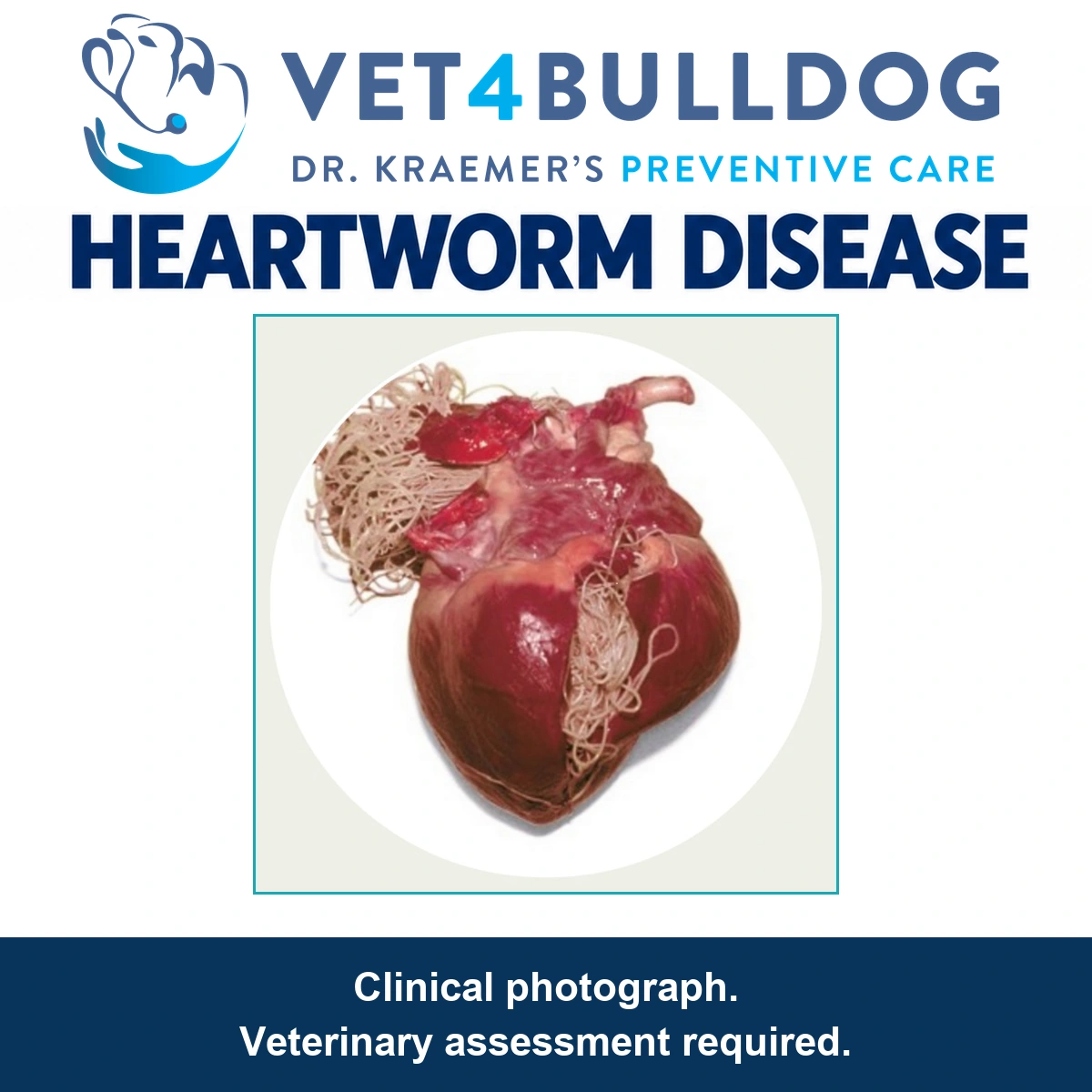
Heartworm Disease in Bulldogs and French Bulldogs can result in severe
- Lung disease
- Heart failure
- Organ damage
- And Death
Despite treatment success, the effects and pathology of bulldog heartworm disease are long-lasting and are likely to impact life expectancy.
Heartworm disease (Dirofilaria immitis) is more common in dogs, but cats can also be infected.
Others are coyotes, ferrets, wolves, sea lions, seals, and other animals; occasionally it even infects humans.
How is heartworm disease transmitted to bulldogs?
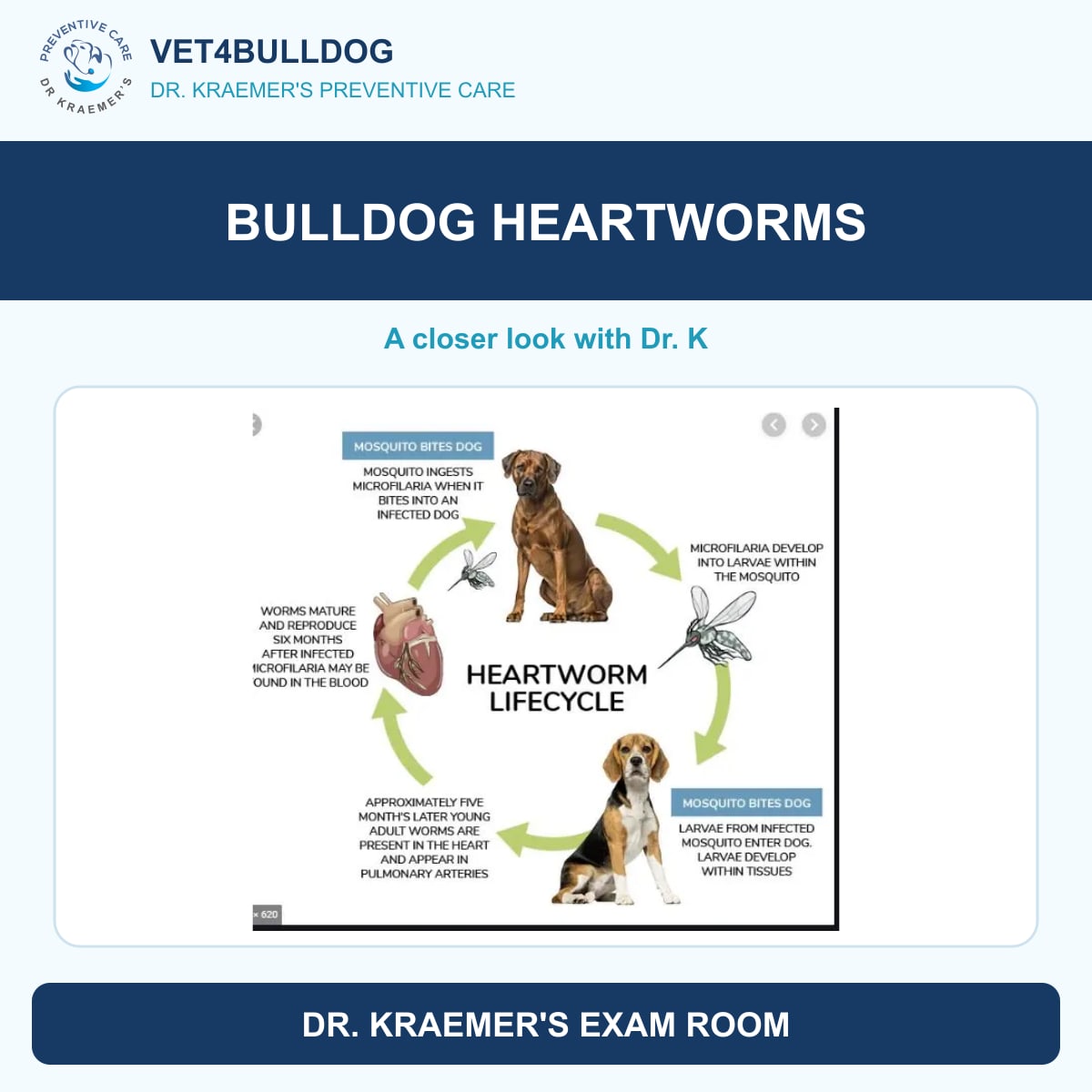
Heartworm disease in bulldogs and French bulldogs is transmitted through the bite of an infected mosquito. When a mosquito carrying heartworm larvae bites a dog, the larvae enter the bloodstream and migrate to the heart, lungs, and associated blood vessels. Over time, these larvae mature into adult worms, which can mate and produce offspring, causing severe damage to the dog’s cardiovascular and respiratory systems.
This disease is serious and can be fatal if untreated, as adult heartworms can block blood flow and cause heart failure, lung disease, and organ damage. Preventative treatments are crucial, especially in areas where heartworms are common, as they are much easier and cheaper than treating an active infection.
Bulldog Heartworm Disease is a serious and deadly
Can Bulldog Heartworm Disease be transmitted to humans?
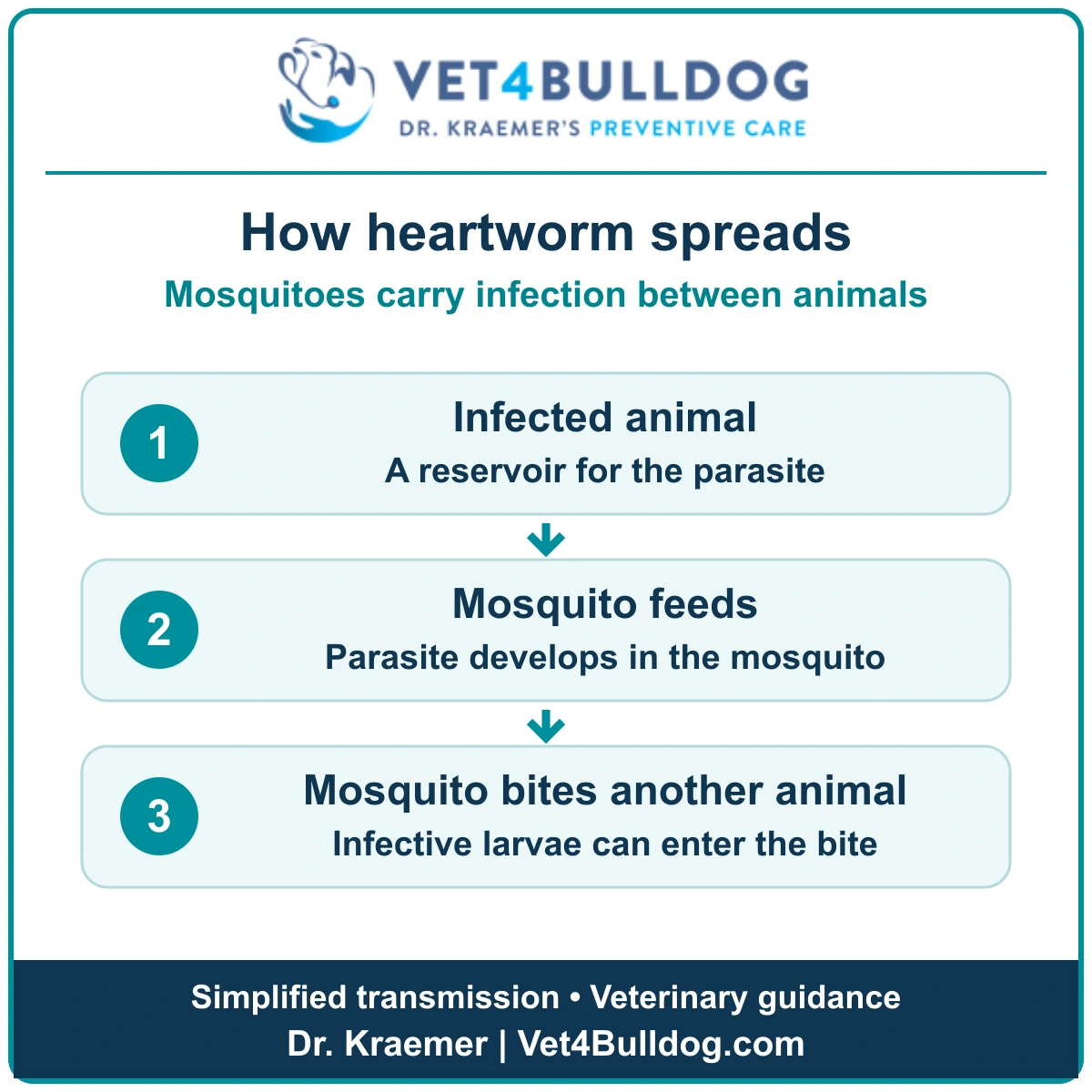
Bulldog heartworm disease is not spread directly from animal to animal or from animal to human. The transmission occurs exclusively through the bite of an infected mosquito. When a mosquito bites an infected animal, it ingests heartworm larvae (microfilariae) present in the animal’s blood. These larvae then develop inside the mosquito.
Once the mosquito bites another animal, such as your bulldog, it transfers the larvae, which can then mature into adult heartworms in the dog’s lungs and blood vessels.
Prevention is key, as there is no risk of direct transmission between dogs or from dogs to humans without the involvement of a mosquito vector.
Heartworm Disease in Bulldogs and French Bulldogs REGIONAL:
Regionally, the disease has been on the rise; heartworm cases are increasing in Los Angeles.
According to a report updated on April 26, 2016, by Los Angeles County Department of Public Health. In recent years Heartworm disease has been on the rise, possibly due to new drought-resistant mosquito strains.
The American Heartworm Society recommends year-round prevention of heartworm disease and annual heartworm tests in all dogs, regardless of geographic location.
Symptoms of Heartworm Disease in Bulldogs and French Bulldogs Are:
By the time clinical signs of heartworm disease appear in bulldogs and French bulldogs, the disease is often in an advanced stage. Common symptoms include:
1. Cough: persistent and often worsens with physical activity.
2. Difficulty breathing: Known as dyspnea, it can be mistaken for asthma-like symptoms.
3. Weakness: Especially after exercise, your dog may tire easily.
4. Loss of energy: A notable decrease in overall activity and enthusiasm.
5. Heart failure: As the disease progresses, the heart becomes overburdened, leading to congestive heart failure and more severe symptoms.
Physical activity aggravates these symptoms; thus it is critical to get veterinarian care as soon as symptoms appear to stop the disease from getting worse.
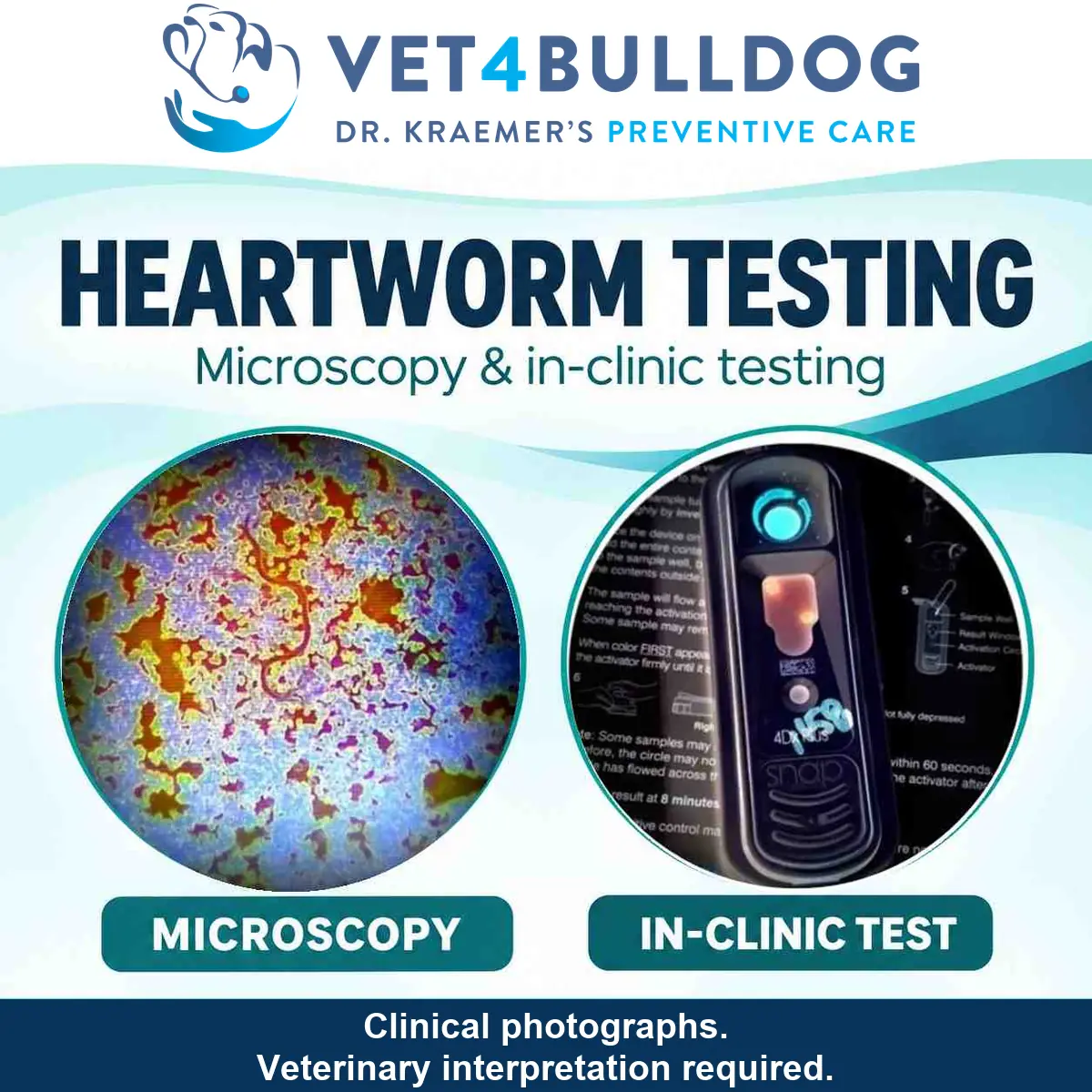
How Can You Prevent Heartworm Disease in Bulldogs and French Bulldogs?
Remember, Bulldog heartworm disease is much cheaper and easier to PREVENT than TREAT.
Traditionally, prevention required oral administration once a month at home.
There is also a once-a-year ProHeart heartworm preventive injection.

HEARTWORM PROHEART INJECTION TREATMENT
The ProHeart injection offers multiple benefits over the monthly oral one:
BULLDOG HEARTWORM TREATMENT’S COMPLIANCE:
A 12-month injection makes it 100% bulletproof against the likelihood of skipping or forgetting a treatment.
BULLDOG HEARTWORM TREATMENT BULLY COMPLIANCE:
Every 12-month injection makes it 100% bulletproof against the likelihood of your pet spitting or vomiting the heartworm chew.
A. AFFORDABLE: ProHeart Injection is low cost.
B. INTESTINAL PARASITE: ProHeart also helps to protect your bulldog from harmful intestinal parasites.
C. GUARANTEE HW: If your pet had a negative HW test prior to the treatment, ProHeart manufacture guarantees the injectable treatment and will pay for the treatment in the unfortunate event your bulldog or French bulldog is found positive during the 6 or 12-month treatment duration.
F. GUARANTEE INTESTINAL PARASITE: ProHeart manufacturer also guarantees the injection effectiveness against the common intestinal parasite; thus, if your pet is diagnosed with hookworms, whipworms, or roundworms during the 6- or 12-month treatment duration, they will pay for deworming treatment.

Straight talk
Heartworm Disease in Bulldog and French Bulldogs: TIPS:
Important heartworm tips course of Dr. Kraemer
BULLDOG HEARTWORM MOSQUITO CONTROL
🩺 STANDING WATER: avoid outdoor open water fixtures, drinking bowls, fountains, and standing water in your gutters
🩺 INDOORS: keep your pet indoors at night
🩺 COYOTE CONTROL: infected coyotes are common reservoirs of the disease. Don’t leave food or water that attracts them and other critters
🩺 RESERVOIRS: untreated pets who are infected serve as reservoirs that allow mosquitoes to infect more pets and people.

Dr. Kraemer’s Heartwomen Summary To the Bulldog Owner:
🩺 VERY SERIOUS Bulldog heartworm is a severe medical condition that affects the heart, lungs, and blood vessels, leading to serious health issues and potentially death if left untreated.
🩺 VERY EXPENSIVE: While heartworm prevention is relatively inexpensive, treating a bulldog with heartworm disease is costly and involves extensive medical care, medications, and monitoring, making prevention much more cost-effective.
🩺 LONG CONFINEMENT: Treatment requires strict cage rest and long periods of confinement. Physical activity must be limited to prevent further strain on the heart, which is a significant burden on both the dog and the owner.
🩺 RISKY TREATMENT: The treatment for heartworm disease, though effective, carries risks, including potential complications from the death of the worms, which can lead to blockages in the dog’s arteries. Prevention is far safer and avoids these dangers.
🩺 LONG LASTING: The harm that heartworm illness causes to your bulldog’s respiratory and cardiovascular systems might persist even after treatment is successful, necessitating continued medical attention.
BULLDOG HEARTWORM PREVENTION
- 🚨VERY EASY
- 🚨VERY INEXPENSIVE
- 🚨VERY SAFE
- 🚨VERY REWARDING

The thing that actually prevents heartworm is a prescription medication, and it belongs in your veterinarian’s hands, not in a shopping cart. There is no supplement, no herb and no natural alternative that does this job, and anyone selling you one is selling you a story. Buy the real thing from your vet, give it on schedule, and this page has done its work.
Where a product of mine has any place here is after the fact, and only then. Heartworm leaves its mark on the heart and the lungs, and that mark does not disappear when the worms do. A dog who has been through it, or an older Bulldog whose heart you are keeping an eye on anyway, is a dog whose background support is worth thinking about. That is what the heart and blood range is for. It may complement what your veterinarian is doing. It does not replace any of it, and it treats nothing.
If your dog has been through heartworm treatment, or your vet is already watching his heart, the heart and blood range is where to look. Tell your veterinarian what you are giving, every time.
To be clear: nothing here prevents or treats heartworm disease. Heartworm prevention is a prescription medication and is a decision for your veterinarian. This page is educational only and is not a substitute for veterinary examination, diagnosis or treatment.
He is an indoor dog. Does he really need it?
Yes. This is the single most common reason owners stop, and it is the one I argued with most. A mosquito does not know the difference between your dog and the one in the yard, and it only takes one getting through an open door for the evening. Indoor dogs test positive every year. The prevention is cheap enough that the argument is not worth having.
Can I stop over the winter?
Year round is what I would do, and it is what most veterinarians in this region advise. Mosquitoes are not reliably gone for months at a time here, and a stop and start pattern is also where missed doses creep in. Keeping it on one date all year is simpler to remember than trying to work out when the season starts.
I missed a dose. What now?
Ring your veterinarian and tell them exactly how long the gap was. Do not guess and do not just carry on as though nothing happened. What they advise, including whether a test is sensible before restarting, depends entirely on the length of that gap. It is an easy phone call and it is the right one.
Why does he need a test if he is already on prevention?
Because prevention works on the immature stages, not on adult worms, and giving it to a dog who is already carrying adults is not without risk. The annual test is how your vet confirms the ground is clear before another year of it. It also catches the consequences of a gap you may not have realized you had.
He tested positive. How bad is this?
It is serious and it is treatable, and the two facts sit together. The treatment is a careful course rather than a quick fix, and the hardest part for most owners is the restriction on activity that goes with it, because an excited dog is working against his own recovery. Your veterinarian will set the plan. What I would say is that the dogs who do best are the ones whose owners took the rest seriously.
Does it matter which prevention he is on?
That is a conversation for your veterinarian, who knows what is prevalent locally, what your dog has tolerated before and what suits your routine, including whether a monthly chew or a longer acting injection is the better fit for a household that forgets things. There is no single right answer and there is no answer I could give you from here.
More Help from Dr. Kraemer
Heartworm sits inside the wider prevention picture, and these cover the rest of it.
- Intestinal worms in Bulldogs and French Bulldogs
- Fleas and flea allergy in Bulldogs and French Bulldogs
- Prevention and wellness guide for mature Bulldogs
- Prevention and wellness guide for the senior Bulldog
If you have a question about your own dog, the Exam Room Q and A is where owners send them.
References
- Heartworm Disease in Dogs, Cats, and Ferrets, Merck Veterinary Manual
- Heartworm Disease in Dogs, Merck Veterinary Manual
- Heartworm Guidelines, Companion Animal Parasite Council
Trusted by Vets ~ Recommended by Owners ~ Approved by Bulldogs