


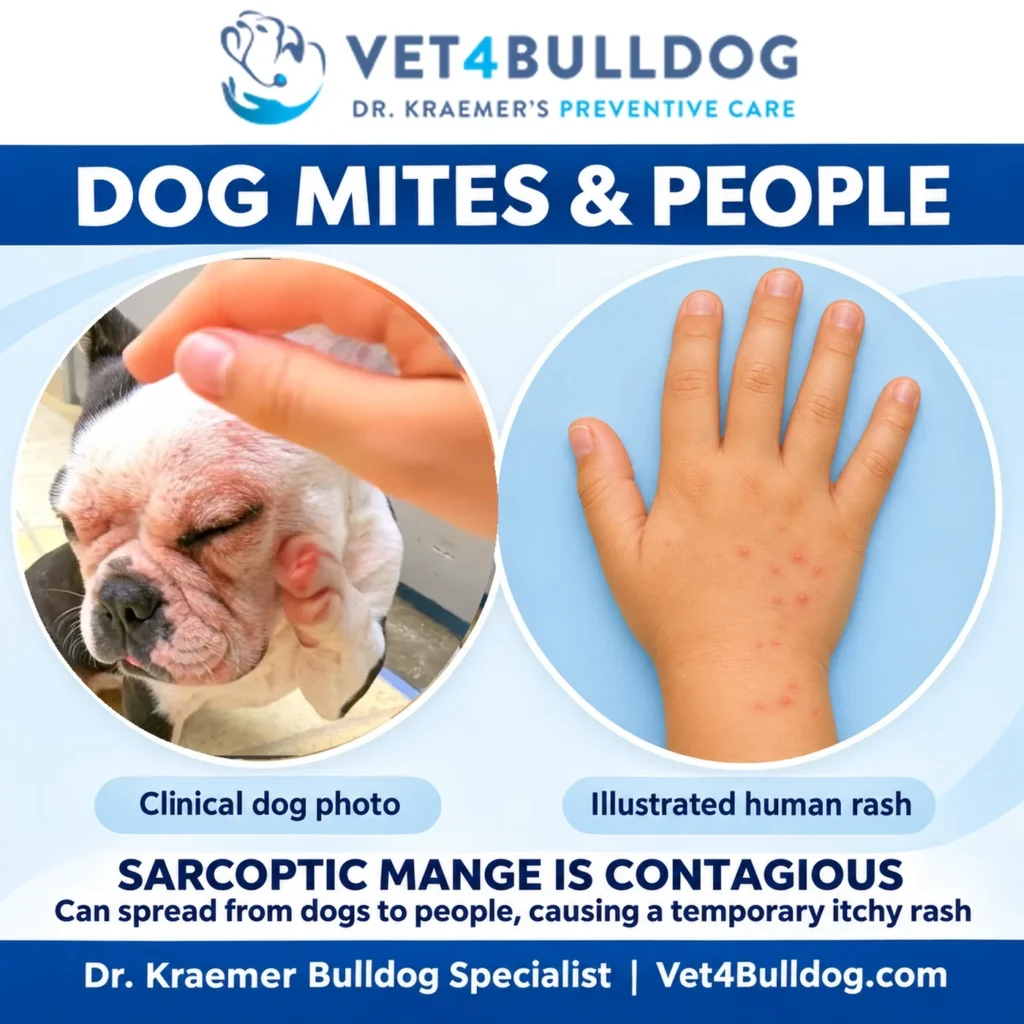
It is contagious, so it can turn up affecting you and your family as well as your other household pets.
Neither mite is visible to the naked eye, but both can be seen under the microscope. Both are more common in younger dogs and puppies, likely because of their incompletely developed, weaker immune systems.
Bulldog Sarcoptic Mange 5 MUST KNOW
- It is uncommon in bulldogs, and that is exactly why it gets missed.
- The intense itch is the hallmark, and it does not improve on conventional itch control medication.
- It is contagious to your other pets and to the people in your house while demodex mite is not.
- A negative skin scrape does not rule it out. The mite hides and the test misses it, even after several tries.
- Support mite and itch management with Dr. Kraemer’s bully therapeutics, alongside a flea preventive that also covers mange and keeping every pet in the house on it.

What Are Bulldog Sarcoptic Mange Mite Symptoms?
First, the intense itch that is not improving with itch control medication.
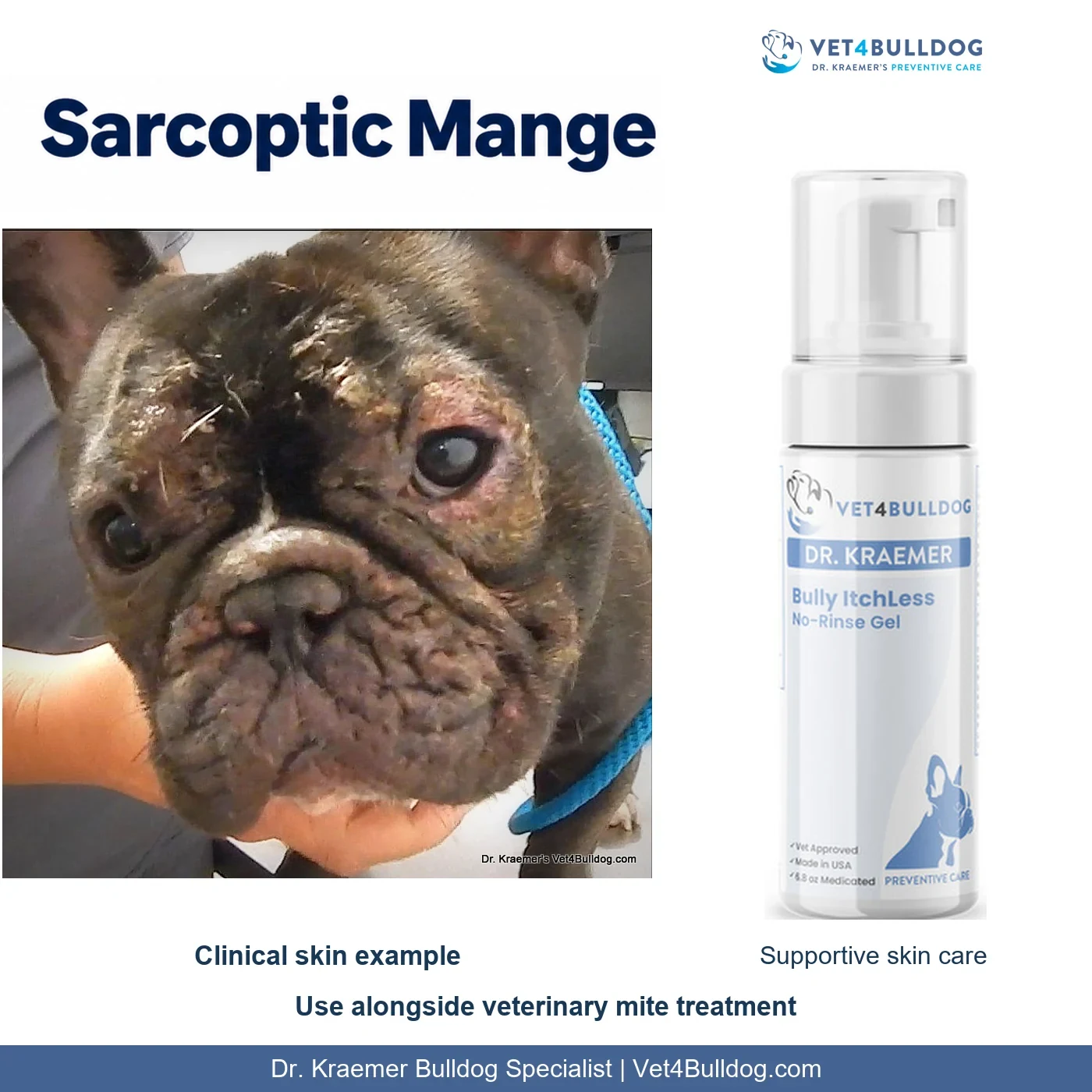
Second, the small red scabby lesions, often on the ear margins, which may be crusted. That crusting is a good place for a skin scraping. They also appear on other hairless places such as the elbows, but they can affect the entire body surface and be confused with the common allergies.
Hair loss and balding.
Other household pets, or members of the household, with itchy skin and lesions.
It is uncommon in bulldogs, and that is exactly why it gets missed.
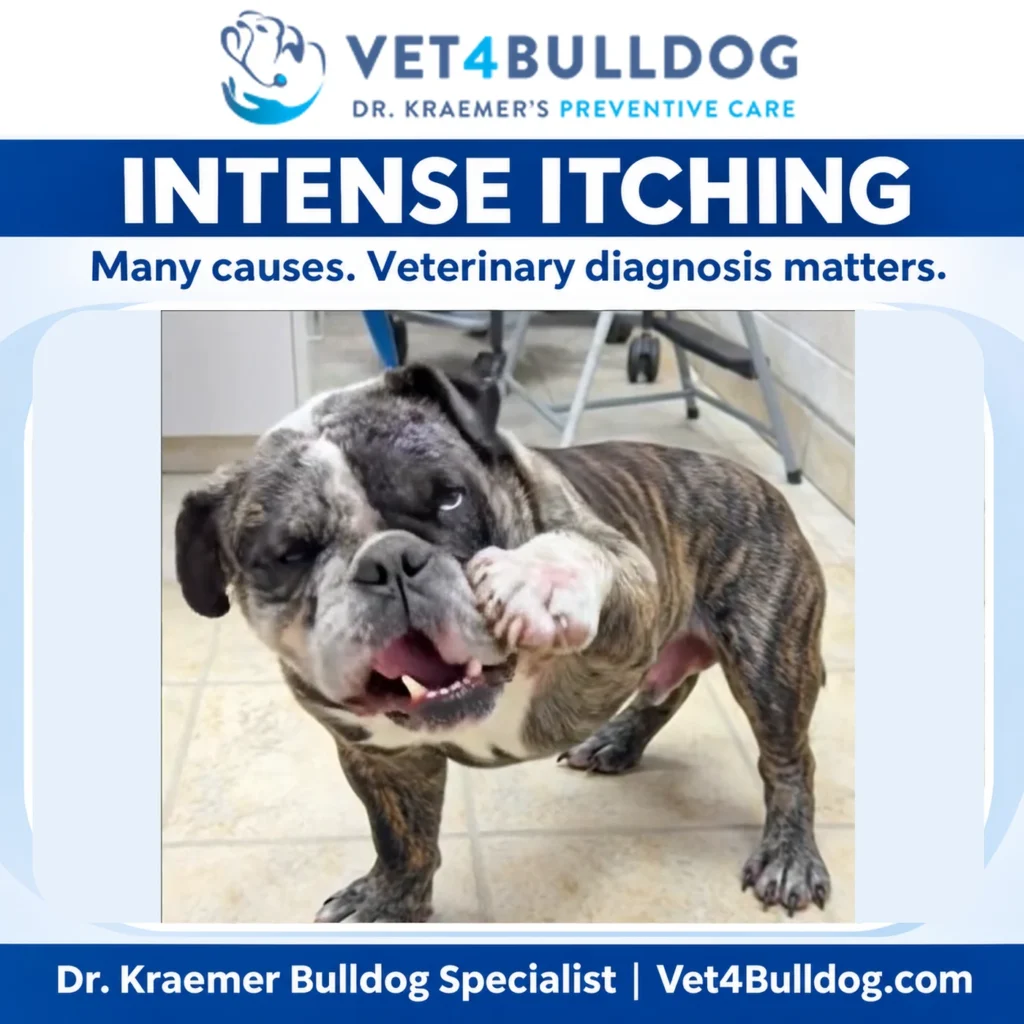
What Causes the Severe Itch in Bulldogs with Sarcoptic Mange?
The motion of the mites across the skin surface, compounded by the eggs laid deeper in the skin, provokes a severe allergic reaction. It does not take many of them to get that going, which is part of why the itch can be so out of proportion to the number of mites present.
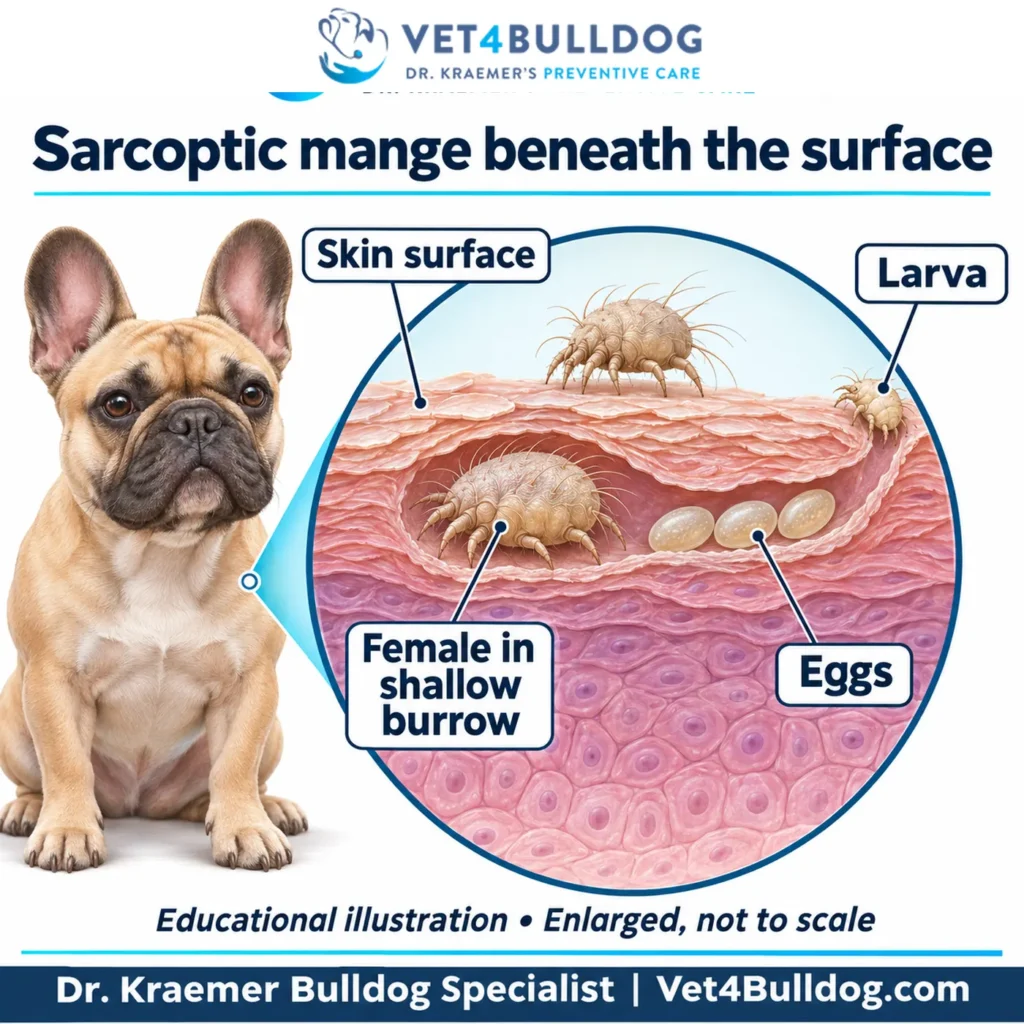
How Mange Mites Are Diagnosed
- Clinical manifestation. Intense itch, red lesions, and other people or pets in proximity with similar problems can be the first clue.
- Itch that does not respond well to symptomatic itch medication.
- A positive finding of mites on a skin scrape under the microscope, concentrating on the lesions and the hairless areas such as the ear tips and the elbows. Keep in mind that the finding can be negative despite the mites being the cause.
- Response to products that eliminate the mites.
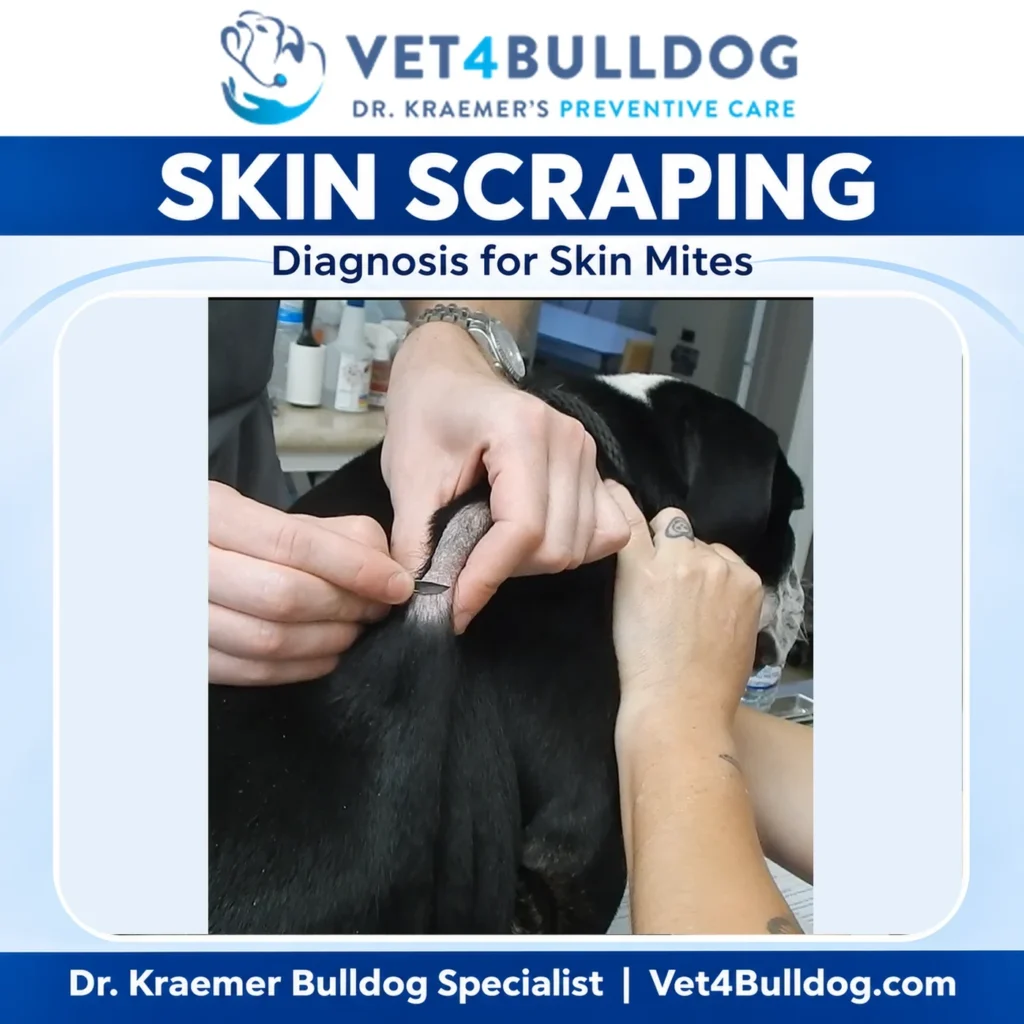
That third point deserves its own warning, because it is where this condition most often slips through.
WARNING: Unlike demodex, this mite loves to play hide and seek. Skin scrape testing often misses it, even after multiple tries. So not finding them does not rule them out as a possible cause.

From Dr. Kraemer’s exam room
A negative scrape is not a clearance
The sentence I hear most on this one is that the test came back negative, so it cannot be mange. I understand why that lands as reassurance but that can be ended as a costly false negative.
This mite hides. A scrape can come back clean two or three times over on a dog that has it. That is why I ask for scrapes in multiple locations, concentrating on the lesions and the hairless places, the ear tips and the elbows, rather than wherever is easiest to reach. And even then, a negative tells me less than owners expect, so I weigh the rest of the picture.
The question that changes my thinking fastest is who else in the house is itching. A dog, a cat and a child all scratching is not a coincidence. True sarcoptic mange is a different parasite from the demodex mite, and that one is contagious, which is another reason the scraping matters.
It is also worth knowing how the two mites differ on itch, because owners who have been through puppy demodex assume they know what mange feels like. While puppy juvenile demodex does not cause itching the way sarcoptic does, the generalized form can be itchy because of secondary bacterial infection. But neither of those forms is contagious.
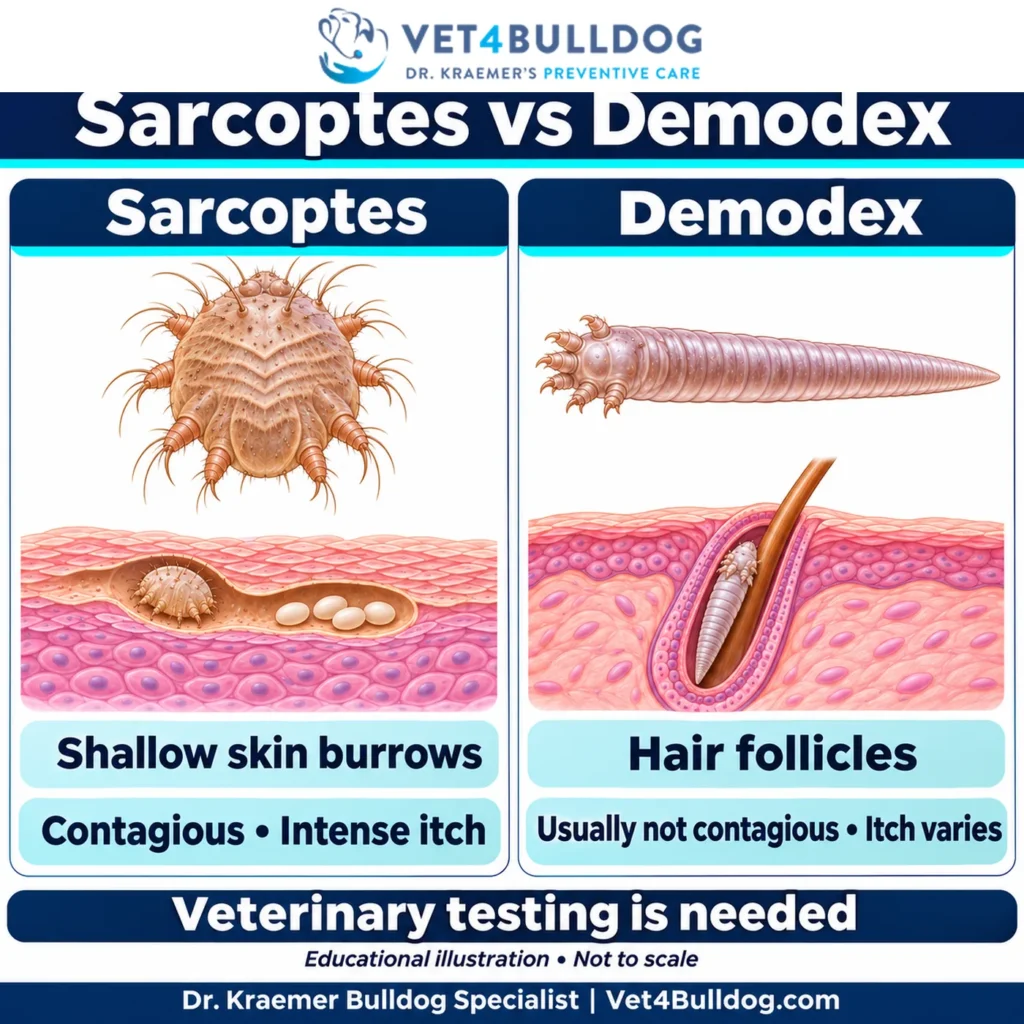
Sarcoptic Mange Versus Demodex Mite, Side by Side
| Demodex red mite | Sarcoptic mange mite | |
|---|---|---|
| How common in bulldogs | Common, and the breed often suffers from the rare generalized, more serious adult form | Uncommon |
| Contagious to your other pets | No | Yes |
| Contagious to people | No | Yes |
| Itch | The juvenile form does not itch. The generalized form can, because of secondary bacterial infection | Intensely itchy in its own right, and it does not answer to conventional itch medication |
| The skin scrape | A positive scrape is how it is confirmed | Often misses it, even after several tries, so a negative does not rule it out |
How Do People and Other Pets Get the Mite?
The mites are very contagious and they love warm areas such as bed sheets.
Fortunately, while they can stay on the skin for a long time, they do not do well off the skin in our home environment and will only survive for a few days in those conditions.
Should I Spray My House with Products That Kill the Mites?
Because of the mite’s poor survival off the skin, hours to a few days, it is not required.
I would recommend washing your bed sheets in hot water, along with the pet’s bedding, harness and collars. Vacuuming, especially the areas your pets use, is also a good idea.
Can Sarcoptic Mange Be Prevented?
The good news is that it is easily prevented by keeping all your pets on some of the most common and readily available flea preventives. Examples are Revolution, Sentinel, Trifexis, Simparica and others.
Most need to be prescribed by your veterinarian, and most achieve multiple preventive purposes at once, covering fleas, intestinal parasites and mange.
How to Treat Bulldog Sarcoptic Mites?
Flea Preventives: As mentioned, many of the commonly used flea preventives also prevent and kill the mites.
Ivermectin: I usually include ivermectin orally for the first three weeks, which is very effective, but you should talk to your veterinarian about it, and there are some breeds that ivermectin should not be used on.
Dipping: In the old days we used to offer dips such as LymDyp and Mitaban. I no longer recommend them. We have much better alternatives these days, there can be adverse effects, and that is before the labor and the time involved.
Antibiotics: at times, for secondary infections.
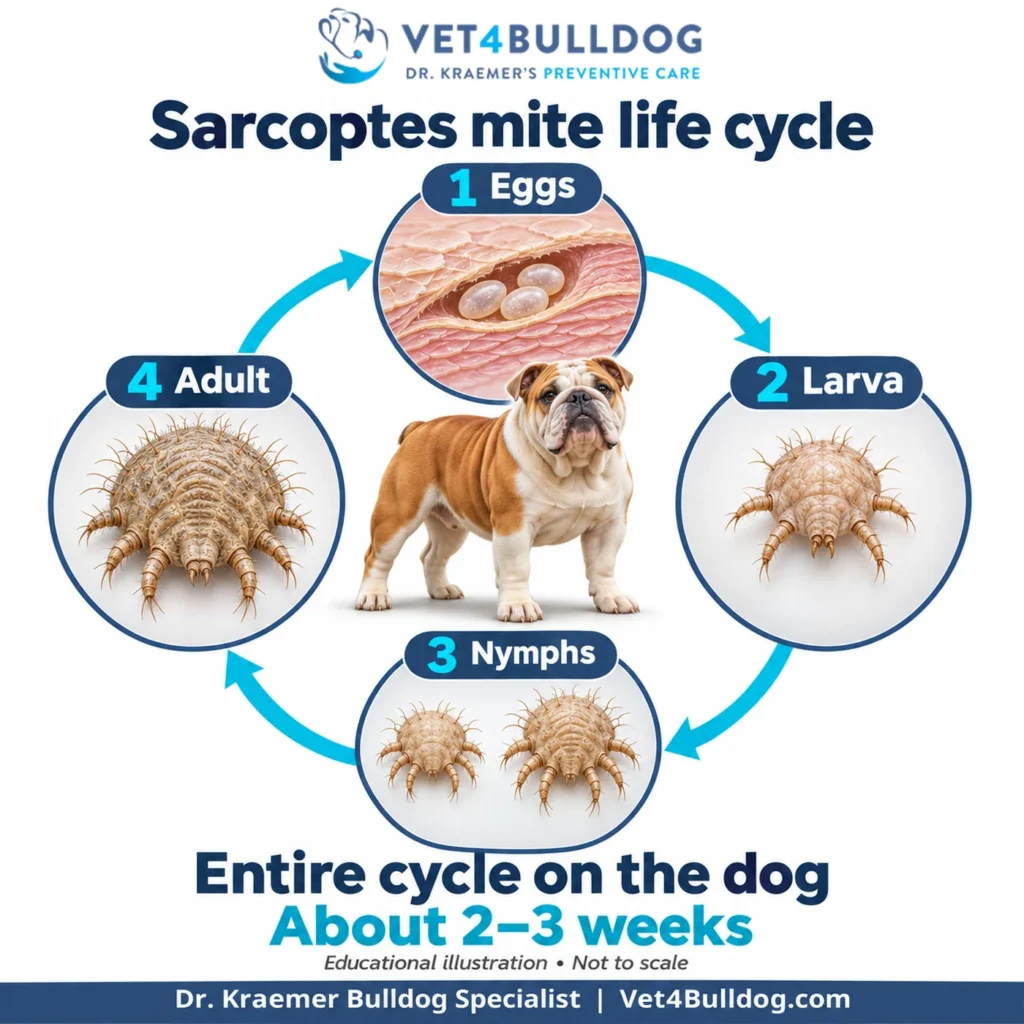
Treatment should be carried out for the entire life cycle of the mite. All animals in the household should be treated to reduce the possibility of re-infestation.
The mite life cycle is nearly a month long, so treatment should be at least that long.
Bully Topical Therapeutics
Bully topical therapeutics may be helpful for soothing, for the itching and for secondary infection used alongside what your veterinarian prescribes treatment.
You can use a combination of our products: the Bully ItchLess 2-in-1 Shampoo and Conditioner for bathing, and the Bully ItchLess No Rinse Gel between baths. The Bully ItchLess Essential-Care Bundle groups them if you would rather not assemble it yourself.
Bully Therapeutic Supplements
Bully therapeutic supplements may complement the treatment: Bulldog Immune Support Plus Chews, Bully Fish Oil EFA DS, and Bully Skin and Ears Allergy Chews.
Dr. Kraemer’s Sarcoptic Mange Rule of Thumb
Because the scrape test is so often inconclusive, I recommend adding a flea preventive that also eliminates sarcoptic mites to any itching case that is not resolving.
Look at it this way: even if the itching has nothing to do with mites, the preventive is inexpensive, and it will prevent and eliminate other common parasites like intestinal worms and fleas.
Anything Else To Do At Home To Prevent or Treat Those Mites?
We have already covered most of the after care, including washing the bed sheets, vacuuming, and avoiding contact with infected pets.
Remember the long life cycle, so do not stop mid treatment.
Complement with our line of topicals and supplements.
Most importantly for both prevention and treatment keep all your pets on a flea preventive that also covers mange, year round, for broad spectrum parasite control.
Can I catch it from my dog?
The scrape was negative, so it is not mange?
Is this the same as the mange my vet found when he was a puppy?
Do I need to treat my other pets?
Do I need to spray or fumigate the house?
He has stopped itching. Can we stop the treatment?
I want to be plain about this one, because the itch on this page is severe and that is exactly the situation where an owner can be sold the wrong thing. Clearing sarcoptic mites is a prescription matter. The modern parasite preventives and the oral medication work very well, the choice is your veterinarian’s, and nothing on our shelves replaces them.
Where our range has a place is alongside that treatment. The ItchLess topicals are complements to prescribed treatment, for the soothing, the itching and the secondary infection, with the treatment decision staying with your veterinarian. On the supplement side, immune support and fish oil may help the skin rebuild over a good few weeks.
And the preventive point is the one worth acting on whether or not your dog ever meets this mite: a flea preventive that also covers mange, on every pet, year round.
“Our vet scraped Daisy twice and found nothing, so we have been treating her for allergies for six weeks. She is no better, she is awake half the night scratching, and now my daughter has an itchy rash on her arms. The vet says the rash is probably unrelated. I am starting to wonder whether we are treating the wrong thing entirely.”
I would want that rash on your daughter’s arms looked at by your own doctor, and I would want it mentioned in the same breath as Daisy, because taken together those two facts are the most informative thing in your message.
Two negative scrapes do not clear this mite. It hides, and the scrape misses it even after several tries, so a negative result tells you far less than it sounds like it does. Add an intense itch that has not answered to six weeks of allergy treatment, and a person in the house who has started itching, and you have the picture that should put sarcoptic mange near the top of the list rather than off it.
What I would ask for is scrapes from multiple locations, concentrating on the ear margins and the elbows rather than wherever is easiest, and a conversation about whether a treatment trial is reasonable given how the case is behaving. Response to treatment counts alongside examination and testing as a way a diagnosis gets made, and on this condition it often is the way.
Whatever is decided, every animal in the house gets treated, not just Daisy, or you will be back in a month looking at what seems like a failure and is really a reinfection.
Important: This information is for general educational purposes only and is not a substitute for a veterinary examination, diagnosis, or treatment.
References
- Mange in Dogs and Cats, Merck Veterinary Manual
- Mite Infestation (Mange) in Dogs, Merck Veterinary Manual
- Diagnosis of Skin Diseases in Small Animals, Merck Veterinary Manual
Trusted by Vets ~ Recommended by Owners ~ Approved by Bulldogs
To be clear: supplements or topicals are not substitutes for prescribed treatment. If your dog is unwell, is being treated for a condition, or is already on medication, review any supplement or topical with your veterinarian so it fits the plan you are already following. This page is educational and is not a diagnosis or a treatment plan for your own dog.