


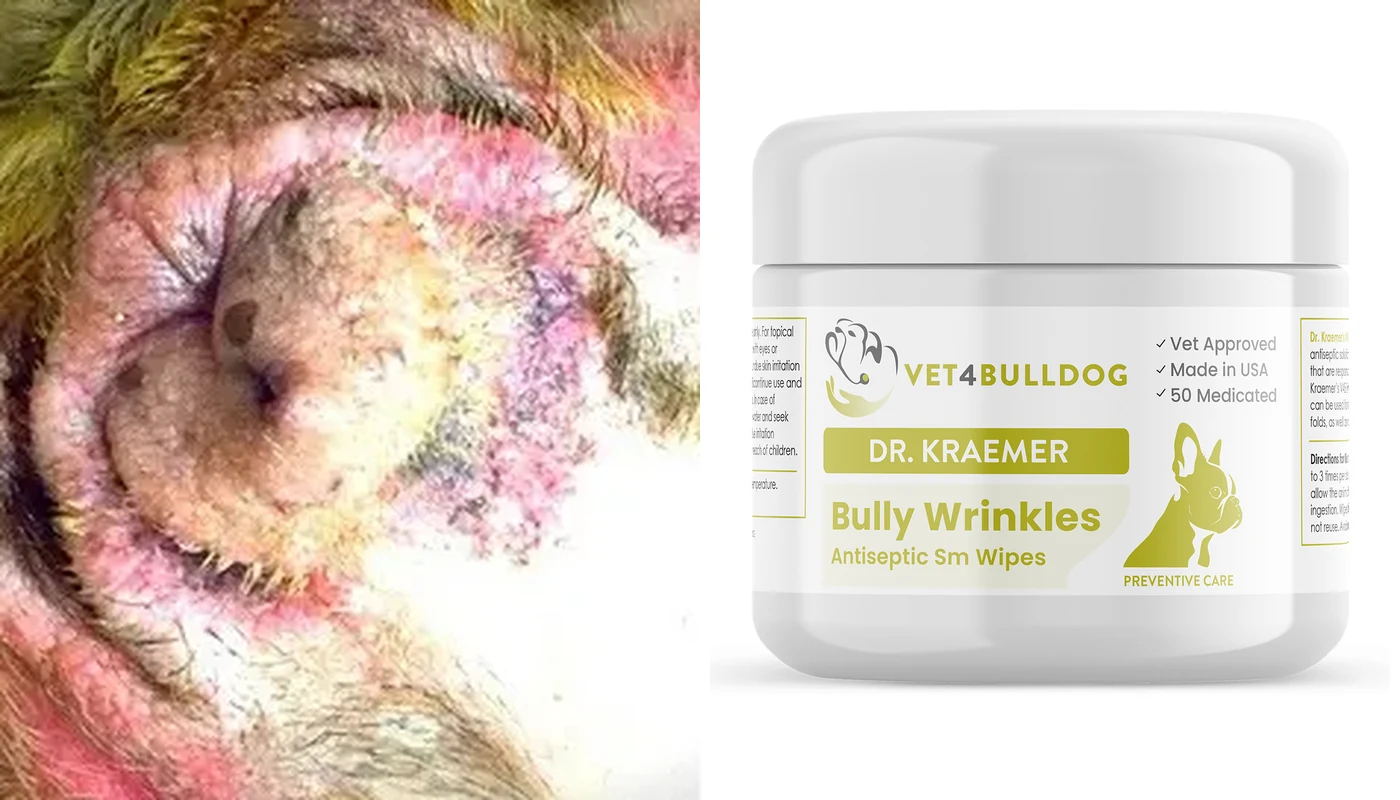
In a lot of Bulldog females the vulva sits recessed beneath a fold of skin. That fold holds warmth, moisture and a little urine after every trip outside, which is an excellent environment for bacteria and a poor one for skin. Dermatitis develops in the fold, the bacteria multiply there, and because the fold sits directly over the opening they have a very short journey into the urinary tract.
That is why these infections recur. Each course of antibiotics clears the bladder and leaves the source completely untouched, so the same bacteria make the same journey again. Owners end up on a loop of three, four, five courses, and the loop has a cost beyond the inconvenience: repeated courses are exactly how bacteria stop responding to the drugs that used to work.
The things that actually break the cycle are unglamorous. Keeping the fold clean and genuinely dry as a daily habit, and in the dogs where the fold is deep enough to defeat all of that, an operation that removes it.
Introduction To Bulldog and French Bulldog Vaginal Skin Infection
Vaginal Fold Moist Dermatitis (VFMD) is a prevalent concern among female bulldogs, stemming from their distinct anatomy.
This condition can be notably uncomfortable for them, underscoring the importance of addressing and managing it effectively.
How UTI Is Caused By Vaginal Fold Dermatitis in Bulldogs
- Moisture & Heat serve as common culprits for Vaginal Fold Moist Dermatitis (VFMD) in female bulldogs. The deep skin folds in the genital area create an environment conducive to bacterial and yeast growth, fostering infections and inflammation.
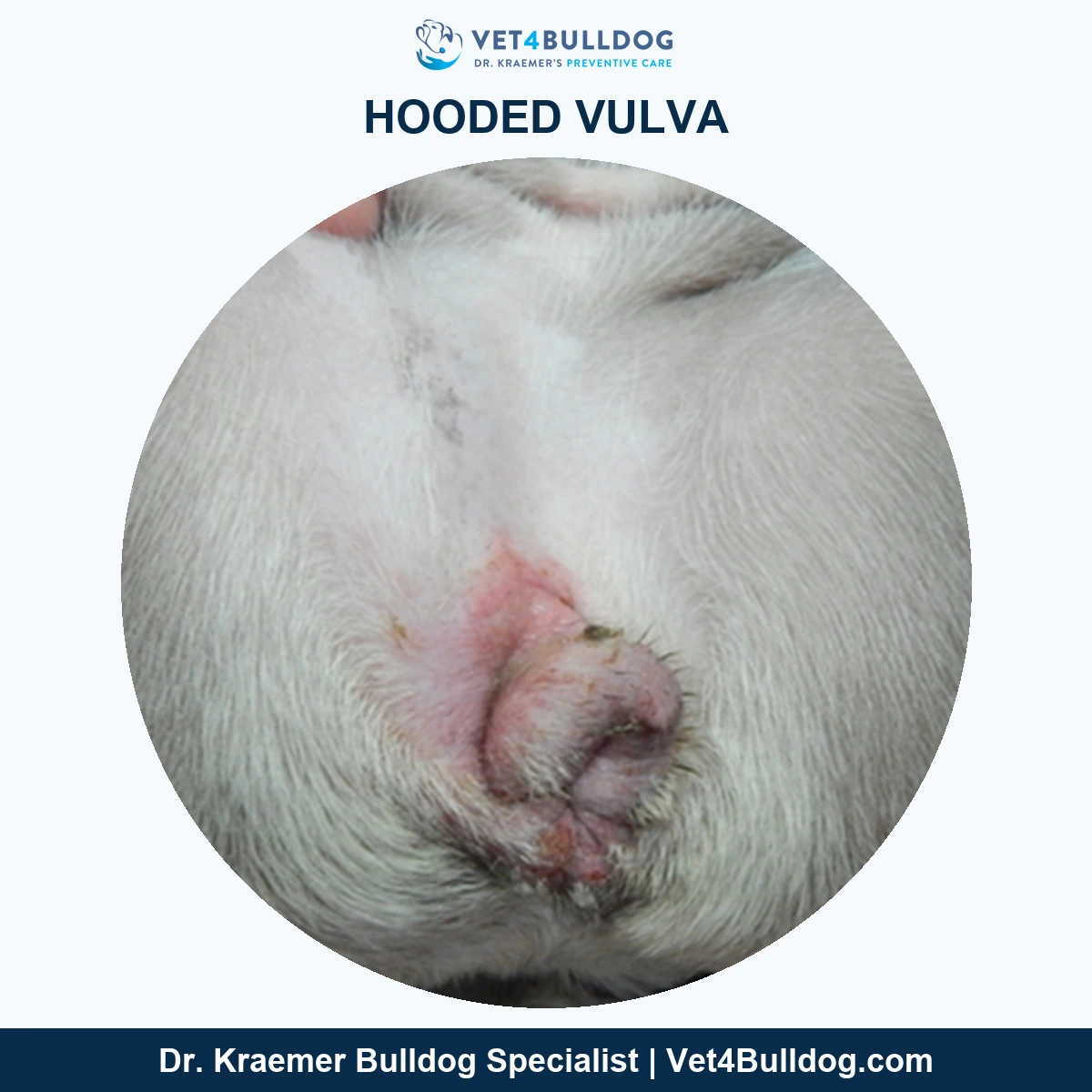
- Hooded Vulva: The presence of a hooded vulva restricts airflow, exacerbating the issue by compounding the trapped moisture problem.
- Obesity: obesity can intensify VFMD as excess weight increases the depth of skin folds.
- Diet: certain dietary factors may also play a role, influencing yeast overgrowth and contributing to the development of this uncomfortable condition in female bulldogs.
- Stress: The impact of stress lies in its ability to suppress the immune system, weakening the body’s defenses against pathogenic organisms
What Are The Symptoms of UTI Due to Vaginal Fold Dermatitis in Bulldogs?
- REDNESS: around the vulva, but mostly inside the folds
- INFLAMMATION & INFECTION: bacterial and yeast organisms
- ITCH & PAIN: rubbing, scooting, biting of the back end
- BAD SMELL: A strong, unpleasant odor of the infected folds and urine
- MOIST & DAMP
- FREQUENT URINATION: caused by the urinary tract infection, pain, discomfort and irritation
- CLOUDY DISCOLORED URINE: urine might be bloody, cloudy, or dark yellow
- VAGINAL DISCHARGE: mucus or pus
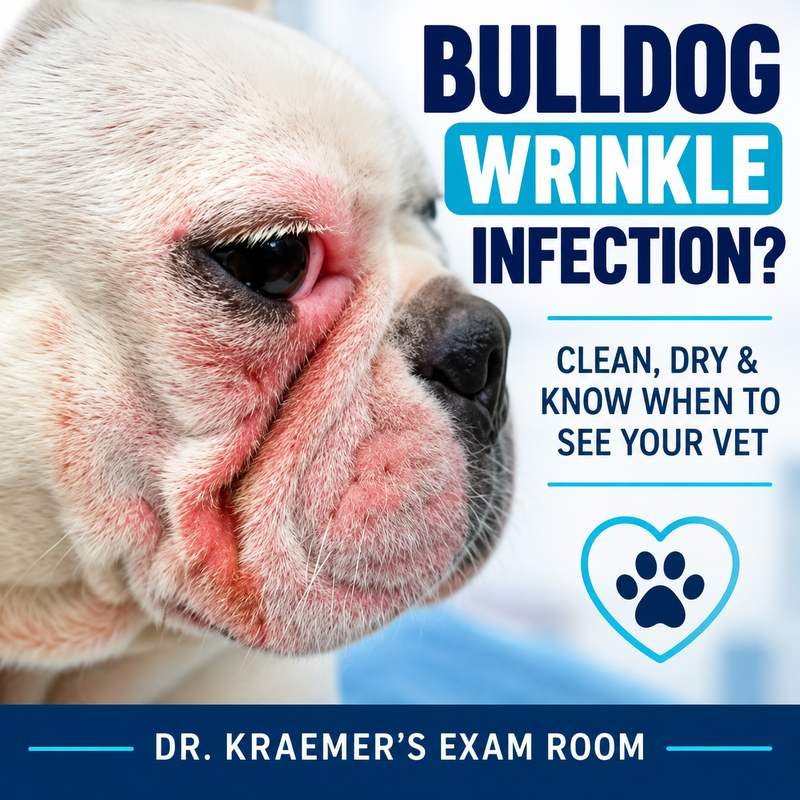
Bulldogs and Frenchie’s are famous for their adorable wrinkles, but those cute skin folds can quickly turn into bacteria and yeast hotspots if not cared for properly.
The deep, warm, and often damp environment inside those folds creates the perfect place for germs to grow, leading to irritation, infection, and a not-so-sweet smell.
Routine wrinkle cleaning is an essential part of your bulldog’s healthcare
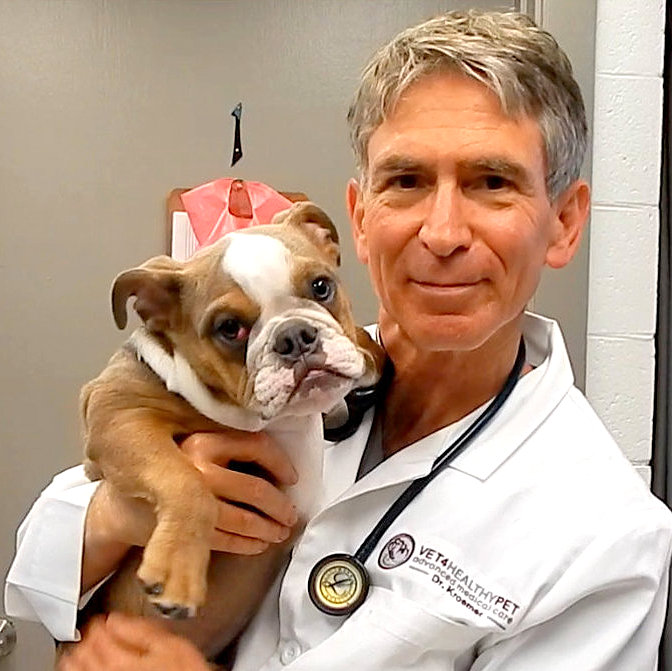
From Dr. Kraemer’s exam room
Antibiotics do not dry a fold
This is one of the most satisfying problems in Bulldog practice to get right, and one of the most frustrating to watch handled badly, because the loop it creates is entirely avoidable. A female comes in with a urinary infection, she is treated, she improves, everyone is pleased. A couple of months later she is back. Treated again, improves again, back again. By the third or fourth round somebody starts wondering whether there is something wrong with her bladder, and there usually is not. The bacteria are being resupplied from a fold. Picture the anatomy for a moment, because once you see it the whole thing becomes obvious.
A recessed vulva sits under a hood of skin, and in bulldogs you often also have deep folds on the sides, both traps warmth, moisture and a little urine after every trip outside. Skin in that state breaks down, bacteria flourish in it, and the distance from that fold into the urinary tract is almost nothing. So the infection is not really a urinary event at all. It is a skin problem with a urinary consequence, and treating only the consequence is why it keeps returning. Every course of antibiotics kills the susceptible bacteria and leaves the survivors to repopulate. Four or five courses in a year is a very effective way of selecting for bacteria that no longer respond to the usual drugs, and I have seen exactly that happen in dogs whose actual problem was a fold nobody looked at.
On top you now have the essential gut microflora (microbiome) altered by the frequent antibiotic prescription which leads to dysbiosis, leaky bowl that may cause additional systemic problems. If you want to understand why I am so insistent about this, the page on resistant infections explains where that road ends. The hood and folds needs daily attention in exactly the way the face wrinkles do. This is ordinary owner maintenance, it is not a veterinary procedure, and it is the sort of routine care this whole site exists to teach. One technical point worth insisting on. When an infection keeps coming back, a urine culture is worth far more than a dipstick.
A dipstick tells you there is an infection, a culture tells you which organism and which drug will work on it, which matters a great deal more by the third episode than by the first. If your veterinarian has not cultured a recurring case, it is a fair thing to ask for by name. And when all of that has been done properly and she is still recurring, surgery might be the solution. The operation removes the fold of skin over the vulva, together with a fold “face lift” once the fold is gone the trap is gone with it. In the right dog it is close to curative and it ends years of repeat prescriptions.
How To Prevent Cystitis Associated With Vaginal Fold Dermatitis in Bulldogs?
Dry: To prevent Vaginal Fold Moist Dermatitis (VFMD) or manage mild cases, it’s crucial to keep the folds dry.
Topical bully antiseptic therapy could be employed and complemented with therapeutic supplements to effectively address the condition and promote healing in the affected areas.
#1 Bulldog therapeutic antiseptic topicals
For more severe cases, the recommendation is to use topical therapeutics daily
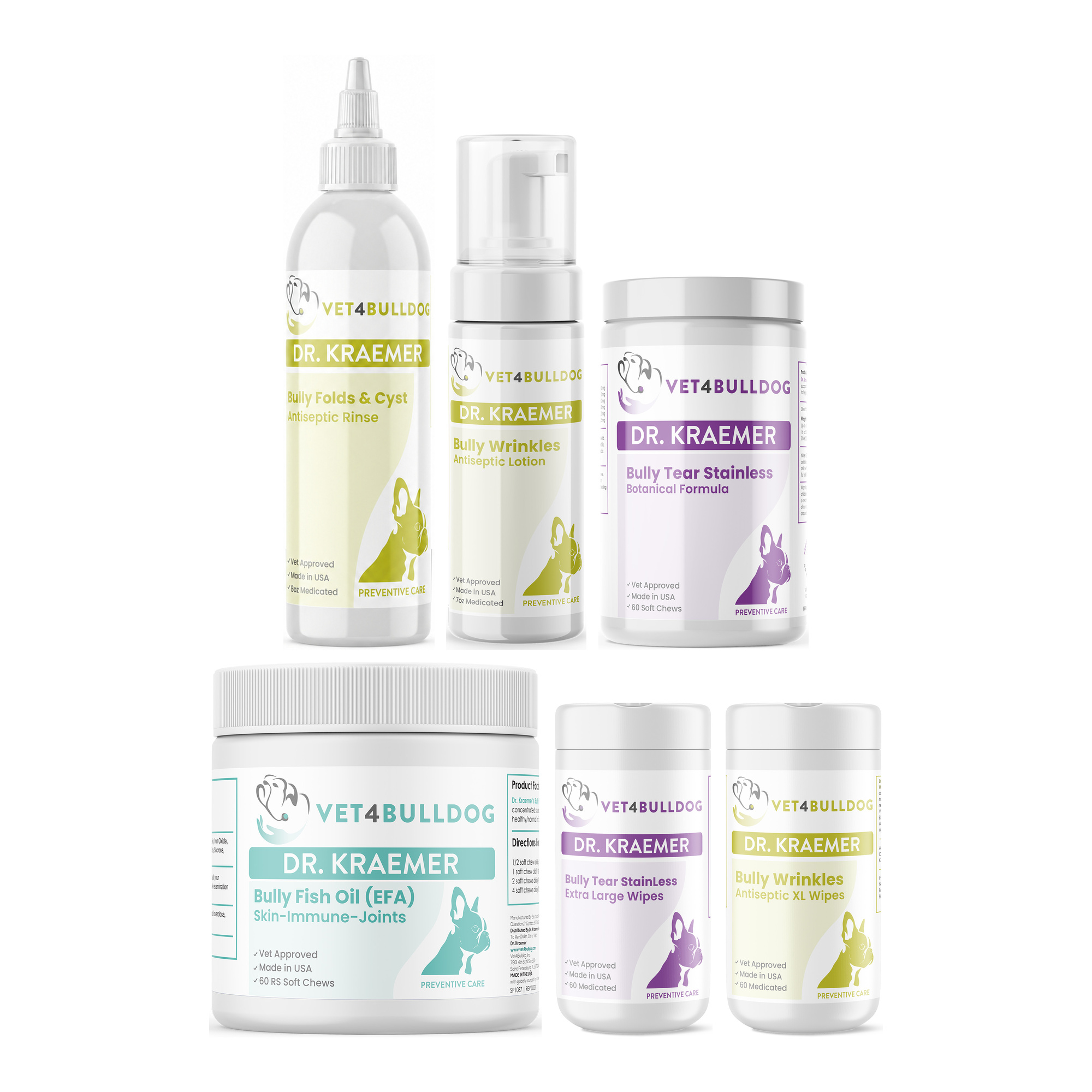
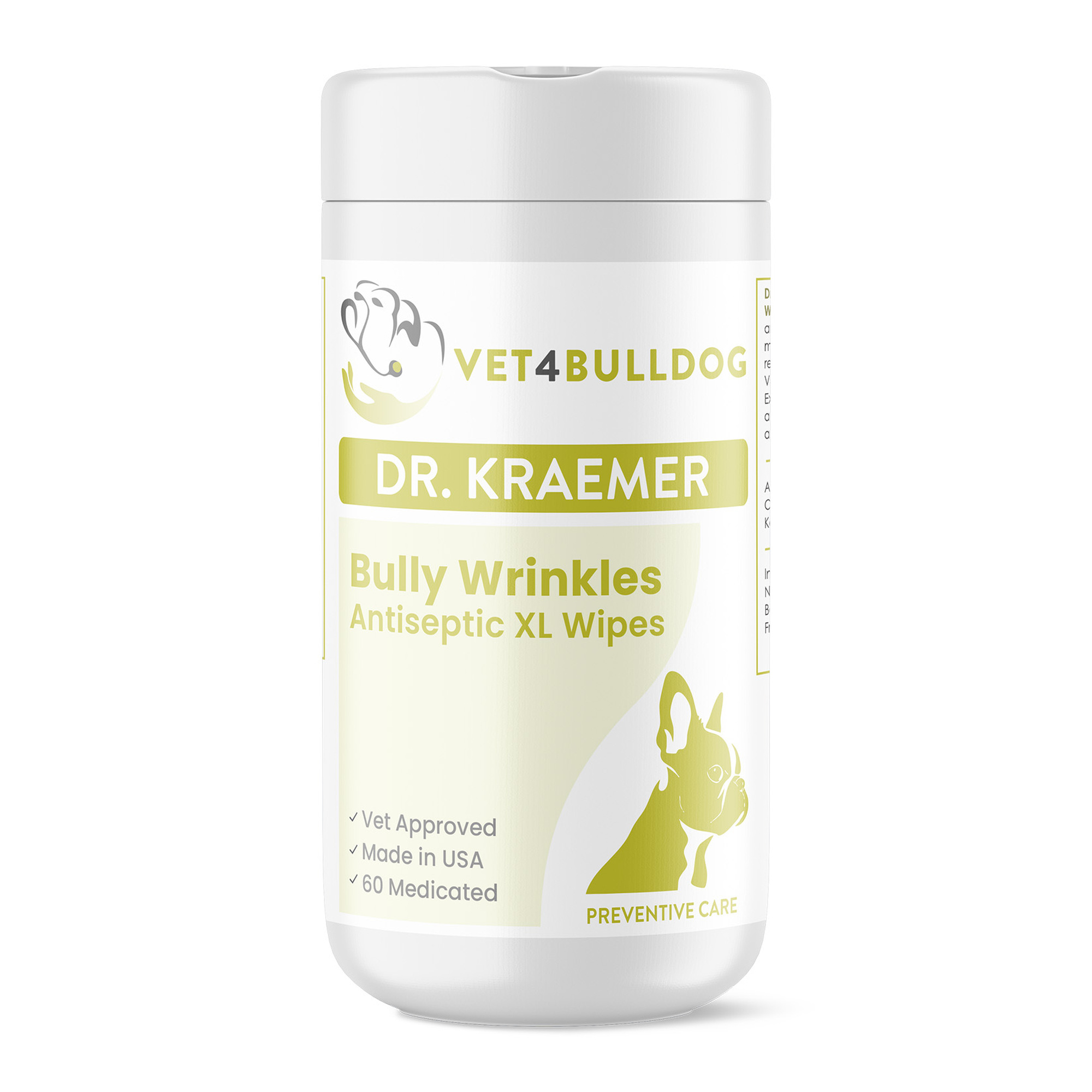
- BULLY ANTISEPTIC SKIN FOLD WIPE
- BULLY ANTISEPTIC SKIN FOLD LOTION
- BULLY ANTISEPTIC SKIN FOLD SPRAY
#2 Bulldog therapeutic supplements
- V4B BULLY FISH OIL EFA
- V4B BULLY COMFORT & ACHE-LESS
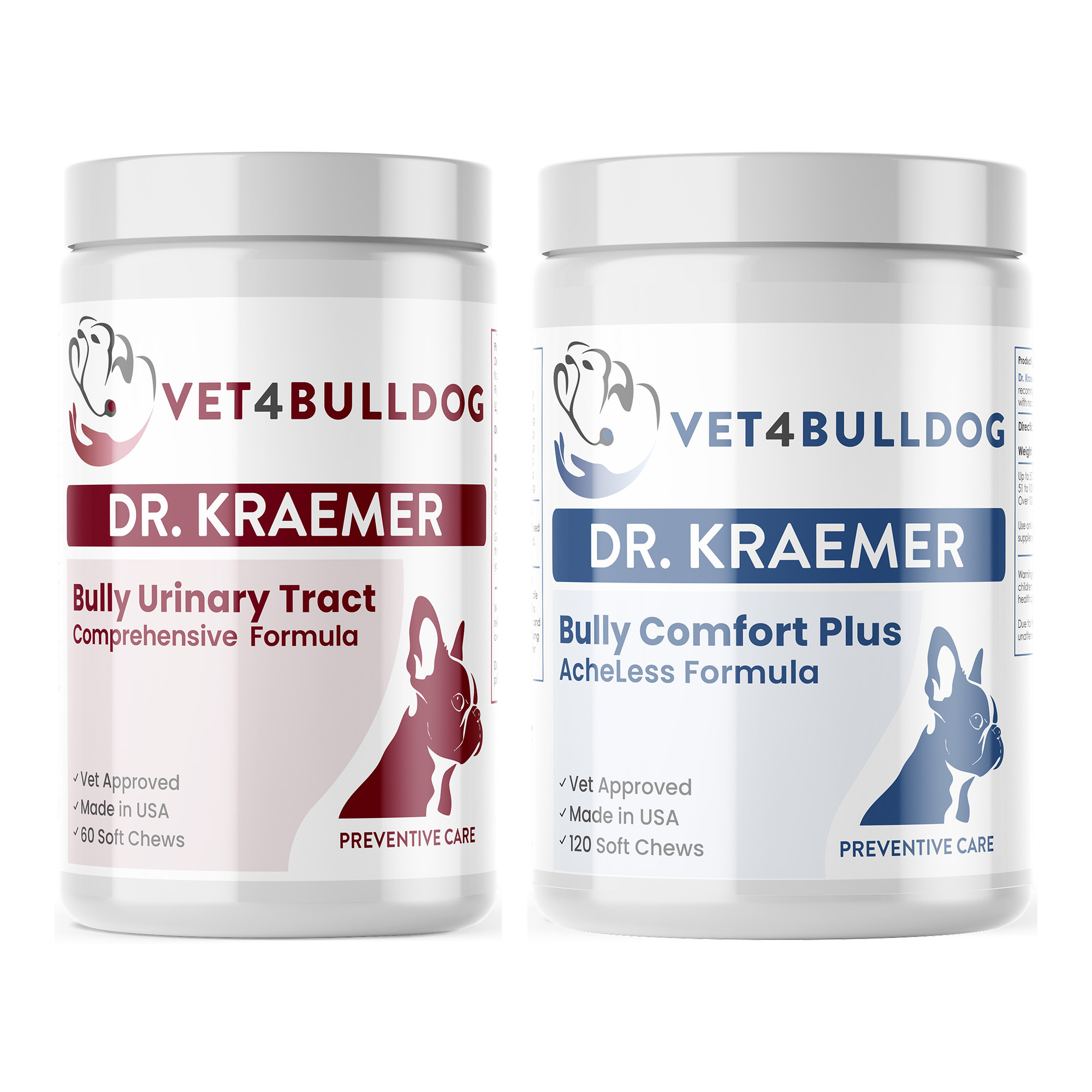
- V4B BULLY URINARY SUPPORT
- V4BBULLY IMMUNE SUPPORT
#3 Vaginal Fold Dermatitis in Bulldogs Surgical Treatment
The primary objective of this procedure is to eliminate excess skin folds around the vulva, restore a more anatomically normal position, and enhance airflow.
By doing so, it promotes the
- Drying of the area
- Minimizes moisture trapping
- Minimizes bacterial growth
Ultimately, preventing frequent urinary tract infections (UTIs).
Bulldog Hood and Vaginal Fold Surgical Correction Safety
- Anesthesia: Performed under general anesthesia to ensure the comfort and safety of your bulldog
- Resection of Excess Skin:
- Excess skin surrounding the vulva is meticulously removed in a crescent or horseshoe shape, eliminating the “hooded” appearance.
- Removal of underlying fatty tissue may also be undertaken.
- Suturing: The remaining skin edges are skillfully sutured together, creating a tighter and more open vulvar area.
Benefits of Bulldog vaginal skin folds surgery
- Reduced Risk of UTIs: Significantly diminishes the likelihood of recurrent urinary tract infections.
- Enhanced Hygiene and Comfort: Improves overall hygiene and comfort for the dog.
- Minimized Inflammation and Irritation: Aids in reducing inflammation and irritation in the vulvar area.
- Facilitates cleaning and maintenance: It enables easier cleaning and maintenance of the folds, contributing to the ongoing well-being of the dog.
Bulldog UTI due to Vaginal Fold Dermatitis: Tips & Warnings
Here are recommendations and cautions curated by Dr. Kraemer regarding this medical condition.
#1 Bulldog Vaginal Folds Anatomy TIP:
Get to know the curvature and depth of the folds by gently exploring them with the antiseptic bully wipe. Rolling your bulldog onto her back or side can make the folds more accessible and easier to clean. Utilize Dr. Kraemer’s medicated antiseptic products, do so daily, and ensure thorough coverage of the hood and folds.
- V4BBully Skin Fold Wipe
- V4B Bully Skin Fold Lotion
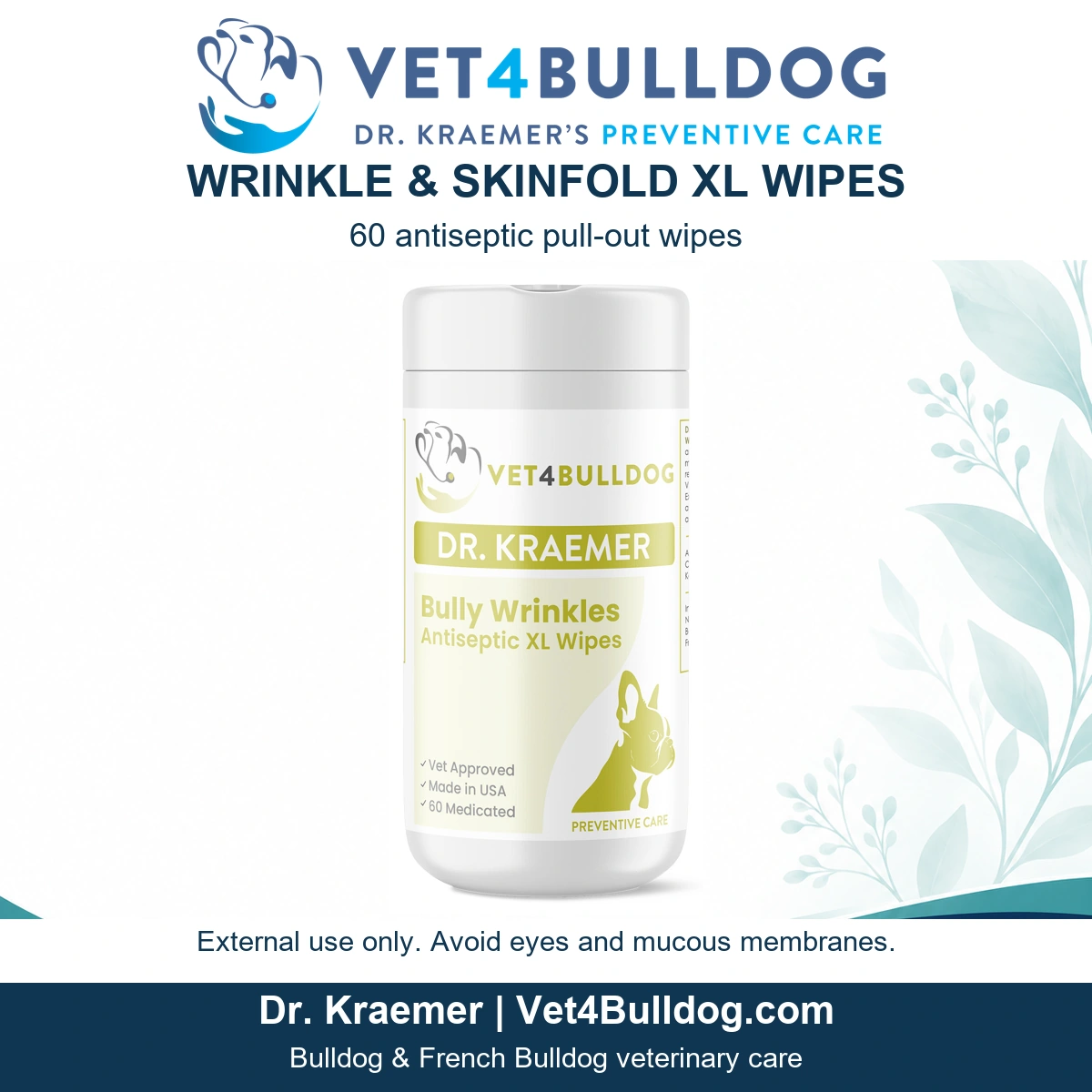
#2 Bulldog Vaginal folds Dermatitis Surgery Warning:
In cases where vaginal fold dermatitis progresses to chronic and persistent urinary tract infections (UTIs) or severe and persistent moist dermatitis, my typical recommendation is surgical intervention.
#3 Bulldog Anal Gland Impaction Warning:
There is a common misconception among some pet owners and pet care professionals, who may incorrectly attribute a pet’s sensitivity and rear-end itching to issues such as
anal gland impaction or intestinal parasites.
The anatomical location of the vagina, situated low and under the rear end, can lead to the oversight of the actual problem, making it easy to misinterpret the root cause of the symptoms.
Why does her urinary infection keep coming back?
She is on antibiotics again. Is that a problem in itself?
Does her weight really make a difference to this?
How do I clean the fold properly?
Why does my vet want a urine culture instead of just a dipstick?
Is surgery really necessary?
Does spaying have anything to do with it?
More Help from Dr. Kraemer
The fold, the bladder and the skin all sit on the same problem. These pages go deeper:
- Urinary tract infection in Bulldogs
- Cystitis and bladder inflammation
- Skin fold dermatitis
- Urinary incontinence, when the leaking comes first
- Weight and exercise in Bulldogs
- Are vets overprescribing antibiotics?
The honest framing first. If your dog has an active urinary infection right now, that is a prescription and your veterinarian’s decision, and nothing here replaces it. These are topicals, so they belong alongside what has been prescribed rather than instead of it.
But this is one of the pages where the routine care genuinely is the treatment plan rather than an accessory to it, because the fold is the source. Keeping it clean and properly dry every day is what stops the resupply, and that is ordinary owner maintenance of exactly the kind this site exists to teach. The wipes are the practical daily option. Dry the fold afterward rather than leaving it damp, which is the step most often missed and the one that decides whether any of it works.
Two things to be clear about. This does not reduce her weight, which on this particular problem is the biggest lever you have. And it does not remove a fold that is simply too deep, which is a surgical question. If she is still recurring after a genuine run at the daily care, that is a conversation to have rather than more wipes. The urinary tract infection page covers the infection side.
To be clear: supplements or topicals are not substitutes for prescribed treatment. If your dog is unwell, is being treated for a condition, or is already on medication, review any supplement or topical with your veterinarian so it fits the plan you are already following. This page is educational and is not a diagnosis or a treatment plan for your own dog.
Culture it before the fourth course
A dog with one urinary infection gets treated. A dog with four gets treated four times, and somewhere around the third one a question should have been asked that usually is not. The question is whether this is the same infection returning because it was never fully cleared, or a new infection each time because something keeps re-seeding it.
Those are different problems with different answers, and the test that separates them is a urine culture. I understand why it often does not happen. The owner wants the dog comfortable today, a culture takes a few days, and a broad spectrum antibiotic usually works.
The trouble is that each empty course nudges the bacteria along, and the dogs who end up with a genuinely resistant infection are very often the ones who had four or five quick courses first. By then the easy drugs are gone and we are choosing from a shorter list. It is the difference between mopping the floor and looking for the leak.
Mopping is faster every single time, right up until the ceiling comes down. So if your girl is on her third or fourth round, ask for a culture, and ask what is being done about the fold. Neither request is unreasonable and both are cheaper than the alternative.
“Lola is a three year old English Bulldog who has now had four urinary infections in eighteen months. Every time she gets an antibiotic, she improves within days, and a couple of months later we are back.
Two different vets have treated her and both said urinary tract infection. She is a little overweight and she does have a deep fold under her tail.
Is there something wrong with her bladder?”
Four in eighteen months is not bad luck and it is usually not a bladder problem either. When the infection keeps returning in the same dog, the question stops being which antibiotic and becomes where the bacteria keep coming from.
In a Bulldog girl the answer is often sitting right there in your description. A deep fold over the vulva stays warm and damp, it collects what it collects, and it sits a very short distance from the opening to the urinary tract.
Clear the bladder with an antibiotic and you have treated the destination while leaving the departure lounge exactly as it was. A fold does not dry out because a dog swallowed a tablet.
The weight matters too, and I say that without any judgment. Extra body condition deepens the fold and makes it harder for air to reach the skin, so the two problems feed each other.
What I would ask for at the next appointment is a urine culture rather than another empty course, so you know what you are treating and whether it is the same organism returning. Then I would treat the fold as the actual patient.
Clean and, more importantly, dry that area daily. An antiseptic wipe made for the job belongs alongside whatever your veterinarian prescribes rather than in place of it, and the drying is the part people skip.
Keep her coat and bedding dry. Supplements that support urinary health may help as part of the longer picture, and your veterinarian is the right person to say whether they fit her plan.
If the fold is deep enough that daily care cannot keep ahead of it, there is a surgical correction that removes the fold, and for the right dog it ends the cycle rather than managing it. That is a conversation to have with your veterinarian once the infection itself is settled.
References
- Merck Veterinary Manual. Infectious Diseases of the Urinary System in Small Animals
- Merck Veterinary Manual. Pyoderma in Dogs and Cats
- Merck Veterinary Manual. Antibacterials for Integumentary Disease in Animals
- Merck Veterinary Manual. Principles of Topical Treatment in Animals
To be clear: supplements or topicals are not substitutes for prescribed treatment. If your dog is unwell, is being treated for a condition, or is already on medication, review any supplement or topical with your veterinarian so it fits the plan you are already following. This page is educational and is not a diagnosis or a treatment plan for your own dog.
Trusted by Vets ~ Recommended by Owners ~ Approved by Bulldogs