


Introduction to Anal Gland Disease in Bulldogs
Let’s be real, anal gland issues aren’t exactly a glamorous topic, but they’re super common in bulldogs and Frenchie’s and can cause major discomfort.
When those little glands get blocked, your pup can feel itchy, sore, and downright miserable.
Left unchecked things can gets much worse, the glands can become inflamed, infected, abscessed and then burst open (yes, it is as bad as it sounds, and it smells worse). The good news? You may help prevent all that drama with a few simple steps:
- Weight: Keep your bully at a healthy weight
- Fiber: Add high-quality fiber supplements made just for bulldogs
- Diet: Feed a balanced, allergy-friendly diet
- Prevention: Stay on top of tail pocket care (hello, no more hidden irritation!)
- Allergies: Manage allergies and skin itch
- Exercised: Go on daily walks and keep the body moving
A little booty care goes a long way, and your bulldog will thank you with fewer scoots and more snuggle’s! 4 Types of Anal Gland Disease:
- Impacted glands
- Inflamed glands
- Infected gland that can also abscess, and leak
- Anal gland Tumor
What Causes Anal Gland Impaction?
Anal gland problems start when normal natural drainage is blocked. When that happens, the glands become:
- swollen
- impacted
- infected
- abscessed
- diseased
Bulldog Anal Gland 5 MUST KNOW!
- The glands are embedded on the two sides of the rectum (anus).
- Obstructed anal ducts lead to infected abscesses that can rupture.
- Anal gland disease often presents as bloody, smelly, purulent, secretions, and butt scooting.
- Treatment includes expressing (emptying) the glands, medication, bully therapeutics, and surgery.
- Prevention includes Dr. Kraemer’s Anal Gland V4B therapeutics.
The owners of this bulldog community prefer prevention over RX.
Insider tip
What Is the Anal Gland Anatomy?
Your bulldog’s anal glands are embedded in the muscles of the anus, making them not readily visible. Each of the paired glands has its glandular sac and attached ducts that normally empty into the rectum during defecation.
What Do the Anal Glands Do?
The current medical purpose of these glands is not clear. Back in their wild, pre-domesticated days, dogs used them to mark territory and identify each other by scent (yep, that’s likely why dogs are so into butt sniffing). While they’re not super useful anymore, these little scent sacs can still cause big issues, so they’re definitely worth understanding and managing. Anal glands are notorious for their oily, pasty, gray-colored residue that permeates with a pungent, unpleasant odor. 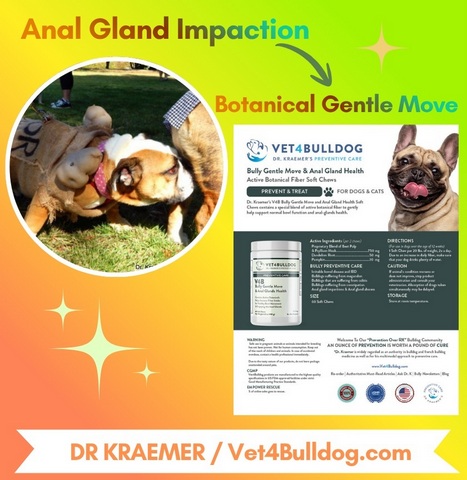
Why Do Anal Glands Have Such a Funky Smell?
Think of anal glands like a bully business card. The unique scent acts as a calling card, marking territory and announcing a dog’s presence to passing dogs. This way, they could
- Territory: claim their turf
- Status: navigate their social hierarchy
- Romance: even find potential mates
BULLDOG ANAL GLAND ID CARD
Beyond territory, the distinct scent offered another benefit: a doggy ID tag.
By sniffing each other’s rear ends, dogs could gather valuable information about one another, like:
- age
- sex
- and even health status.
The anal glands likely played a vital role in canine social interaction. Domestication moved on and most of those functions are gone, but the glands are still there, and at times they still cause problems. 
What Are the Symptoms of Anal Gland Disease in Bulldogs?
Anal gland disease shows up in several ways, some mild and some dramatic. It can affect both glands or just one.
The most common signs of impaction and disease are:
- SCOOTING: Dragging the back end on the floor
- BITING & ITCHING: trying to bite the back end
- FUNKY SMELL: Some owners describe it as “yeasty” or “fishy.”
- REDNESS: Redness of the perianal area due to self-trauma and inflammation
- PAIN: Crying in pain, biting their hind end
- DEPRESSION: Stop eating; act irritable
- DRAINAGE: usually bloody, pasty discharge

Bulldog and French Bulldog Anal Gland Disease Types
The most common types are:
1. ANAL GLAND IMPACTION
Impaction is the most common bulldog anal gland problem.
It usually presents as
- red bump
- itchy butt
- scooting
2. ANAL GLAND SACCULITIS
Sacculitis (inflamed sac) is a complicated form of anal gland impaction.
It usually presents as:
- redness
- swelling
- pain
3. BULLDOG ANAL GLAND ABSCESS
An abscess is an infected anal gland.
It usually presents as:
- major swelling
- very painful
- bright red to raw
- often ruptures into an open wound
- bloody discharge
4. ANAL GLAND TUMOR
On rare occasions, the sac can become cancerous. The most common anal gland tumor is adenocarcinoma.
It is more common in aging dogs and may present as:
- If sizeable, it could impede defecation
- Bleeds
- Abscess
- Painful
Is Anal Gland Impaction Painful?
Yes, anal gland impaction, disease, and abscess can be itchy and painful. During the acute phase, pain medication might be required. ➡️ Dr. Kraemer’s Bully Comfort & AcheLess
supplements to help relieve discomfort.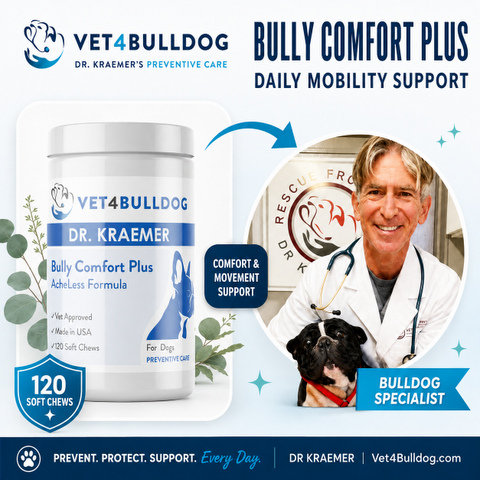
How to Prevent Bulldog Anal Gland Impaction
Prevention beats treatment: it is less painful, safer, and cheaper.
1. ANAL GLAND WEIGHT LOSS
Obesity is linked to chronic anal gland problems, so keeping your bully lean often prevents them. 
2. BEST FOOD FOR ANAL GLAND HEALTH
A diet built around high-fiber ingredients supports firmer, more frequent, and more complete bowel movements. That is the most “natural” way to express the anal glands.
3. ANAL GLAND THERAPEUTIC SUPPLEMENTS
Botanical fiber is an excellent anal gland therapeutic, and it works hand in hand with bulldog gut health and probiotics. Natural botanical fibers help the glands empty and can prevent:
- Anal gland impaction
- Anal gland abscess
- Lower-bowel diseases that are responsive to fiber
- Bulldog colitis
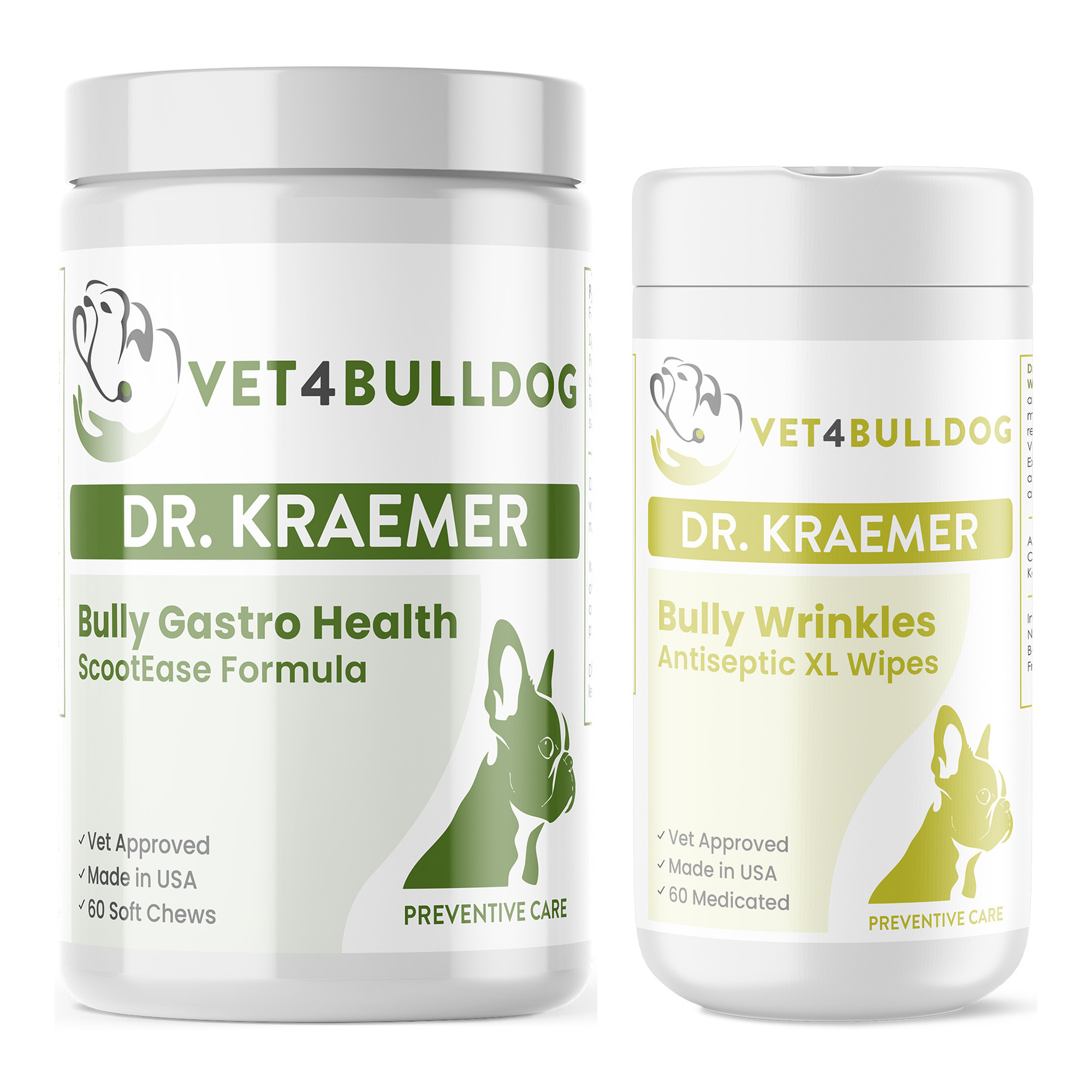
🌿Dr. Kraemer’s V4B Bully Gentle Move & Anal Gland Care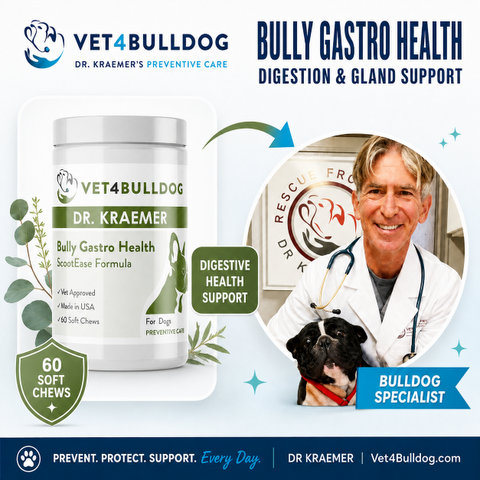
4. BULLDOG ANAL GLAND HYGIENE
Keeping the perineal area clean prevents the irritation, itching, and rubbing that traumatize the anal gland and sac. Wiping with therapeutic bully antiseptic XL wipes helps maintain an itch-free, healthy perianal “butt area.”
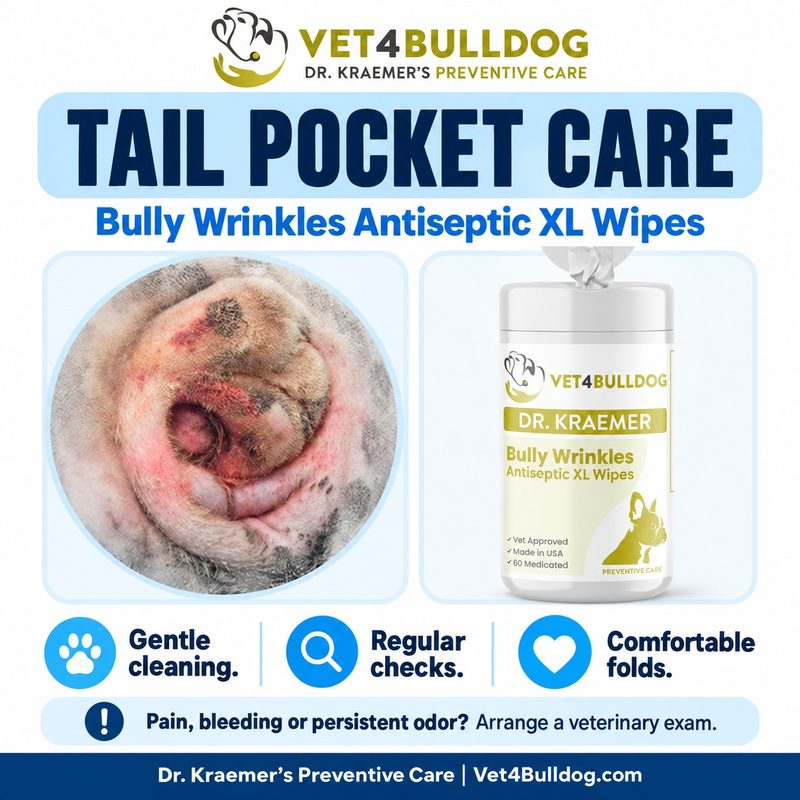
5. PREVENTING BULLDOG TAIL POCKET DISEASE
An infected tail pocket triggers the same itching, scooting, and rubbing as perineal dermatitis. Prevent it, and treat it daily, with Dr. Kraemer’s Bully Antiseptic Skin Folds XL Wipes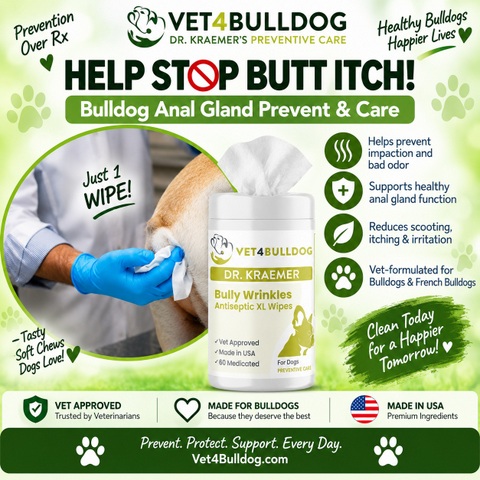 to help avoid trauma and injury to the nearby anal glands and sac.
6. BULLDOG ALLERGY PREVENTION
Allergies of all kinds, especially around the butt, tail, back, and hind legs, cause acute and chronic itching. That itching drives secondary infection and the self-trauma that damages the anal gland and sac.
How to Treat Anal Gland Disease
Treatment depends on the underlying disease, its severity, the degree of pain, and how long it has been going on.
1. ANAL GLAND IMPACTION SELF-CARE
Most Bulldog and French Bulldog owners have the glands expressed by an experienced veterinary team member. For the adventurous owner seeking “fame & glory,” doing it at home is an option.
- GLOVE: Place a disposable glove on your hand; anal gland residue is not pleasant.
- KY JELLY: Place a lubricant on the fingers if attempting to express rectally.
- TEAMWORK: Most times, you will need someone to hold your dog and keep her or him upright.
- DIGIT:
- Insert one-third of your thumb (for the right gland) or index finger (for the left gland) into your dog’s rectum, about fingernail deep.
- Press the outer wall with that same thumb or finger.
- Move the finger up and down between 4 and 5 o’clock (right) or 7 and 8 o’clock (left) and locate a pea- to grape-sized bump.
- SQUEEZE: Squeeze gently; you should feel the gland contents release.
- INSPECT: Check the residue on your finger for abnormalities and blood.
- WIPE: Wipe the area with a
- FREQUENCY: Every bulldog is different. Check every two weeks; once the gland is consistently empty, stretch it to every four weeks.
2. ANAL GLAND IMPACTION MEDICAL CARE
Impaction is the most common anal gland problem the veterinary team sees. An experienced team member can manually express the impacted glands and relieve it.
➡️Expressing anal glands should be done rectally.
3. ANAL GLAND TREATMENT UNDER ANESTHESIA
In some cases sedation is required:
- ABSCESS: Repair ruptured anal gland abscess
- PAIN: too painful to be expressed awake
- MEDICATE: Flush and medically pack the duct and gland
- FNA: Fine-needle aspirate for cytology when a tumor is suspected.

4. ANAL GLAND PRESCRIPTION RX
More advanced disease, such as an abscess, may require prescription medication:
- Antibiotics: for abscesses or infected glands
- Pain Relief: such as NSAIDs and other prescription analgesics
- Anti-Inflammatory medications such as cortisone and NSAIDs
5. ANAL GLAND BULLY THERAPEUTICS
Therapeutic supplements help treat anal gland disease:
- Natural anti-inflammatories Bully Fish Oil Immune-Joint-Skin Chews
- Anal gland emptying: Natural botanical fibers Bully Gentle Move & Anal Gland Health Chews
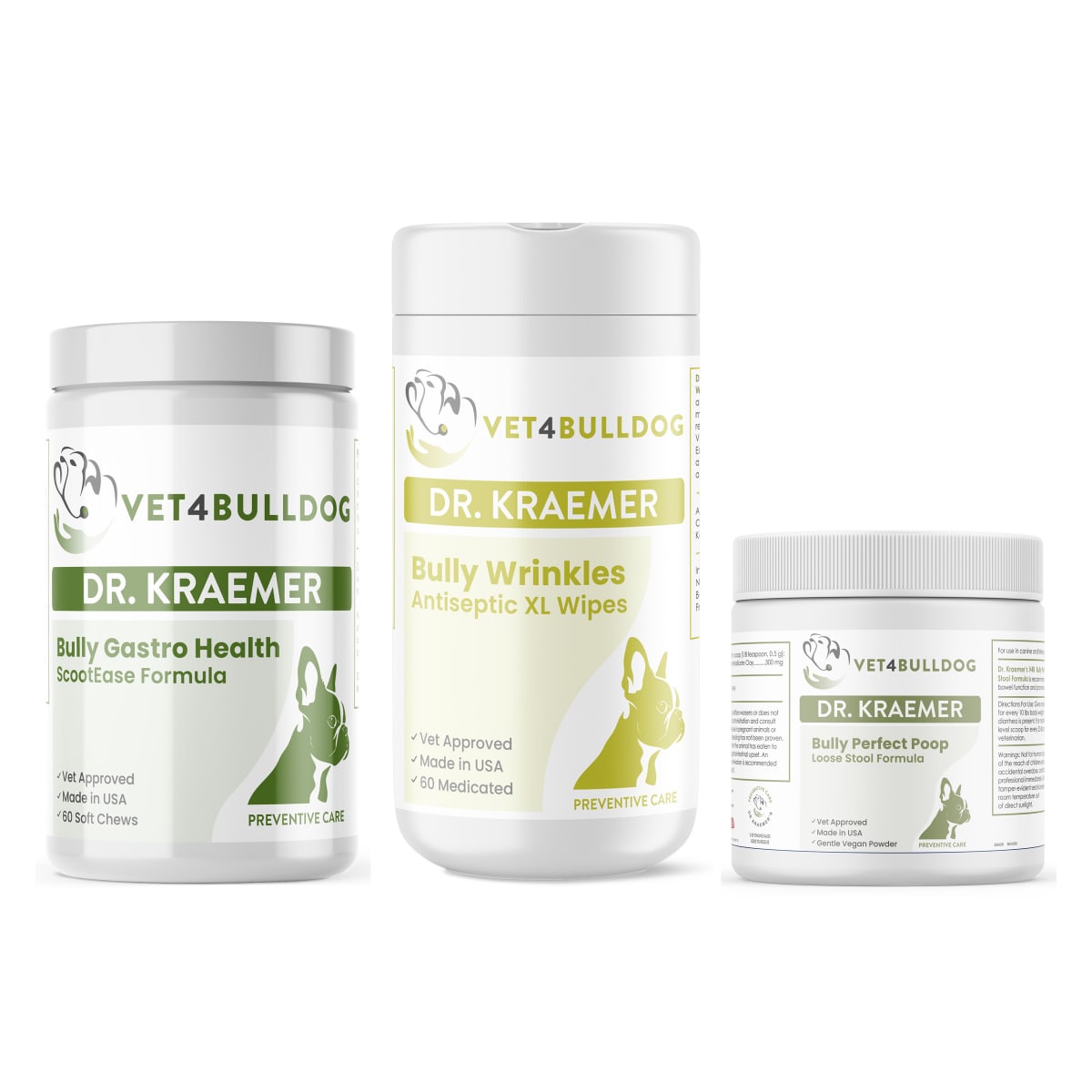
🌿Dr. Kraemer’s “Gentle Move & Anal Gland Care” are palatable chews that are easy to administer as treats.
“Buster has been scooting a lot more than usual and licking back there. There is a strong smell now, and it looks a little swollen. Is this something I caused?”
Scooting, odor and a little swelling together is the classic impaction picture, and in Bulldogs it usually comes down to anatomy and stool consistency, not anything you did wrong. Don’t blame yourself. Scooting and odor can happen even with attentive care. Because you’re also seeing swelling, Buster should have a veterinary exam to check for impaction, or an abscess. Once the immediate problem is addressed, we can focus on stool quality, healthy weight, and any nearby skin fold irritation to help keep him comfortable.
Why is my bulldog scooting?
Can I express the glands at home?
Do groomers express them properly?
How often should they be expressed?
How do I prevent anal gland problems?
When is it an emergency?
Anal Gland Sacculectomy Surgery
At times, surgical removal of the anal gland is recommended (sacculectomy). Reasons for this could be:
- Chronic recurrent anal gland infection
- Tumor of the Anal Glands
Care must be taken not to injure the anal sphincter, since that can cause lifelong fecal incontinence. 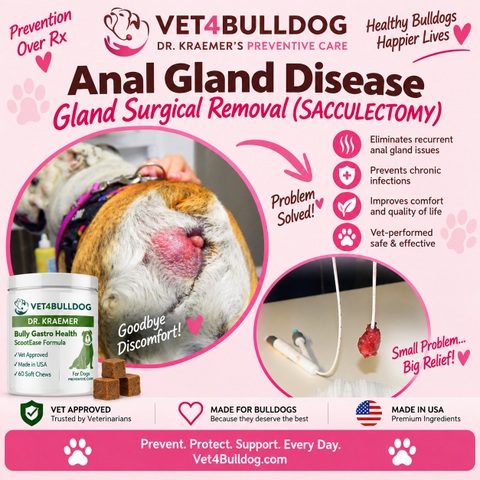
Bulldog Anal Gland Tips & Warnings
Essential anal gland tips and warnings from Dr. Kraemer.
#1 RECTAL EXAM TIP:
When performed rectally, a veterinary team member can assess whether the gland is normal and requires no intervention, or whether it is full and needs to be expressed and, if so, whether it is readily expressible. If the gland was recently expressed, a rectal examination can also confirm that it is indeed empty.
#2 NON-RECTAL ANAL GLAND EXPRESS TIP:
When conducted externally (non-rectally), as commonly performed by most groomers, it becomes challenging to ascertain whether the glands are empty or full. It is not uncommon for a groomer to mistakenly assert that the glands are in good condition merely because nothing was expelled during the expression process, when, in fact, they might be impacted.
🚨Furthermore, external expression does not guarantee complete evacuation of the glands.
#3 ANAL GLAND, BUTT & PERIANAL TIP:
Scooting, biting, and itching of your bulldog’s back end is often an anal gland disease but keep in mind that it also can be due to:
- Bulldog Tail Fold Dermatitis
- Bulldog Anal Gland Impaction
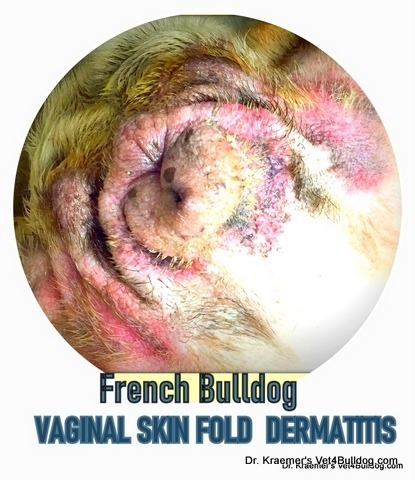
- Bulldog Vaginal Fold Dermatitis (female)
- Bulldog Flea Allergy
- Bulldog Other Allergy
- Bulldog Whipworms
#4 BULLDOG SKIN FOLD DERMATITIS TIP:
The anal gland odor is often described as a “Yeasty or Fishy Smell”. Severe skin fold dermatitis, including vaginal fold and tail pocket dermatitis, can smell exactly the same way, so examine those areas too.
🚨Both should be wiped with Dr. Kraemer’s bully V4B antiseptic wipe.
#5 ANAL GLAND PREVENTIVE CARE TIP:
Familiarize yourself with your bulldog’s back end (tail, rectum, perianal area, vaginal folds) and adhere to my “Zen & Bulldog Maintenance” preventive program that includes
- WIPE: Regular wiping with bully antiseptic wipes
- EXPRESS: Manual digital rectal emptying of the glands when impacted
- PREVENT: Providing natural ache relief, anti-inflammatory, and anal gland-emptying supplements.
#6 DR. VISIT ANAL GLAND EXAM TIP:
If you suspect an anal gland problem, see your vet before it turns into a bigger problem.
#1 ANAL GLAND PAIN WARNING:
Expressing anal glands can be painful; at times, mild sedation is required.
#2 GROOMERS EXPRESSING ANAL GLAND WARNING:
Do not express anal glands routinely unless it is medically indicated.
It is typically advised to avoid expressing the glands if your bulldog shows no discomfort and has no history of anal gland disease, even though groomers or hospital staff may recommend (or be asked to perform) “preventive” anal gland expression.
While neglecting anal gland issues can cause pain and discomfort for your bulldog, the other extreme, frequent and unnecessary emptying, can also be detrimental. Overzealous expression can irritate the glands, increasing the risk of inflammation, infection, and even impaction (a hardened, painful blockage).
Remember, preventive care includes,
- weight management
- quality diet
- bully therapeutic supplements
- skincare
- allergy care
- tail fold care
- vaginal folds and hod care
Prevention does not require frequent anal gland expression.
Healthy anal glands empty themselves with regular, healthy bowel movements.
#3 BULLDOG TAIL FOLD WARNING:
Anal gland problems can compound bully tail fold dermatitis in bulldogs and French bulldogs suffering from tight, deep-pocketed, or corkscrew tails. This might happen due to anal gland debris trapped in the fold and self-trauma due to itching and scooting.
#4 SEDATION WARNING:
Expressing anal glands can be painful; thus, at times, mild sedation is required.
Sedation and anesthesia in bulldogs are a high risk, please read Dr. Kraemer’s warning on this subject HERE
#5 ANAL GLAND ABSCESS SURGERY WARNING:
Anal sac surgical removal should be reserved for tumors and severe chronic cases.
It should only be done by a surgeon familiar with the breed and experienced with the procedure.
There are some potential risks, such as:
- ANESTHESIA: As for any surgical procedure
- INCONTINENCE: The anal glands are embedded near the anal sphincter. Scarring or injury to the nerves and muscles could lead to some degree of fecal incontinence.
- DRAINING TRACT: If the surgeon fails to remove all the glandular tissue or an infection of the surgical site occurs, an abscess with a draining tract will form, forcing a revision (cleanup) of the original surgery.
Insider tip
DR. KRAEMER’S FINAL ADVICE
Remember, the goal is to keep your bulldog’s anal glands healthy and functioning normally.
🚨Prevention is always preferred over medication, medical treatment, and surgery
ANAL GLAND PREVENTION CARE SUMMARY
- Exercise
- Stress-free environment
- A balanced, nutritious diet
- Lean body weight
- Proper hydration
- A sufficient fiber supplement
- Proper anal and perianal hygiene
- Proper tail fold hygiene
Veterinary Care and Supportive Products
If the area is swollen, hot, painful, bleeding, or has burst open, that needs a veterinary visit rather than home care. For fiber support and long-term anal gland health, explore Vet4Bulldog options selected for Bulldogs and French Bulldogs.
More Help from Dr. Kraemer
Scooting has more than one cause. These real-world guides and answered questions may help you connect the dots:
- Infected, red, painful anal gland Q&A
- Five Bulldog gut health and probiotic must-knows
- Food allergy and stomach upset Q&A
- Diarrhea and probiotics in Bulldogs
- Pain and pain control in Bulldogs
About the Author
Roy Kraemer, DVM, is a veterinarian with extensive clinical experience caring for Bulldogs and French Bulldogs. His educational work emphasizes prevention, early recognition, appropriate at-home care, responsible medication use, and veterinary evaluation when disease is persistent or severe.
Trusted by Vets ~ Recommended by Owners ~ Approved by Bulldogs
References
- Merck Veterinary Manual. Anal Sac Disease in Dogs
- WSAVA. Global Nutrition Guidelines
- American Animal Hospital Association. 2022 AAHA Pain Management Guidelines for Dogs and Cats
To be clear: supplements or topicals are not substitutes for prescribed treatment. If your dog is unwell, is being treated for a condition, or is already on medication, review any supplement or topical with your veterinarian so it fits the plan you are already following. This page is educational and is not a diagnosis or a treatment plan for your own dog.