


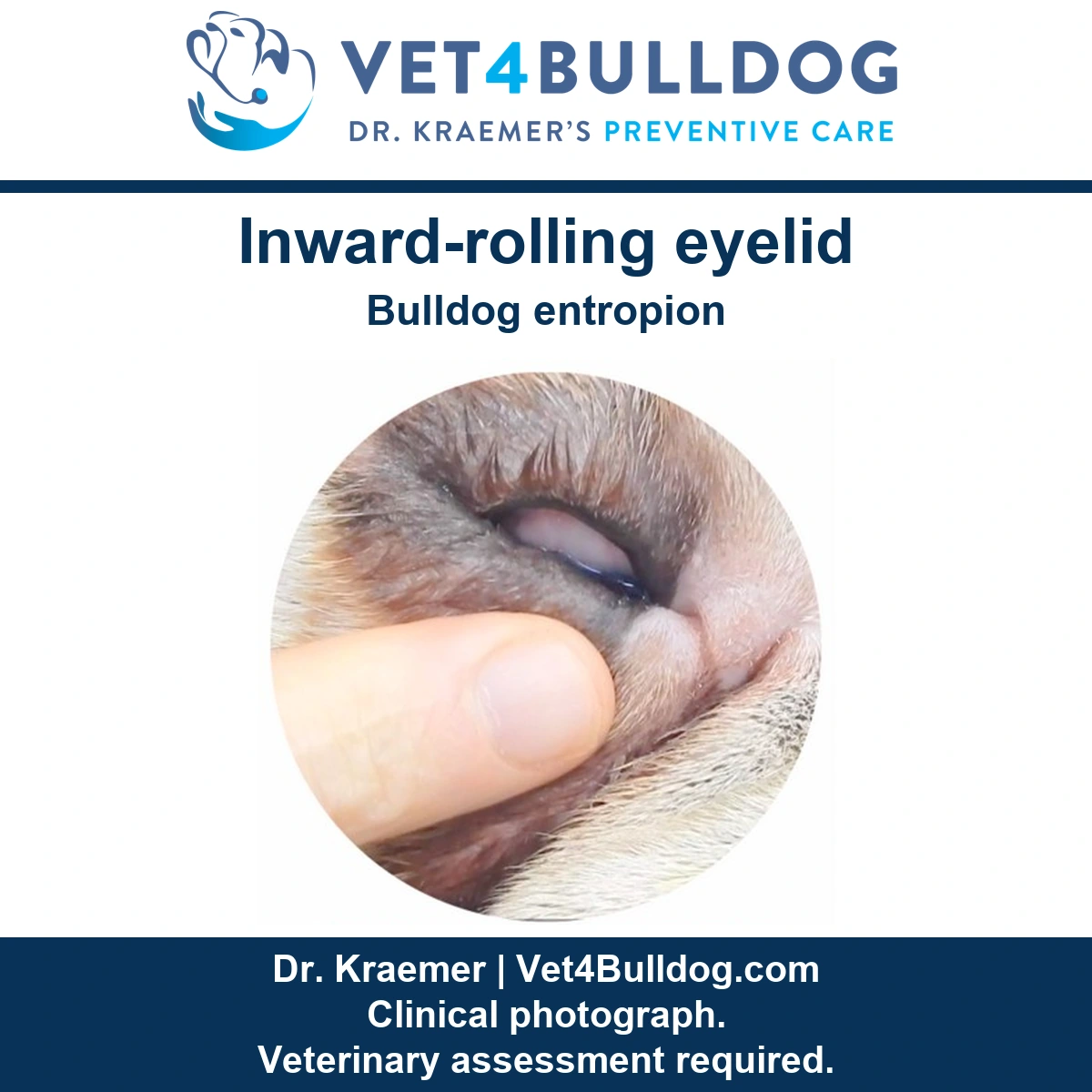
The eyelid rolls inward, which turns the lid margin and the hair on it into something scraping the cornea every time your dog blinks. He blinks roughly once every few seconds, all day, for as long as it goes uncorrected. That is the whole mechanism, and once you see it that way the rest of this page makes sense.
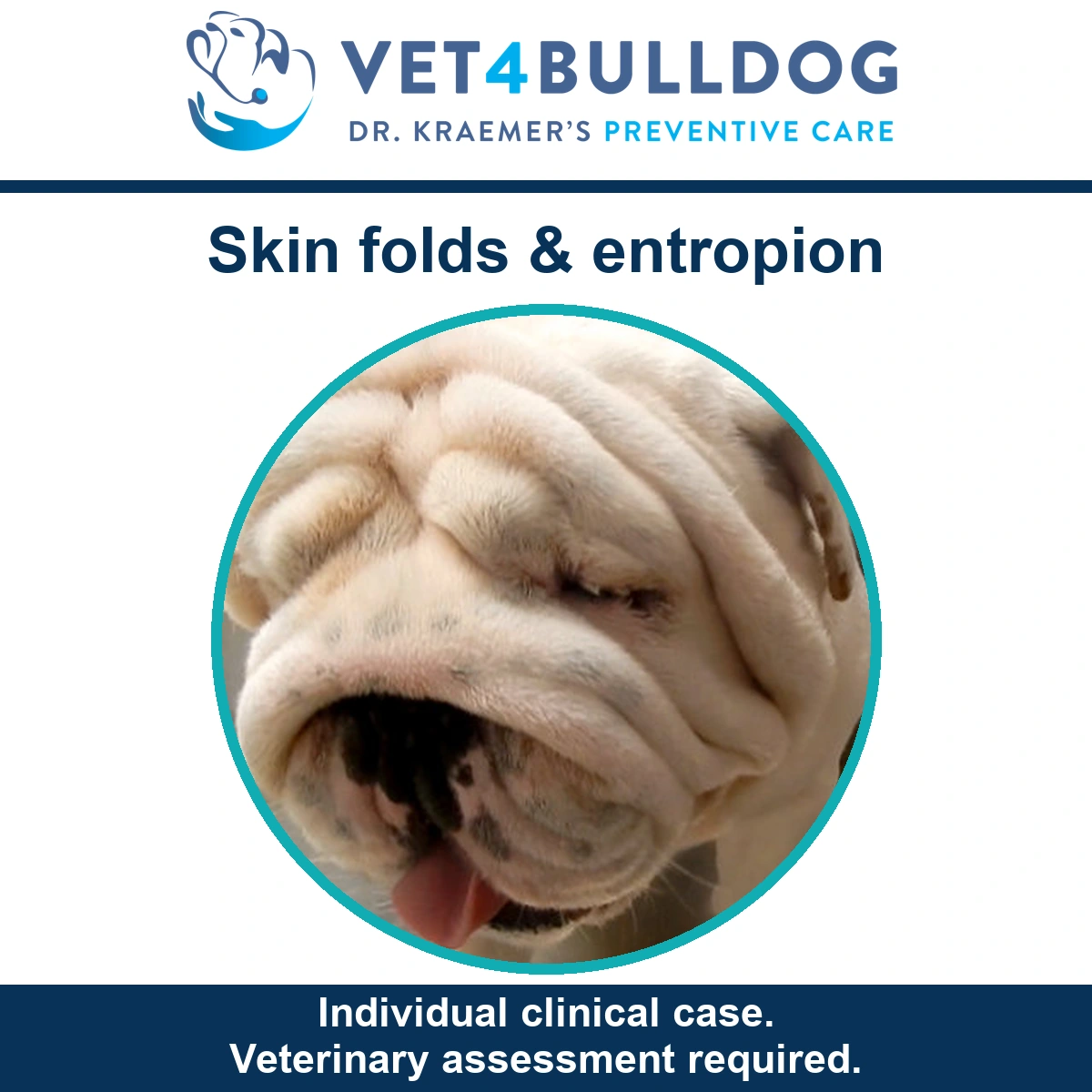
In this breed it is largely a matter of construction rather than bad luck: heavy facial folds, generous loose skin, and a brow that has weight to it. All the things that make a Bulldog look like a Bulldog also pull on the eyelid.
There is one trap worth knowing before any of the detail, because it changes whether your dog needs an operation at all. A painful eye makes a dog squint. Squinting pulls the lid inward. The inward lid rubs and makes the eye more painful, and round it goes. That is a different condition from true entropion, it is treated differently, and telling the two apart is a short test in the consulting room rather than a judgment call.
Our bulldog puppy is four months old and his left eye has been weepy and half closed since we got him. The vet says it is entropion and that we should wait before operating because his face is still growing. In the meantime he has already had one ulcer. Waiting feels wrong to me when he is clearly uncomfortable and it keeps happening. Are we doing the right thing, and is there anything we can do while we wait?
Your vet is giving you good advice and your instinct is also right, which is an uncomfortable combination. Let me explain why both can be true.
The reason for waiting is real. A four month old Bulldog face is still changing shape, and a lid corrected to fit today’s head can end up over-corrected on the adult one. Over-correction is the worse outcome, because a lid that no longer closes properly leaves the eye exposed and dry, and that is harder to live with than the original problem.
But waiting does not mean doing nothing, and that is the part owners are often not told. Where a young dog is already ulcerating, there is a temporary option: the lid can be tacked, turning it outward with a few sutures while the face finishes growing. It is a much smaller procedure than the definitive one, it buys the cornea protection during the months that matter, and in a proportion of puppies the lid settles as the head matures and the bigger operation is never needed at all.
So the question to take back is not whether to wait, it is whether to tack in the meantime. That is a reasonable thing to ask and most veterinarians will be glad you did.
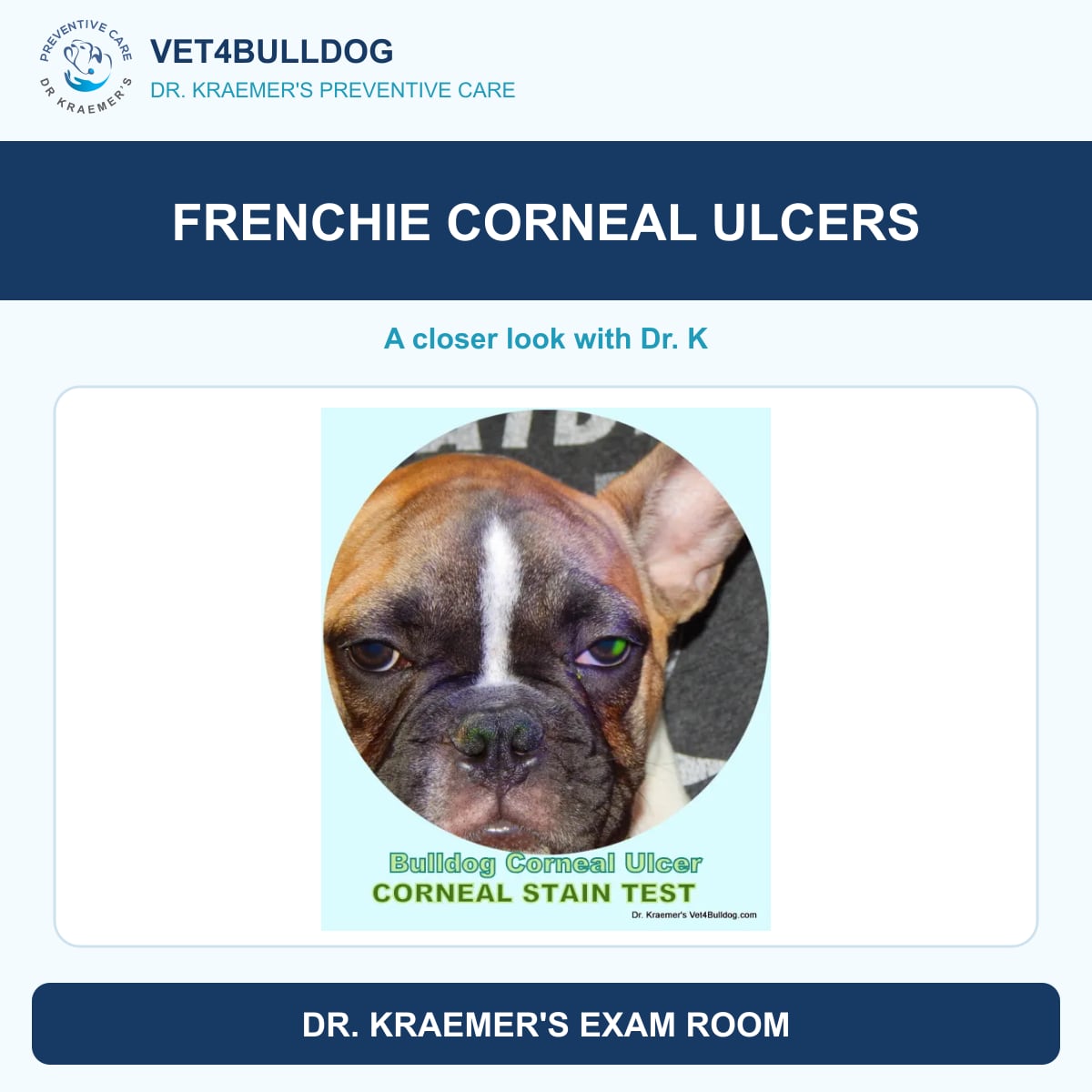
One more thing given he has already had an ulcer. Ask whether the eye has been stained and whether what you are seeing now is the lid pulling the eye, or the eye pulling the lid. Those run in opposite directions and the answer changes the plan.
Hello Dr. Kraemer 🩺 💉🦴I’m writing about my bulldog puppy, Jasmin. She’s been blinking more frequently, and her left eye appears puffy, painfully spasmatic, and watery 👀. We’ve previously addressed entropion in her other eye, but could this be connected?
We don’t trust any other vet when it comes to our Jaz! 🐾👀 #JuzTheFrenchie #entropionpain #PainFullEye” ❤️
Thank you! 😊
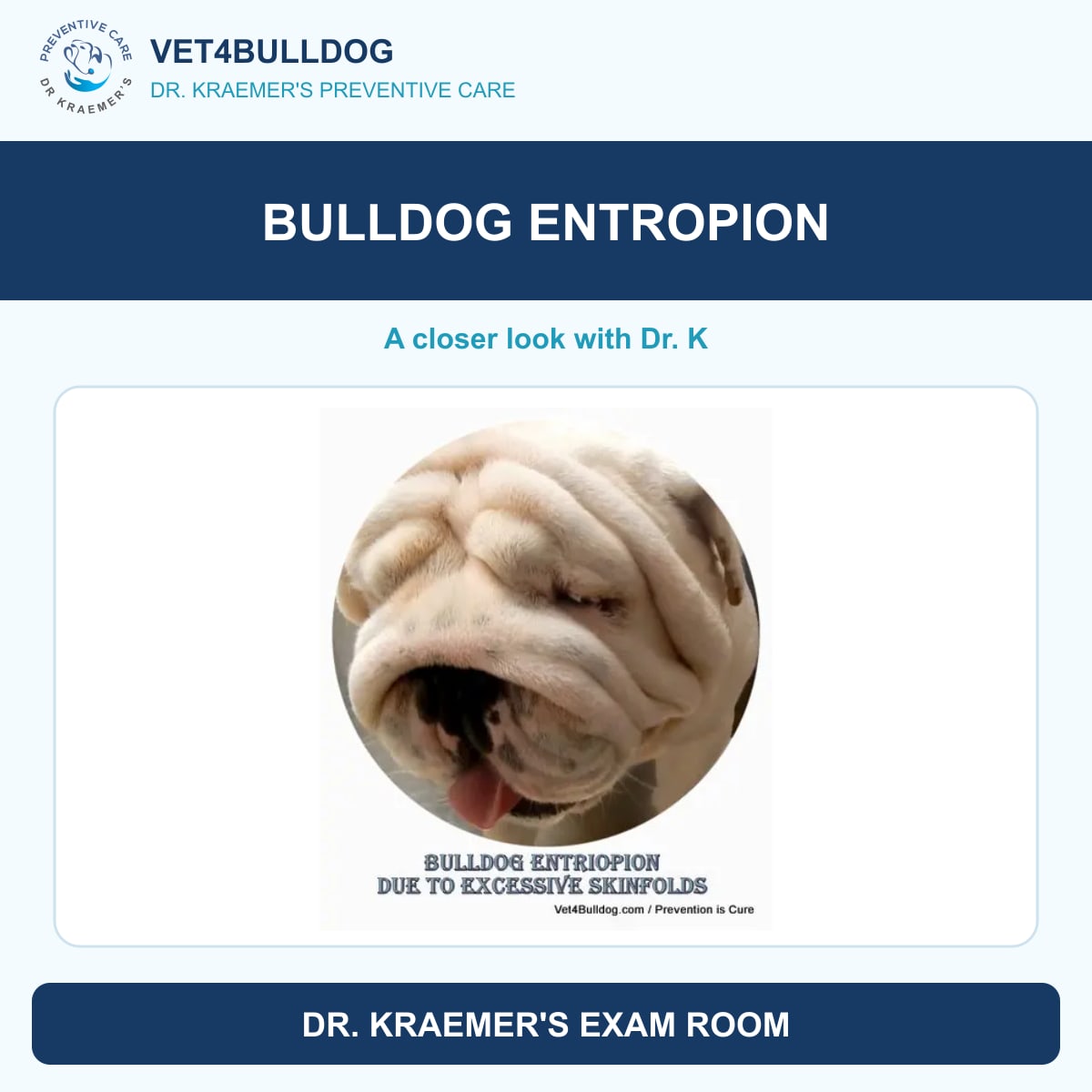
Entropion is a common condition in bulldogs and French bulldogs that causes an inward rolling of the eyelid edges. The amount of skin and wrinkles covering your bulldog’s head and face region, as well as the weight of the folds, determine the severity of the entropion.
Bulldog Entropion 5 X MUST KNOW
- Primary entropion is inherited, typically as a result of selective breeding for flat faces and associated skin folds.
- The most common cause of secondary entropion is painful eyelid spasms that are linked to malformed eyelashes and ulcers. Timely
- To avoid permanent corneal injuries and vision impairment, timely repair is critical.
- Bulldog entropion is usually treated with temporary staples or with permanent blepharoplasty surgery.
- Prevention includes Dr. Kraemer’s Eyes and Eyelid Care Bundles
Members of this bulldog community prefer prevention over RX

Bulldog Entropion/AGE:
Entropion is one of the most common eye problems in bulldogs, and it is often present at a young age while they are growing, but it can also be acquired later in adulthood.
Entropion can affect both the lower lid and the upper lid
WARNING PUPPIES:
If your young puppy has not opened their eyes after a few weeks of age, the puppy’s eyes should be evaluated for entropion.
WARNING TIMING:
If you suspect that your bulldog puppy is suffering from entropion, see your veterinarian as soon as possible.
Avoiding delays may help prevent costly corneal damage and potential vision loss.
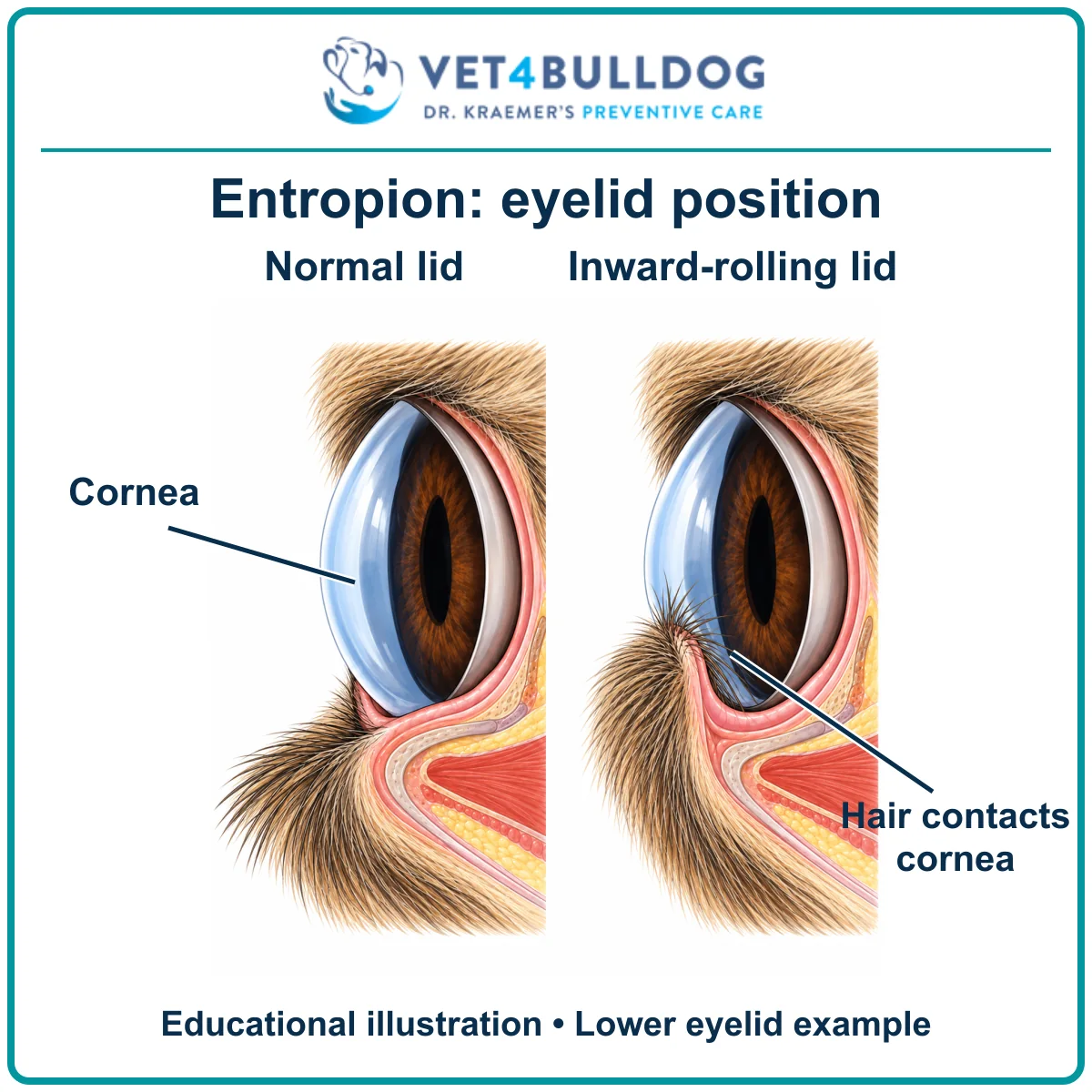
Bulldog Entropion Types:
There are two types of entropion:
- primary
- secondary
Primary Bulldog Entropion
Primary entropion is genetic (inherited), mostly due to the breed’s brachycephalic (smooshed face) anatomy and associated redundant skin fold
The amount of skin and wrinkles covering your bulldog’s head and face region, as well as the weight of the folds, determine the severity of the entropion.
WARNING BREEDING:
Due to the inherent underlying cause, those bulldogs should not be used for breeding
Secondary Bulldog Entropion
Secondary entropion is the inward rolling of the eyelids due to spasmatic pain.
Examples of eye problems that lead to painful spasms are:
- Eyelash problems
- Distichiasis
- Trichiasis
- Ectopic Cilia
- Corneal ulcers
- Other defects
Entropion, eyelash issues, and corneal ulcers frequently manifest simultaneously.
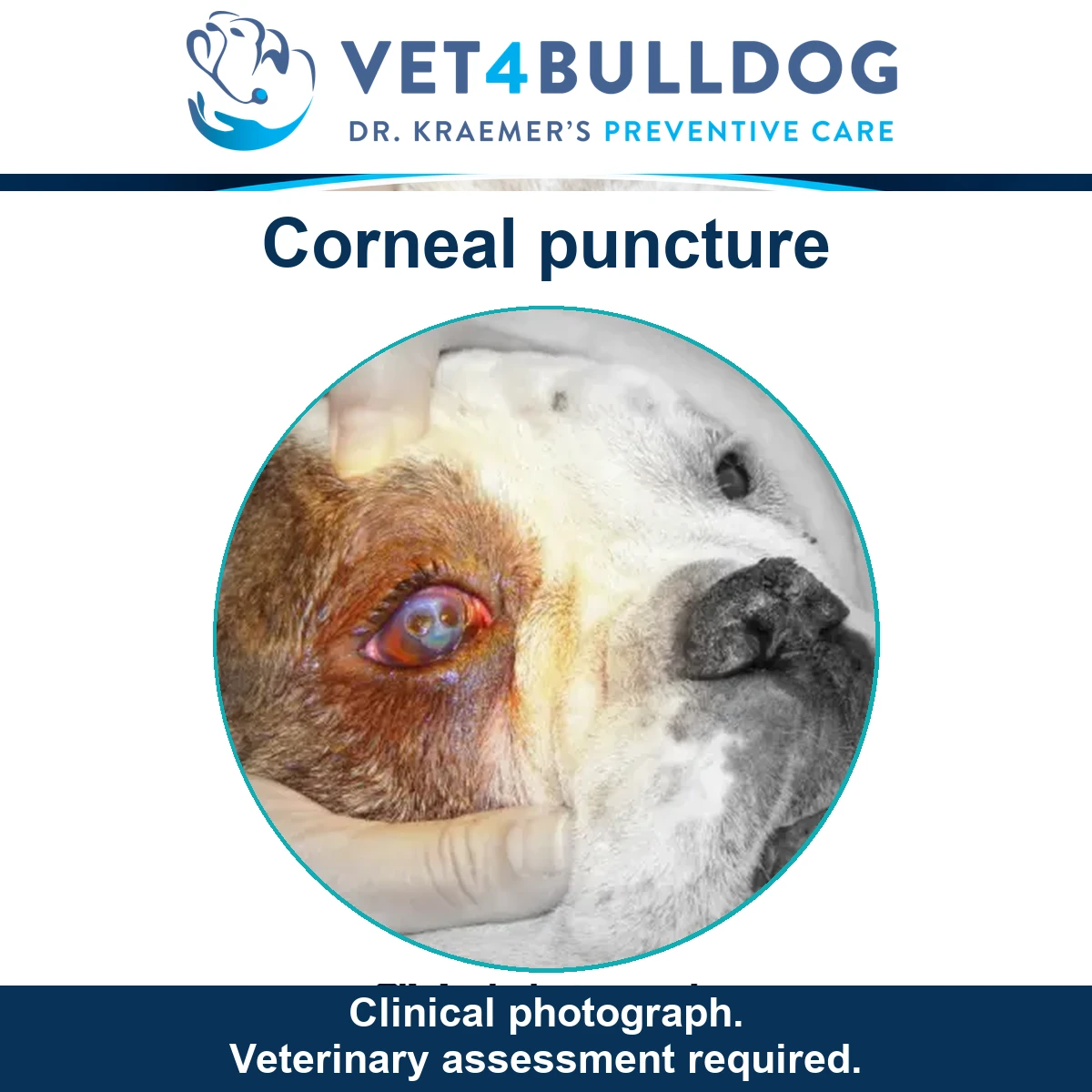
Entropion in Bulldogs and French Bulldogs PAIN WARNING
Both primary and secondary entropion can cause excruciating pain.
There are two typical causes:
- Contact between the eyeball (cornea), the eyelid, and its associated eyelashes
- The second type is corneal ulceration caused by contact
The pain aggravates the eyelid muscle spasm, which causes a more severe inward roll-in, which exasperates the pain and thus aggravates the spasm and inward rotation of the eyelid (entropion).
Entropion in Bulldogs / PRESENTATION:
- Closed-shut lids
- Intense squinting and blinking
- Limited vision
- Obvious pain and discomfort
- Pawing and rubbing at the eyes
- Eye discharge
- Swollen eyelids
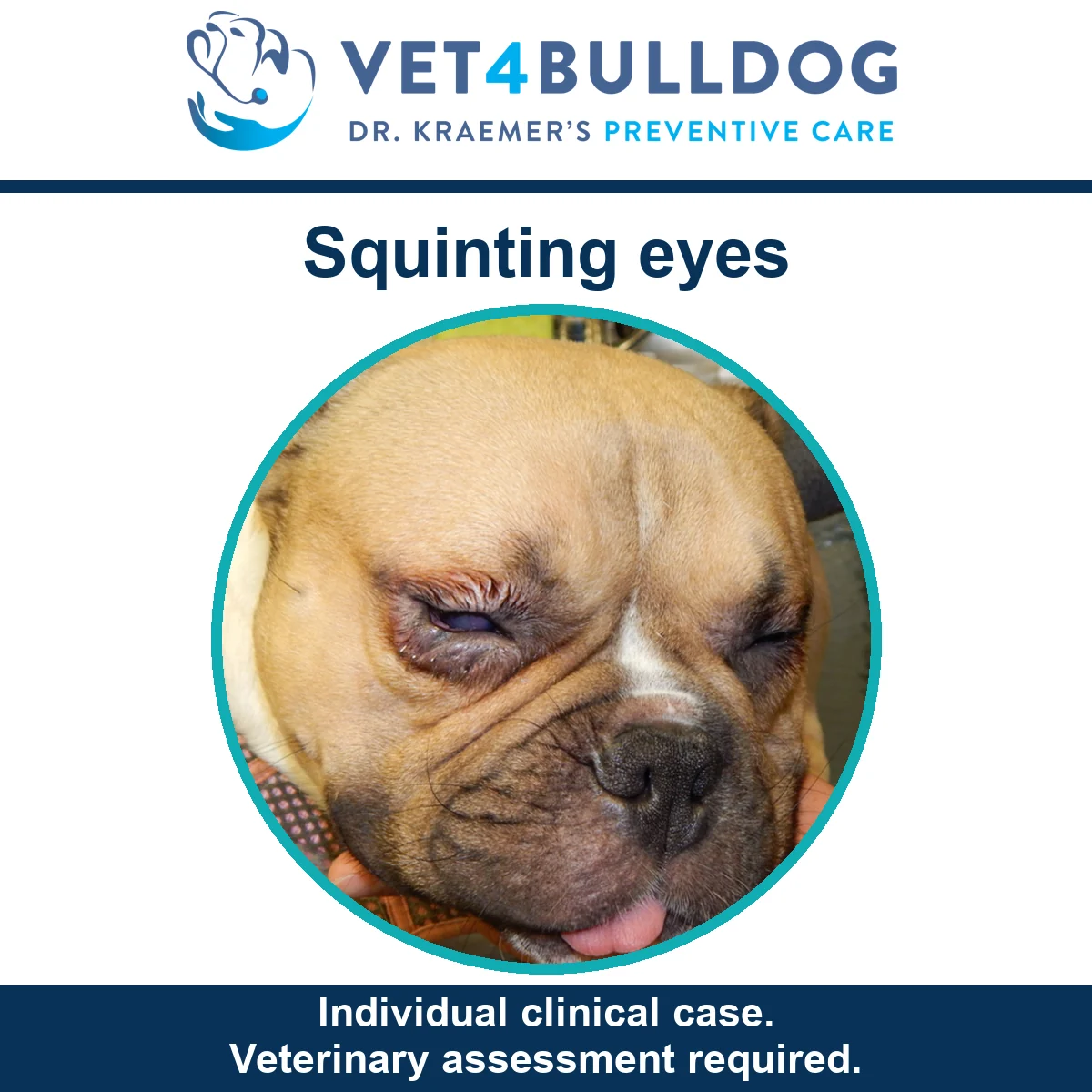
Entropion in Bulldogs / DIAGNOSIS
Eye Exam (ocular examination): check for
- Abnormal eyelashes
- Corneal ulcers
- Other deformities and abnormalities
EXAM REQURIMENTS:
- Magnification (high power glasses)
- Bright Illumination
- Topical Opthalmic Anesthetics: relive pain and spasm
Cornea Fluorcein Dye: testing for a corneal ulcer
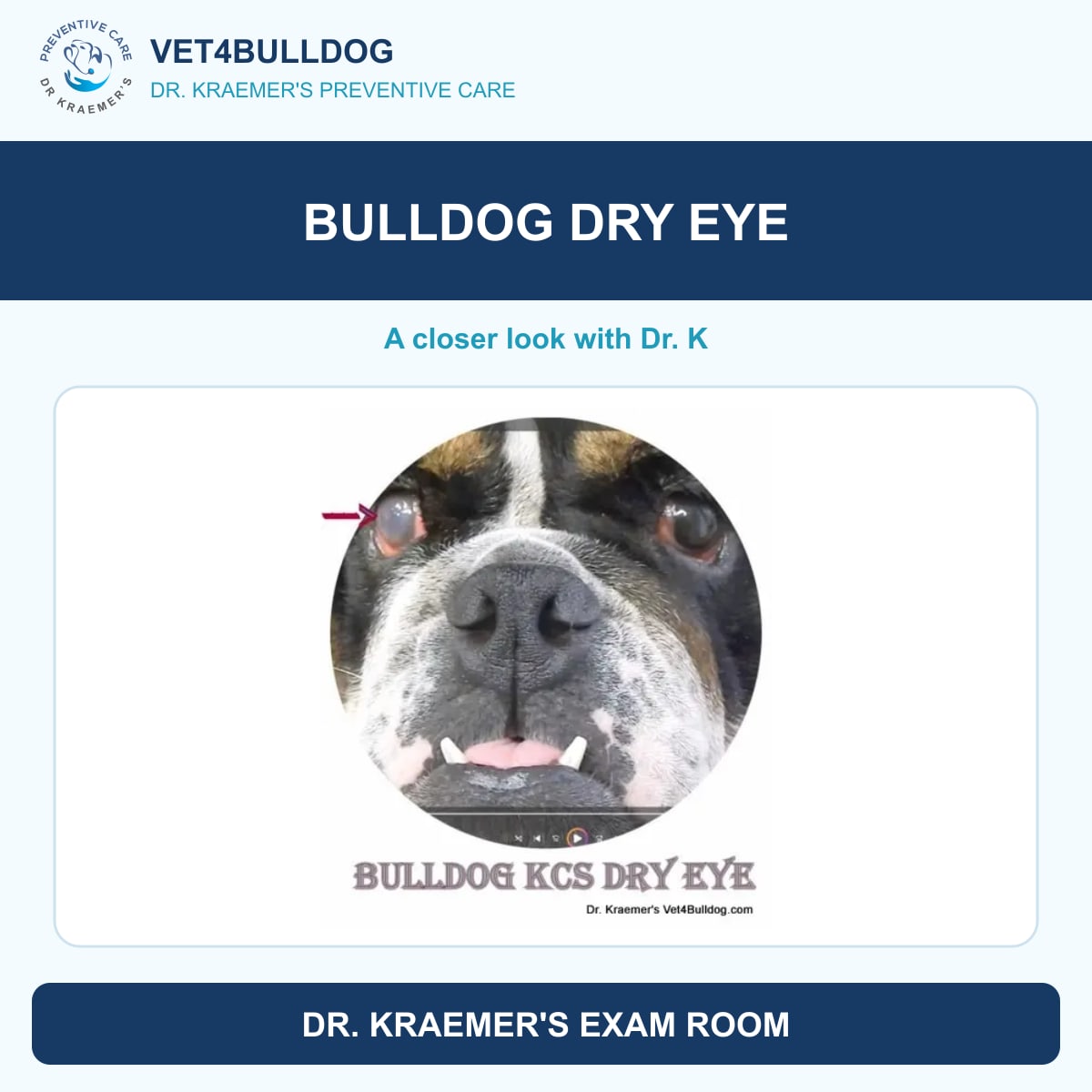
Schimmer Tear Test: checking tear production and KCS
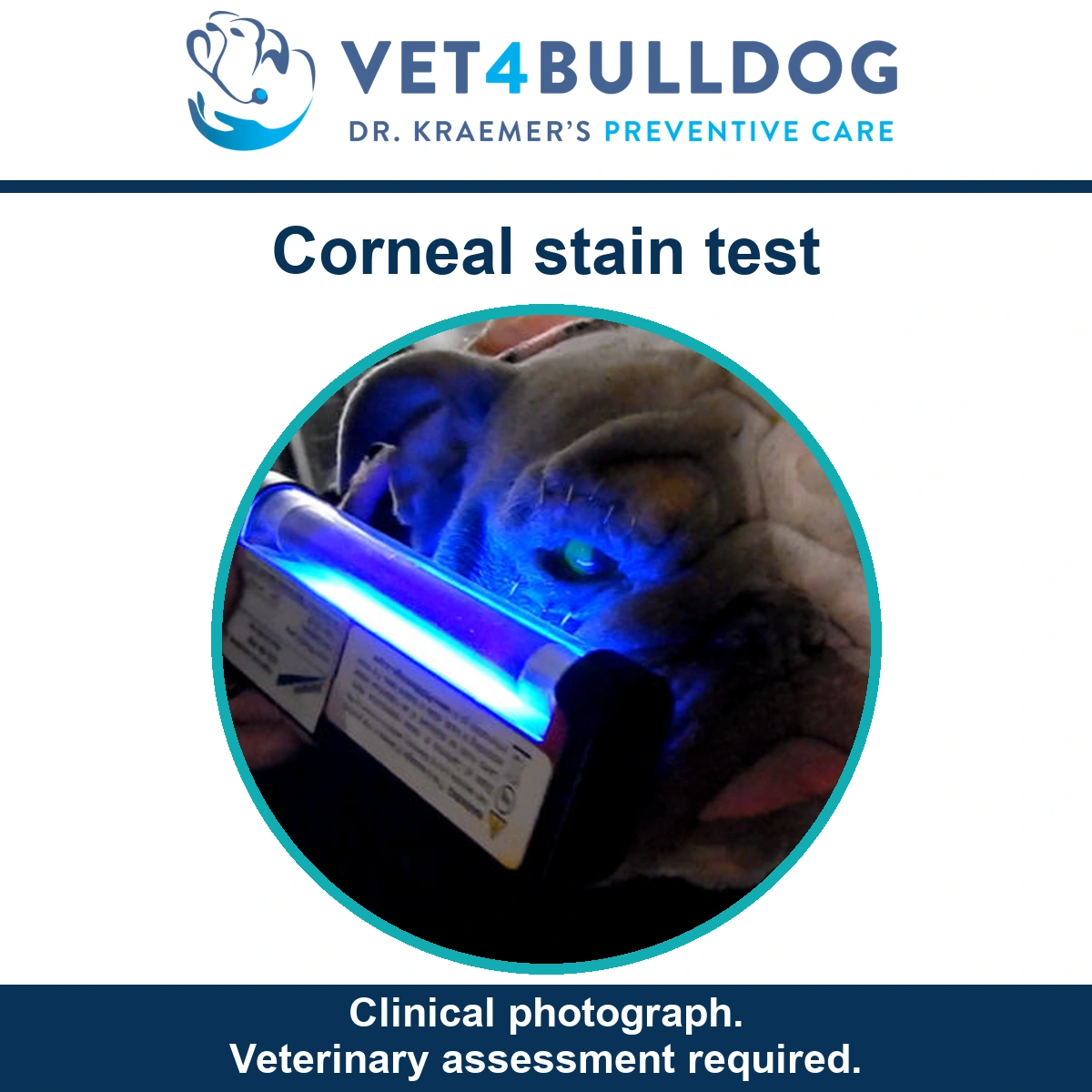
TIMING WARNING:
Timing of the ocular exam and treatment is critical, the longer the wait the more intense the pain becomes and the higher the chances for serious corneal injuries, scarring and even sight loss and blindness
Secondary Bulldog Entropion / PREVENT & TREAT
Identifying and treating the underlying problem, such as eyelash abnormalities and corneal ulcers, usually relieves the spasmatic eyelid and, therefore, the inner rotation.
- Pain medication
- Topical eye drops
- Anti Spasmatic
- Lubricant
- Antibiotics
- Serum (some type of ulcer)
- Pain relief
- E-Cone (protective buster collar)
- Temporary entropion surgery
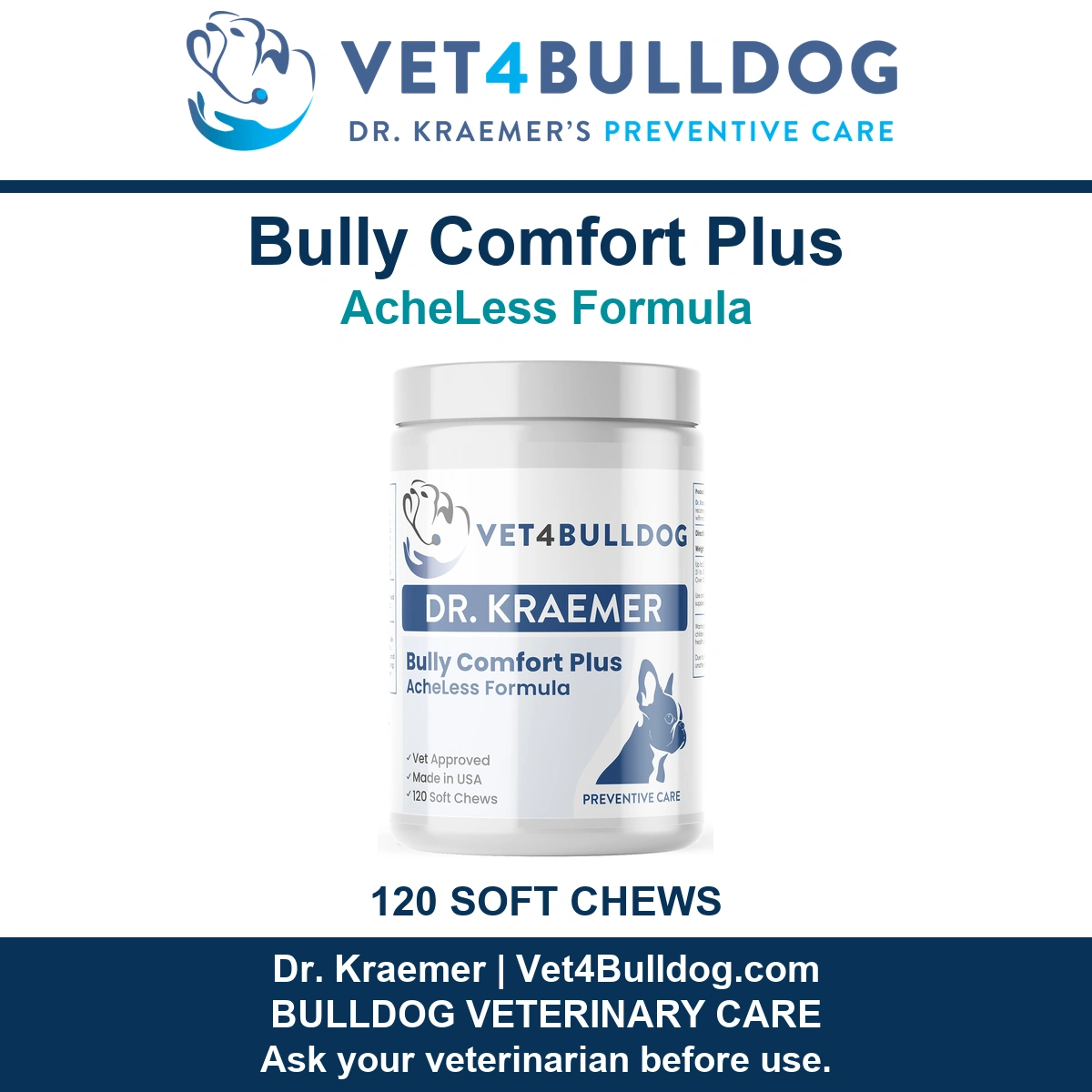 Secondary entropion typically does not require entropion blepharoplasty surgery; instead, temporary entropion is sufficient to relieve the spasm and enhance access to corneal ulcers and ingrowing eyelashes.
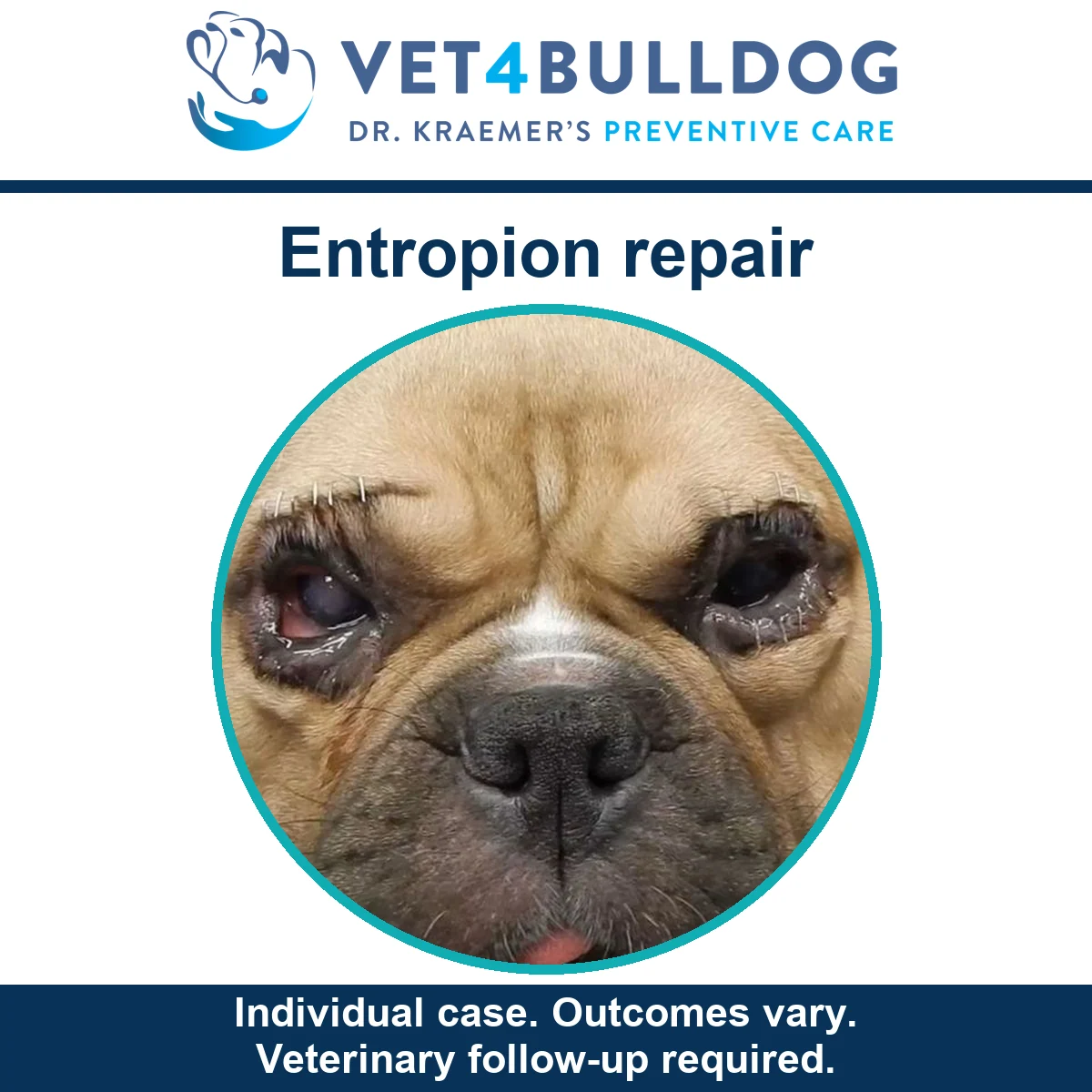
Bulldog Therapeutics
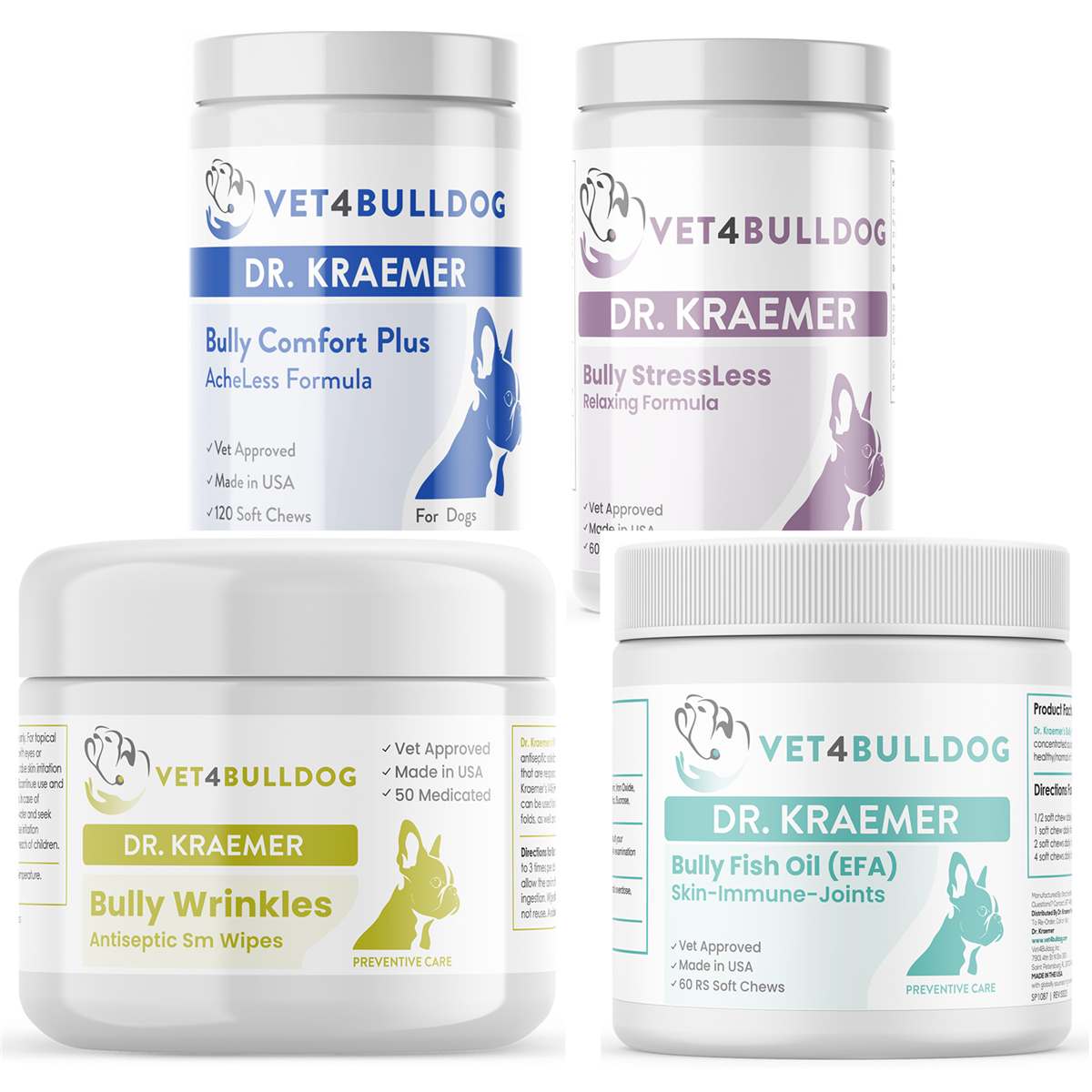
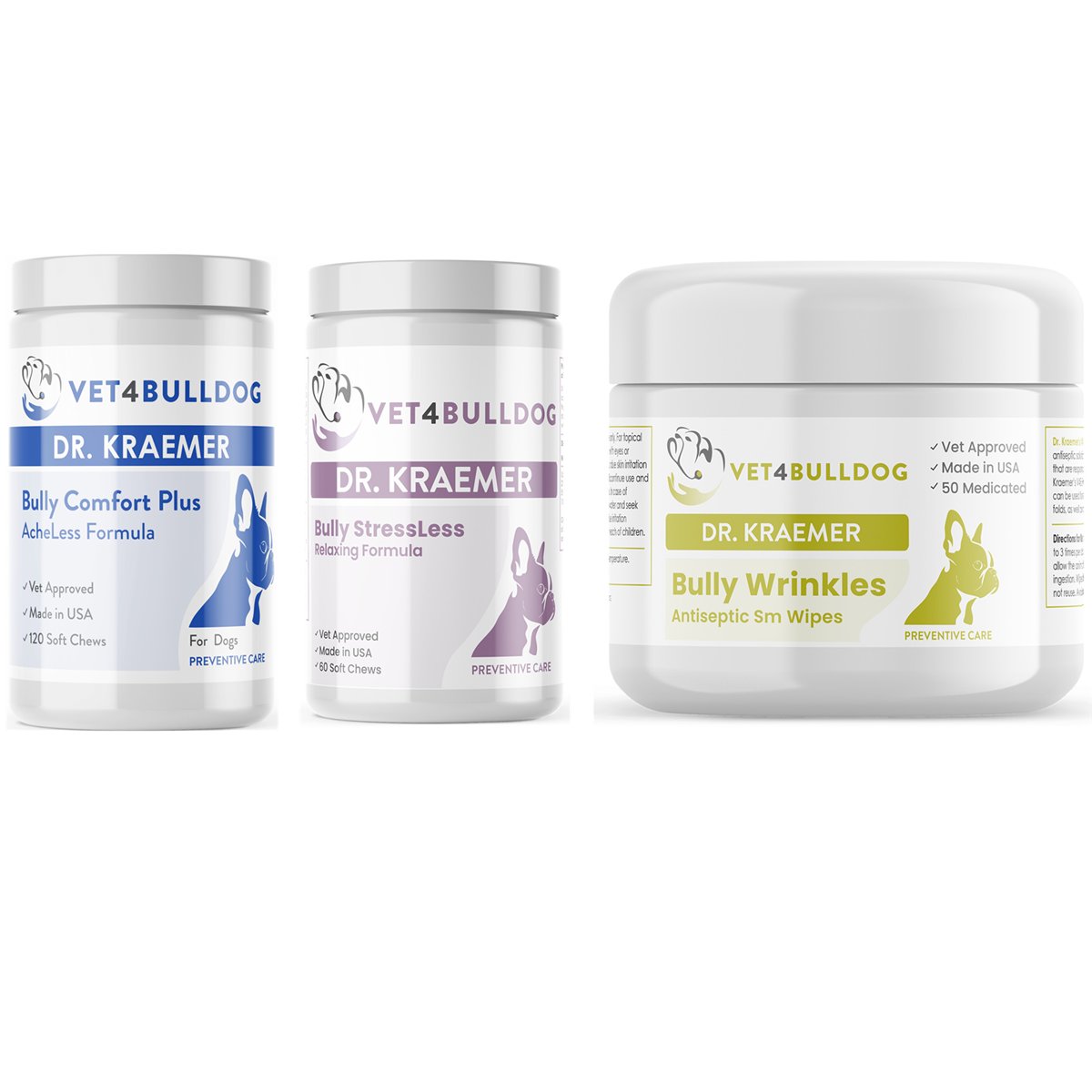
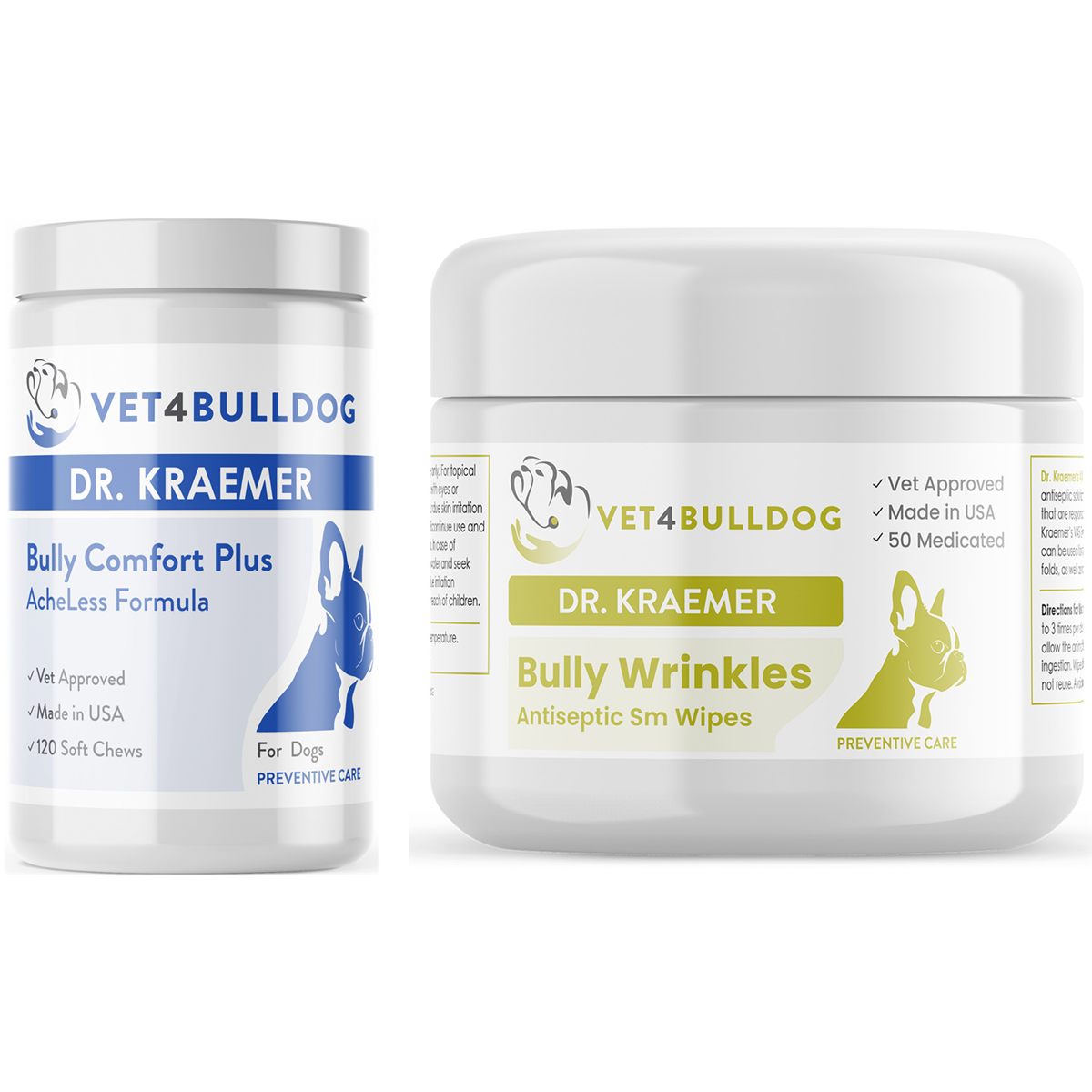
- V4B Bully Comfort & AcheLess
- V4B Bully Fish Oil EFA
- V4B Bully Antiseptic Skin Fold Wipes:
Bulldog Primary Entropion / PREVENT & TREAT
See Secondary Entropion for topical and systemic medication
Blepharoplasty Surgery Entropion Correction
Primary entropion requires surgery correction in addition to topical and systemic pain relief medications.
The goal of the surgery is to remove skin in the shape of a crescent to allow stretching upward (upper eyelid) or downward (lower eyelid).
Entropion Surgery Suture Material:
I recommend soft, non-irritating sutures that dissolve quickly.
- When suture removal is due, it will reduce stress and unintended injuries to the patient and medical team.
- It will also eliminate the need for sedation in noncompliant patients, as well as the risks and costs associated with it.
- Itching, inflammation, and allergic reactions to suture materials are less likely with these types of suture materials.
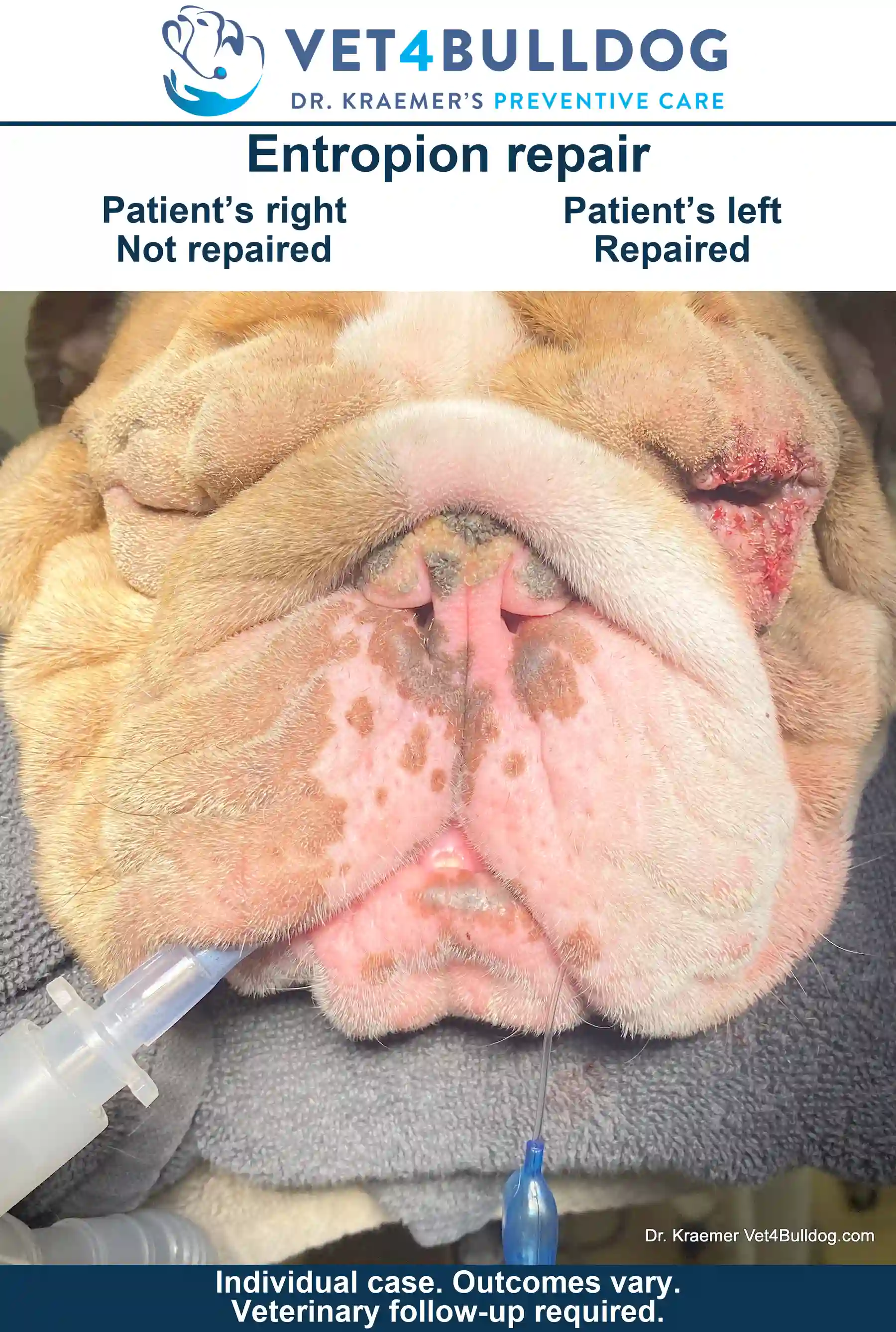
WHAT IS TEMPORARY ENTROPION?
Temporary entropion ideally is done with surgical stapling; the benefits are
- It does not require anesthesia
- It does not require surgical expertise
- It takes only a few seconds
Secondary entropion is ideal for:
- Growing puppies
- Anesthetic-risk patients
- Secondary Entropion
- Primary Entropion: as “first aid” to relieve pain and prevent progression till surgery can be scheduled
WHAT IS ECTROPION?
Ectropion is an entropion overcorrection characterized by an excessive outward roll of the eyelid.
Ectropion interferes with normal blinking and tear distribution, resulting in dry eyes (KCS).
WARNING
Ectropion correction is challenging and necessitates surgical expertise. Additionally, it might need permanent artificial tear placement.
Therefore it is critical that an experienced surgeon perform the entropion blepharoplasty surgery
Entropion Bulldog Dr. Kraemer’s Rule of Thumb:
Bulldog entropion frequently manifests as abrupt squinting along with red, watery eyes, which is a sign of a developing corneal ulcer and needs immediate attention. I advise you to get veterinary care as soon as you can.
Entropion in Bulldogs and French Bulldogs / PROGNOSIS
For both primary and secondary entropion, the prognosis is good if the problem is identified and treated early and the cornea has not sustained any damage.
If the cornea has been affected ulcered and scarred, vision might be permanently impaired and in a severe case such as perforated corneal your bulldog might lose his/her eye.
Selective breeding may have simply exaggerated entropion in breeds that were already prone to it. We do not recommend breeding a bulldog who has had entropion.
Bulldog Entropion Dr. Kraemer’s Tips & Warnings
Bulldog Entropion PUPPIES TIP:
Entropion in bulldogs and French bulldogs can happen at any age. to avoid the risk associated with anesthesia in young bulldog puppies, I will typically delay the surgical correction until the dog is more fully grown. Instead, I will place a temporary suture with only light sedation to evert the eyelids as a temporary fix.
Entropion in Bulldogs VISION LOSS WARNING:
Injury to the cornea due to entropion can lead to partial or complete loss of vision.
Entropion in Bulldogs E-CONE:
Place a buster collar on the head as soon as you become aware of an eyelid, entropion, or corneal problem. The pain of the ulcerated cornea can lead to pawing and rubbing, inflicting additional trauma.
Is the lid pulling the eye, or the eye pulling the lid
This is the distinction I would most like every Bulldog owner to walk in already knowing, because it decides whether their dog has an operation.
True entropion is structural. The lid is built in a way that rolls it inward, and it will keep doing that regardless of how the eye feels. Spastic entropion is the reverse: something is hurting, often an ulcer, the dog squints hard in response, and the squeezing rolls an otherwise normal lid inward. Now the rolled lid rubs, which hurts more, which produces more squinting. It is a loop that feeds itself, and from the outside it looks identical to the structural kind.
Separating them is quick. A drop of topical anesthetic takes the pain away for a few minutes. If the lid relaxes back to a normal position once the dog stops squinting, you were watching a pain response rather than a conformational problem. If it stays rolled in, it is structural.
Why it matters so much: operating on a spastic entropion means correcting a lid that was never the problem, in a dog whose real problem is still sitting on the cornea untreated. It is one of the few genuinely avoidable surgeries in this breed, and the test that avoids it takes about five minutes. If your dog is heading toward eyelid surgery and nobody has mentioned that test, it is a fair question to ask.
Over-correction is worse than under-correction
When owners worry about this surgery they usually worry about whether it will work. The thing I would actually have them ask about is the opposite failure, which is taking away too much.
The operation removes a crescent of skin below or above the lid to roll the margin back out. Take too little and the lid still turns in and the dog needs a second procedure, which is disappointing but fixable. Take too much and the lid is pulled outward and no longer closes cleanly, which leaves the surface of the eye exposed and drying. That is a harder problem than the one you started with, and in a breed whose eyes already sit forward and already struggle to close fully, it is not a small thing.
Which leads to the advice I gave every client: this is a procedure where who holds the blade matters more than usual. Ask how many of these they do, ask specifically about Bulldogs rather than dogs in general, and do not be shy about asking for a referral to someone who does a lot of them. A good surgeon will not be offended, and a conservative first correction with a planned touch up later is a perfectly respectable plan.
And since this means a general anesthetic in a short faced dog, the anesthesia conversation is part of the surgery conversation, not separate from it. There is a page on that linked below and it is worth reading before the consultation rather than after.
I want to be straightforward about that, because this is a page where an owner is looking for something to do and the honest answer is that the fix is structural. No topical, no supplement and nothing on this site rolls an eyelid back out. If your dog has true entropion, the conversation is with a surgeon.
Where the products here genuinely belong is the skin around the eye, which is not a sideshow in this breed. The nasal and facial folds sit directly beside the lid, they hold moisture and discharge against the skin, and a weeping eye keeps that area permanently damp. Antiseptic fold care is part of the multimodal approach to that skin and is used alongside what your veterinarian prescribes rather than instead of it. Keeping those folds clean and dry will not correct the lid, and it does take one aggravating factor away from an eye that is already working hard.
That matters just as much after surgery as before it, while the area is healing and still producing discharge.
To be clear: nothing here treats or corrects entropion. Topicals are used alongside veterinary treatment and are not a substitute for veterinary examination, diagnosis or treatment. This page is educational only.
Does he definitely need surgery, or might it settle?
It depends which kind he has, and that is a question with an actual test behind it rather than a matter of opinion. Spastic entropion, where pain is making him squint and the squinting is rolling the lid, often resolves once whatever is hurting is treated. True structural entropion does not settle, because the lid is built that way, and in those cases surgery is the correction. Ask your veterinarian which one they are looking at and how they decided. In a young puppy there is also a middle path, a temporary tacking, which protects the eye while the face finishes growing.
He is only a few months old. Why is the vet making us wait?
Because his face is still changing shape, and a lid corrected to fit a puppy head can end up over-corrected on the adult one. An over-corrected lid does not close properly, which leaves the eye exposed and dry, and that is a worse problem than the original. Waiting is sound advice. What waiting should not mean is leaving a cornea to be scraped for months, so if he is already ulcerating, ask about temporary tacking to hold the lid out in the meantime. In some puppies the lid settles as the head matures and the definitive operation is never needed.
He keeps getting ulcers. Is that the entropion?
Very likely, and it is the reason entropion gets taken seriously rather than treated as cosmetic. Hair dragging across the cornea with every blink damages the surface, and in a breed with reduced corneal sensation the dog often does not complain as loudly as the damage deserves. Repeated ulcers in the same eye with no other explanation is one of the clearest arguments for correcting the lid rather than treating each ulcer as it arrives.
Can it be done at the same time as his neuter?
Often yes, and it is worth asking, because the saving is not just money. Every general anesthetic in a short faced dog carries more planning and more risk than it does in another breed, so combining procedures means one episode instead of two. The counter argument is that a very young dog may not be ready for the definitive lid correction yet, in which case the timing does not line up and should not be forced. Raise it with your vet and let the surgical timing lead rather than the convenience.
Will it come back after surgery?
A properly corrected lid generally stays corrected, and the most common reason for a second procedure is a deliberately conservative first one. Many surgeons take a little less than they think they need, precisely because over-correction is the worse error, and a planned touch up is a reasonable plan rather than a failure. What can change the picture is a dog who gains a lot of weight or whose facial folds deepen with age, since both put fresh pull on the lid.
Can I breed from him once it is fixed?
Primary entropion is inherited, so correcting it surgically changes the dog and not what he passes on. A dog who needed structural correction is not a dog to breed from, and most breed clubs and kennel registries take the same view, in some cases explicitly. This is the unglamorous part of the subject and it is the only part that reduces how often I see it. If you bought him from a breeder, it is worth telling them, however awkward that conversation is, because the information is only useful if it travels back up the line.
Trusted by Vets ~ Recommended by Owners ~ Approved by Bulldogs
More Help from Dr. Kraemer
Eyes in this breed are a structural story rather than an isolated one, so these are the pages I would read next.
- Abnormal Eyelashes and Corneal Ulcers in Bulldogs
- Cherry Eye in Bulldogs and French Bulldogs
- Dry Eye and KCS in Bulldogs and French Bulldogs
- Nose and Face Skinfold Dermatitis
- Anesthesia in Bulldogs and French Bulldogs
- Brachycephalic Obstructive Airway Syndrome (BOAS)