


Quick answer
A hypoplastic trachea is a congenital narrowing of the windpipe, and it is not the same condition as tracheal collapse. Collapse is a floppy windpipe, it is a small breed problem, and it comes on later in life. Hypoplasia is a windpipe that was built narrow from birth, and it does not get narrower over time.
That last point is the one owners miss. The trachea is not the thing that deteriorates. What deteriorates is everything above it: the nostrils, the soft palate, the saccules, the larynx. A bulldog with a narrow windpipe and otherwise clear airways usually lives a normal life. A bulldog with a narrow windpipe plus stenotic nares and an elongated soft palate is in real trouble, because the narrow pipe removes all the reserve he had.
So the decision is not about the trachea. It is about repairing the faults that can be repaired, and repairing them early. Keep him lean, keep him cool, keep him calm, raise the food bowl, and get the nose and palate assessed.
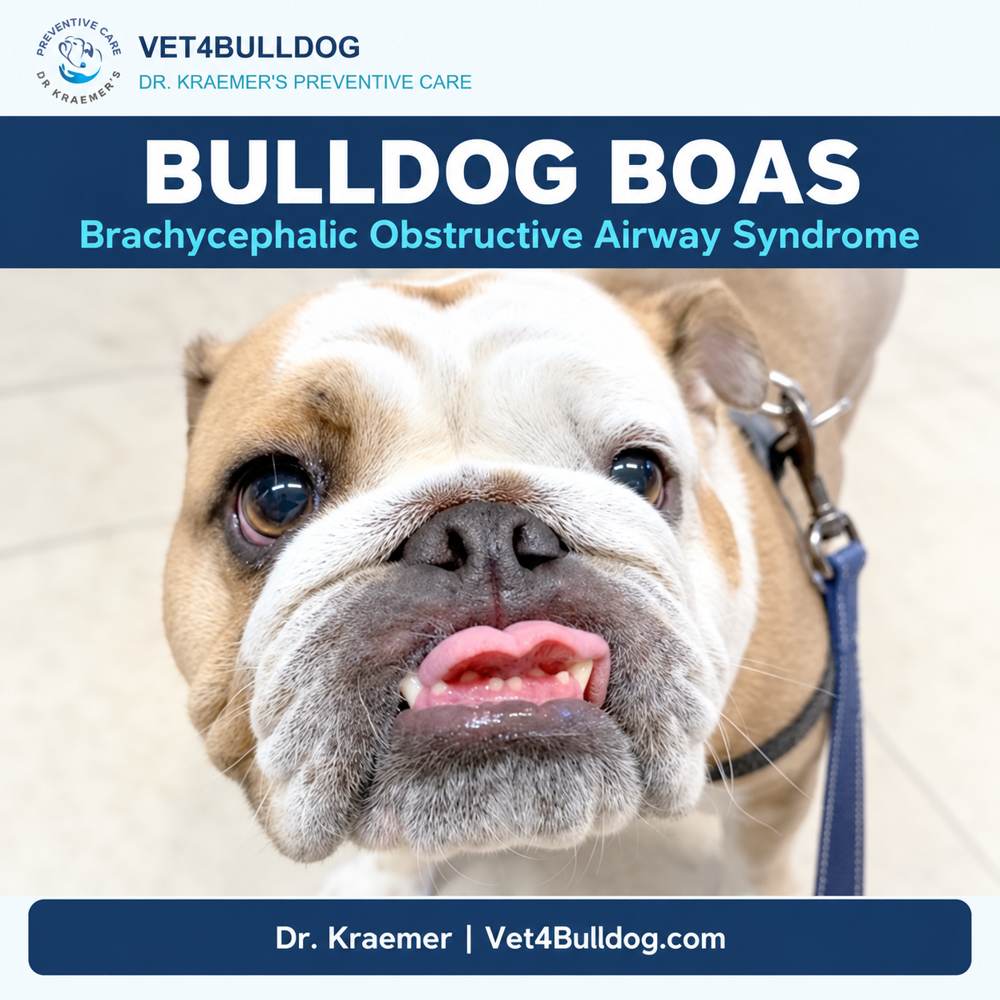
Bulldog hypoplastic trachea is a breathing and respiratory condition listed under the
brachycephalic obstructive airway syndrome (BOAS).
Bulldog Airway Problems Included in BOAS
- Stenotic Nares (Pinched nose)
- Elongated Soft Palate
- Everted Laryngeal Saccules
- Irreversible Laryngeal Collapse
- Blown up, prolapsed tonsils
- Large, thick tongue
- Swollen nasal turbinates
WARNING: Hypoplastic trachea will exacerbate other BOAS conditions
Bulldog Hypoplastic Trachea 5 X MUST KNOW
- It is a narrowing of the windpipe, an inborn condition unique to bulldogs
- Hypoplastic trachea is not the same as trachea collapse, a condition of small breeds
- If other BOAS are repaired early, hypoplastic trachea as a stand-alone is of little consequence.
- Management includes weight control, a stress-free environment, a cool temperature, and supplements
- Prevention & Care includes Dr. Kraemer’s Affordable Hypoplastic Trachea Bundles
Members of this bulldog community prefer prevention over RX
Hypoplastic Trachea in Bulldogs / CAUSE:
CONGENITAL: Hypoplastic trachea is an abnormally small diameter of your bully windpipe, it’s a
congenital inborn condition.
Trachea Collapse vs. Hypoplastic Trachea
Hypoplastic trachea is common only to the brachycephalic breed and is not the same as
trachea collapse, a condition common to miniature breeds.
Hypoplastic Trachea in Bulldogs and French Bulldog DIAGNOSIS
- Chest and neck radiographs
- Other:
- Blood work
- Pulse Oximeter.
- Blood Pressure
- Blood Gas Analysis
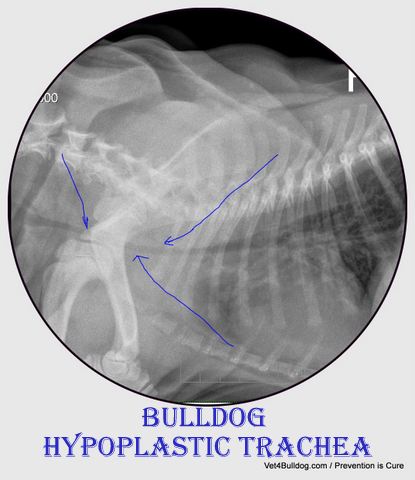
I get this letter more than almost any other, and it is usually the radiograph doing the scaring rather than the dog. A hypoplastic trachea looks dramatic on film. A narrow black stripe where a wide one should be is a striking picture, and a vet who does not see many bulldogs will read it as a grim finding. Here is what I would want to know about Tank before I accepted that prognosis: how does he actually breathe? Is he noisy at rest, does he tire on a short walk, does he retch or regurgitate, has he ever gone blue or fainted? The film does not answer any of that. The dog does. If Tank breathes reasonably well, a narrow windpipe on its own is something he has had since birth and has already adapted to, and it will not narrow further. What I would do next is not aimed at the trachea at all, because nothing can widen it. I would have his nostrils and his soft palate assessed, because those are fixable, and in a dog with limited reserve the value of fixing them is much higher than in a dog with a normal windpipe. Then the daily work: lean body weight, no exertion in heat, a raised bowl and a slow feeder if he retches, and calming support so excitement is not driving his breathing rate up. Get a second opinion from someone who works with bulldogs before you accept a short life expectancy for him.
Bulldog Hypoplastic Trachea PRESENTATION
- Labored, Noisy Breathing
- Snorting and Stridor
- Exercise intolerance
- Retching, Regurgitating, and vomiting
- Pneumonitis, Aspiration pneumonia
- Overheating
- Hypoxia and Cyanosis
- Sudden Collapse
Bulldog Hypoplastic Trachea PREVENTION
- BREEDING: Don’t breed dogs with known hypoplastic trachea and severe BOAS
- LEAN BODY WEIGHT: Weight Control
- EXERCISE: Avoid intense activity
- CLIMATE: Avoid Activity on a hot day
- FEEDING: raise the food bowl, use slow feeders
- SUPPLEMENTS: bully therapeutics
Bulldog Hypoplastic Trachea THERAPEUTIC BULLY SUPPLEMENTS
- Bully StressLess Chews
- Bully Immune Support
- Bully HEMP Calm & Relax
- Bully Probiotics and Digestive Enzymes

Hypoplastic Trachea in Bulldogs and French Bulldogs TREATMENT
MYTH vs. REALITY: Contrary to what your vet might tell you, hypoplastic trachea in bulldogs as a standalone airway condition is a usually a nonfactor.
BOAS SURGICAL REPAIR:
Most bulldogs with hypoplastic trachea and no other airway problems will live a relatively normal life, but if they have other existing BOAS problems like stenotic nares and elongated soft palate, the hypoplastic trachea will exacerbate them. Most times, it only becomes a factor when presented together with other BOAS conditions.
It is critical to repair all the primary BOAS problems and do so early.
Bulldog Hypoplastic Trachea TREATMENT
ANTI-VOMITING & ANTI-NAUSEA: If your bully is retching, vomiting, or regurgitating, you can add anti-emetics like Cerenia or Reglan
ANTI ACID & ANTI REFLUX: medication like Omeprazole and Pepcid AC
STEROIDS: (anti-inflammatory dosage): Short-term cortisone might help an acute episode.
TRANQUILIZERS: like Acepromazine
CALM & SOOTHING BULLY THERAPEUTICS :
Hypoplastic Trachea in Bulldogs DR. KRAEMER’S TIPS & WARNINGS
Bulldog Hypoplastic Trachea RADIOGRAPHS TIP:
Hypoplastic trachea is often diagnosed incidentally when chest radiographs are taken. It could look dramatic and scary; thus, your vet might give you a bad
prognosis or worse.
Remember, if other BOAS conditions are not presented or if they are repaired on time, the hypoplastic trachea impact on your bully’s life and life quality is
usually minimal.
Bulldog Hypoplastic Trachea FEEDING TIP
If your bully is retching, try to elevate the food bowl and use a slow feeder. See
the treatment section for anti-nausea and anti-reflux rx.
BULLDOG HYPOPLASTIC TRACHEA WARNING:
Brachycephalic breeds like bulldogs and French bulldogs typically suffer from
- Smooshed, compressed face
- Pinched nose
- Swollen nasal tissue
- Abnormal nasopharynx
All of which restrict and obstruct airflow and reduce oxygenation. As compensation, bulldogs must increase respiratory effort by producing higher airway negative pressure (suction). This section stresses the delicate pharyngeal and laryngeal tissue, the tongue, soft palate, and tonsils causing inflammation, swelling, tissue fatigue, prolapse, and collapse.
This chain of events gets worse day by day, further worsening the airway obstruction and ultimately leading to endstage irreversible damage and airway restriction. This in turn also increases vasovagal tone and intraabdominal pressure, which leads to retching, vomiting, and aspiration, commonly known as bulldog aspiration pneumonia.
Left untreated bulldog BOAS can tragically end in asphyxiation and death
Insider tip
Most hypoplastic tracheas are found by accident. The X-ray was taken for something else entirely, a cough, a pre-anesthetic check, a swallowed sock, and there it is. That matters, because a finding nobody went looking for is usually a finding that was not causing a problem.
Two practical things. First, ask your vet for the tracheal diameter relative to the thoracic inlet rather than a yes or no. It turns an alarming picture into a number you can track, and it tells you where your bulldog sits rather than simply that he is abnormal.
Second, tell every anesthetist before any procedure. A narrow windpipe needs a smaller endotracheal tube than the dog’s body weight suggests, and an anesthetist who does not know is an anesthetist reaching for the wrong tube. That single sentence from you is worth more than any supplement on this page.
Is a hypoplastic trachea the same as tracheal collapse?
Can it be fixed?
What are the signs?
How is it diagnosed?
Does it get worse with age?
Why does my bulldog retch and vomit?
What can I do at home?

Veterinary Care and Supportive Products
A hypoplastic trachea found on a radiograph is a reason to assess the whole airway, not a reason to despair. Ask your vet to examine the nostrils and to say whether the soft palate warrants assessment under sedation, and tell any anesthetist about the narrow trachea before a procedure so a smaller tube is prepared. No supplement widens a windpipe. What supplements do is reduce the anxiety, inflammation and reflux that make a narrow airway behave worse than it is.
The Hypoplastic Trachea bundles
- Hypoplastic Trachea Basic Bundle
- Hypoplastic Trachea Essential Bundle
- Hypoplastic Trachea ULTIMATE Bundle
More Help from Dr. Kraemer
The windpipe is one link in the chain. These cover the rest of it:
- BOAS, the whole picture
- Stenotic nares, the pinched nose
- Elongated soft palate
- Everted laryngeal saccules
- Aspiration pneumonia
- Anesthesia and sedation in Bulldogs
Trusted by Vets ~ Recommended by Owners ~ Approved by Bulldogs
Shop Hypoplastic Trachea Support →
References
- American College of Veterinary Surgeons. Brachycephalic Syndrome
- Merck Veterinary Manual. Tracheal Disorders in Dogs
- University of Cambridge. BOAS Respiratory Function Grading Scheme
To be clear: supplements or topicals are not substitutes for prescribed treatment. If your dog is unwell, is being treated for a condition, or is already on medication, review any supplement or topical with your veterinarian so it fits the plan you are already following. This page is educational and is not a diagnosis or a treatment plan for your own dog.