


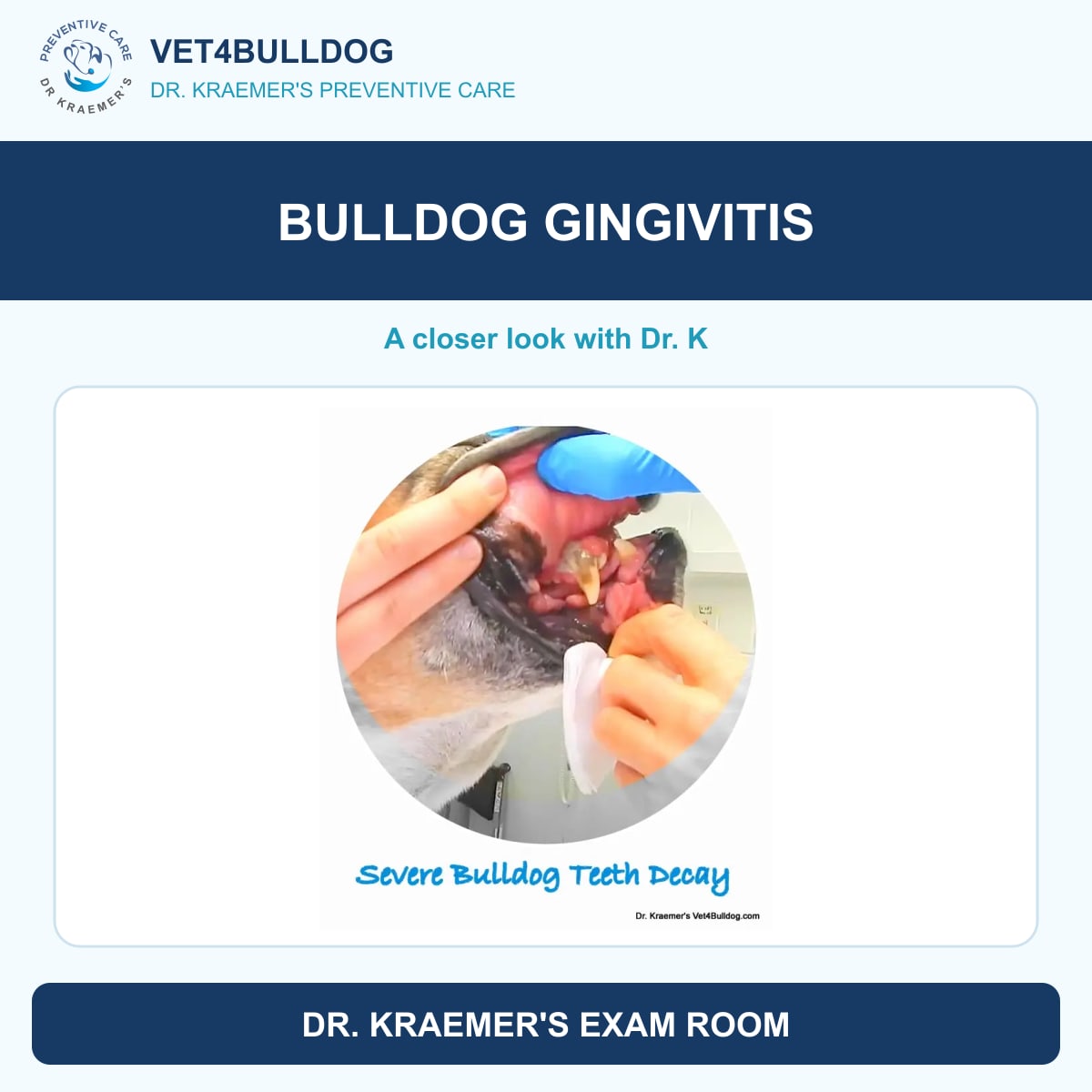
Gingivitis is the stage that still reverses. Once it becomes periodontitis and the bone starts going, nothing brings that bone back. The whole game is staying on the right side of that line.
Gingivitis is inflammation of the gum margin, and the cause is plaque: a film of bacteria that reforms on a clean tooth within hours. Left alone for a few days it hardens into tartar, and once it is tartar no amount of brushing will shift it. That short window is the reason dental care in this breed is a daily habit rather than an occasional project.
Bulldogs are dealt a poor hand here and it is structural, not neglect. The breed carries a normal number of teeth in a jaw that has been shortened, so teeth crowd, rotate and overlap, and every one of those overlaps is a sheltered spot where plaque sits undisturbed. Add an undershot bite and a tongue that works hard, and you have a mouth that accumulates faster than an ordinary one and is harder to clean.
The earliest thing most owners notice is breath, and it is worth taking seriously rather than treating as part of owning a Bulldog. The gums are telling you that bacteria are winning at the margin. At that point you can still turn it around.
The cause Brushing Wipes Water additive Veterinary care Prevention
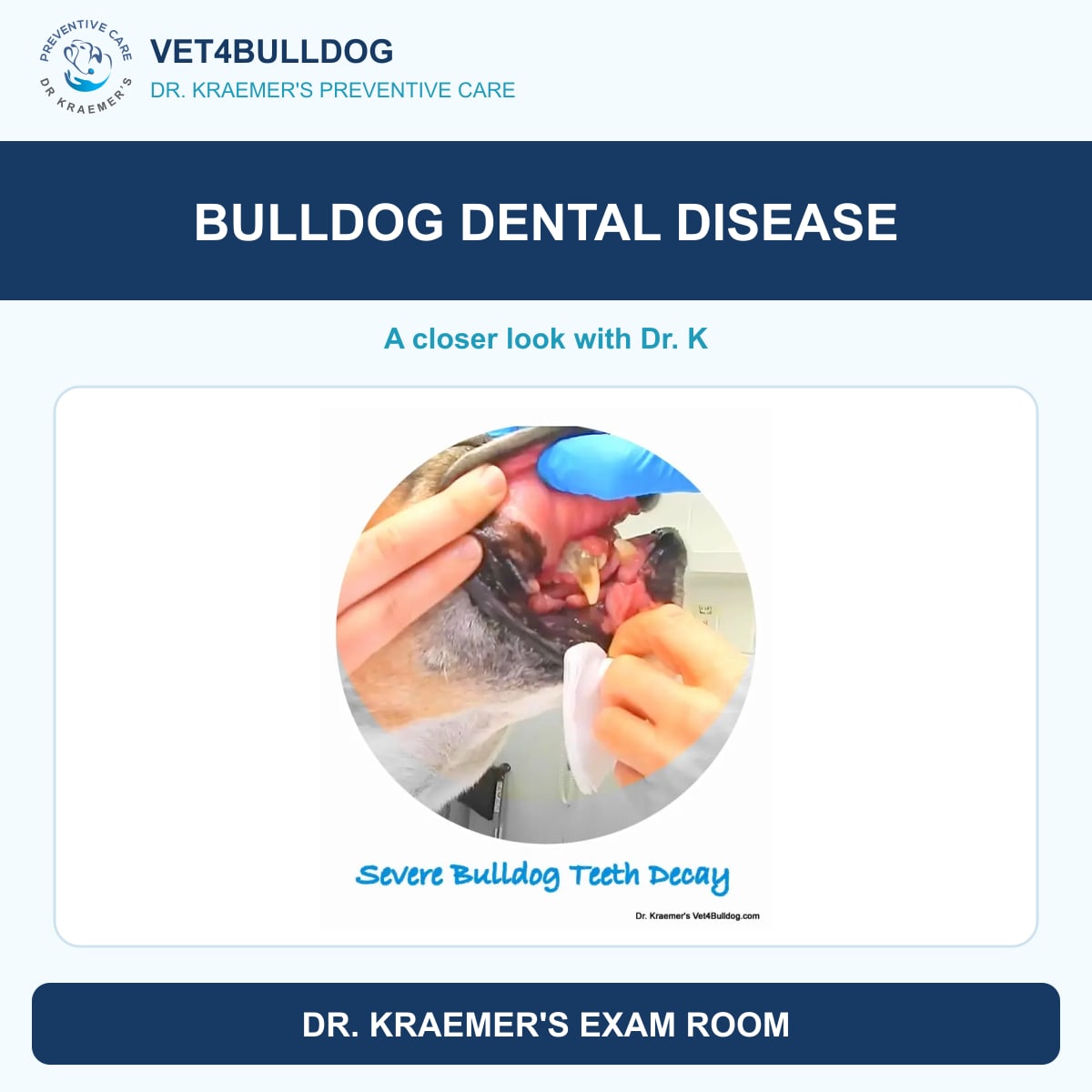
One of the most common and potentially harmful medical conditions seen in veterinarian’s offices is periodontal disease.
Bulldog periodontitis includes gingivitis, which is inflammation and redness of the gums due to an underlying tooth infection.
The harmful bacteria can spread and negatively affect your bulldog’s bodily function, systems, and vital organs.
Gingivitis in Bulldogs and French Bulldogs CAUSE:
Gingivitis and gum disease in bulldogs and French bulldogs are caused by bacteria build-up between the teeth and gum area.
Healthy bulldog gums lie tight and close against their teeth, If the gums are forced away from the teeth due to plaque and tartar, food and bacteria will lodge under the gum, an infection will form and periodontal disease will ensue.
Gingivitis in Dogs and Bulldogs Gum Disease in Pets FINDINGS:
- REDNESS: your bulldog gums’ normal pink color changes into a red-purple color
- SWELL: your bulldog gums will appear puffy and swollen
- BAD SMELL: your bulldog’s breath will have a pungent odor due to the bacterial infection
- SALVATION & DROLLING: Your bulldog might present with excessive production of saliva
- PAIN: your bulldog gums will appear sensitive and painful to touch. Pain can lead to depression, anxiousness, aggression, and a loss of appetite.
- BLEEDING GUMS: at times, your bulldog gums will bleed after eating, chewing toys, or teeth brushing.
The Brachycephalic (flat-faced) dogs like your bulldog and French bulldog, pugs, Pekingese, and boxers, are at increased risk of developing gingivitis due to the formation of their mouth and jaw and the crowding in the way their teeth are placed.
Gingivitis in Dogs and Bulldogs Gum Disease in Pets PREVENTIVE :
Gingivitis reverses. Periodontitis does not.
If you take one thing from this page, take the difference between the two words, because it decides what is still possible. Gingivitis is inflammation of the gum itself. Clean the plaque off properly and consistently and the gum settles down and recovers. Periodontitis is what comes next: the attachment and the bone around the tooth root start to be destroyed, and that is not reversible. You can halt it, you can manage it, you cannot grow the bone back. So every conversation about dental care in this breed is really a conversation about which side of that line your dog is on today.
Why Bulldogs lose this race more often than other dogs is anatomy rather than owner failure. The breed has a normal set of teeth fitted into a jaw that has been shortened, so the teeth crowd, rotate and lean against each other. Every overlap is a sheltered pocket where plaque is left in peace, and plaque is a living film that re-establishes on a clean tooth within hours. Give it a few days undisturbed and it mineralizes into tartar, which is cemented on and no longer brushable. That is the whole mechanism, and it is why frequency beats effort here.
So brushing is the gold standard and I am not going to pretend otherwise, because it is the only thing that physically disrupts the film where it forms. Daily is the target. Every other day is noticeably weaker, and twice a week is close to decorative. Everything else in the dental category, the wipes, the water additives, the chews, exists to narrow the gap on the days when brushing does not happen, which in a real household is many of them. I would rather an owner used a wipe every day than planned to brush and managed it on Sundays.
Now the warning I would most like Bulldog owners to hear, because it is sold hard and it misleads people. Anesthesia free dental cleaning, sometimes offered by groomers or at events, scrapes the visible part of the tooth and leaves the part that matters untouched. Periodontal disease lives below the gum line, inside the pocket, and nothing can be properly cleaned or even assessed down there in a conscious dog. What you buy is a whiter looking tooth sitting above a problem that is still progressing, and the tidy appearance is exactly what delays the real treatment. It is also not a comfortable experience for the dog.
A proper assessment means x-rays and probing around each tooth under anesthesia, and I know anesthesia is the word that worries Bulldog owners most. That concern is legitimate and it is about the airway rather than the dentistry, so it is a reason to choose your practice carefully and to talk through their monitoring and their brachycephalic protocol, not a reason to settle for the cosmetic version. A mouth is not assessable from the outside. Bone loss is invisible until it is severe.
One last breed specific thing, and it is peculiar to Bulldogs and often missed entirely. These dogs lick and groom intensely, and hair gets worked down under the gum margin where it sits as a foreign body and keeps the inflammation running. You can clean such a mouth diligently and watch the gums stay angry, because the irritant is buried rather than on the surface. If that sounds like your dog, it is worth reading the subgingival hair page and raising it specifically, since it is the kind of thing somebody has to look for deliberately.
BULLDOG DENTAL MECHANICAL BRUSHING:
Any soft, yellowish-brown plaque should be brushed and scraped off before it is allowed to set harden, and turn into calculus (tartar).
BULLDOG DENTAL ANTISEPTIC WIPE:
Wipe your bulldog subgingival hair, food particles and raw gums with Dr. Kraemer’s V4B Bulldog anti-septic dental wipe
BULLDOG DENTAL SPLASH:
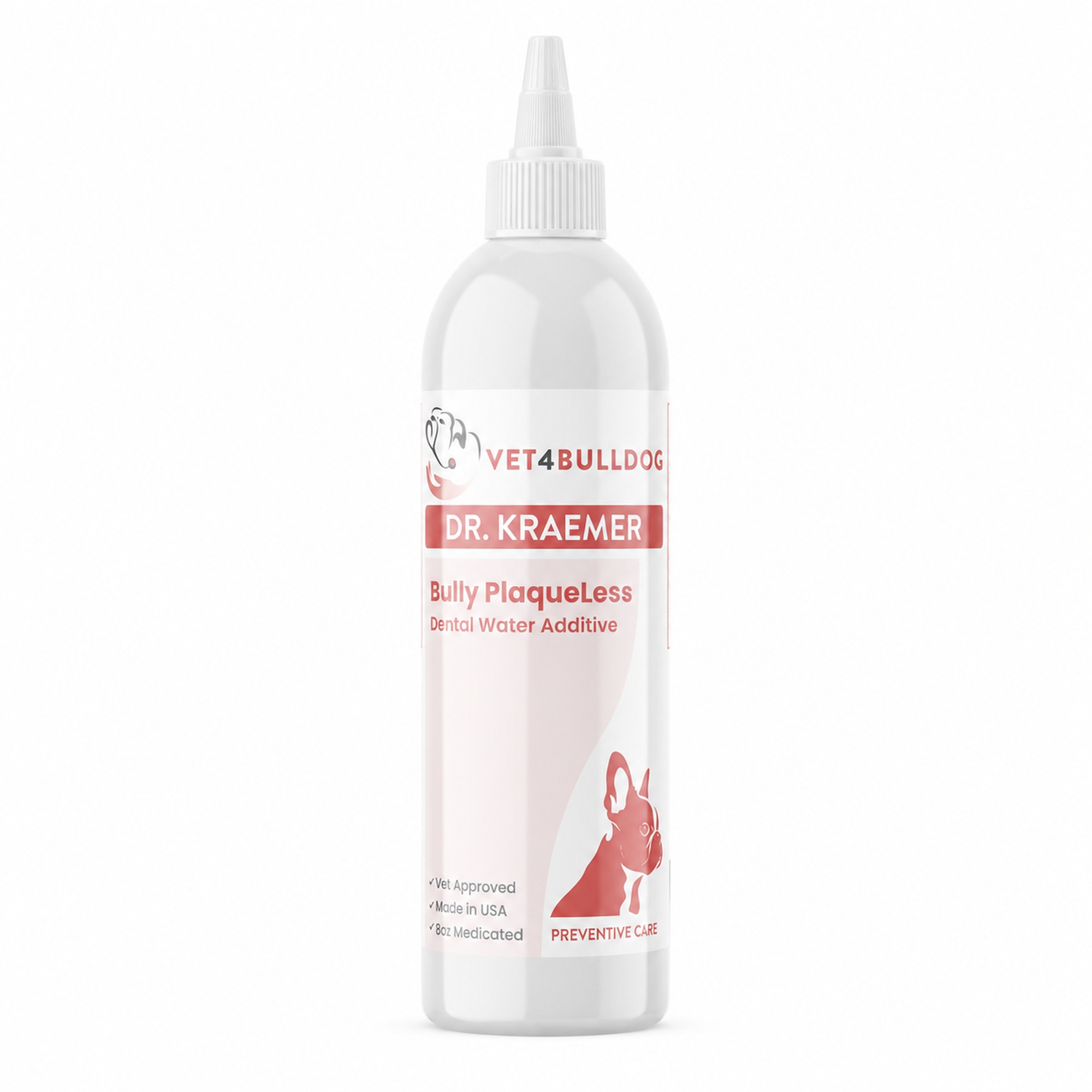
Add your bulldog water to Dr. Kraemer’s V4B Bulldog Dental Aqua Splash formula to help reduce plaque and provide a freshened breath.
BULLDOG DENTAL PLAQUE LESS CHEWS:
Treat your bulldog with Dr. Kraemer’s V4B Bully Hygiene PlaqueLess Dental Chew. For your bully dental health and halitosis.
Gingivitis in Bulldogs and French Bulldogs VETERINARY CARE:
If you believe that your bulldog or French bulldog puppy has gingivitis, you should seek help from your veterinarian. Leaving the condition untreated could allow bacteria to spread through the dog’s bloodstream to set on a potentially life-threatening condition.
Bulldog inflamed rosy gums are a “flushing red signal” to an underlining dental disease
Once your veterinarian has identified gingivitis and the underlying dental condition, they might recommend anesthesia and conduct professional cleaning, scaling, and polishing.
Often, dental radiographs would be recommended to help identify disease below the gum line.
Gingivitis in Bulldogs and French Bulldogs WELLNESS:
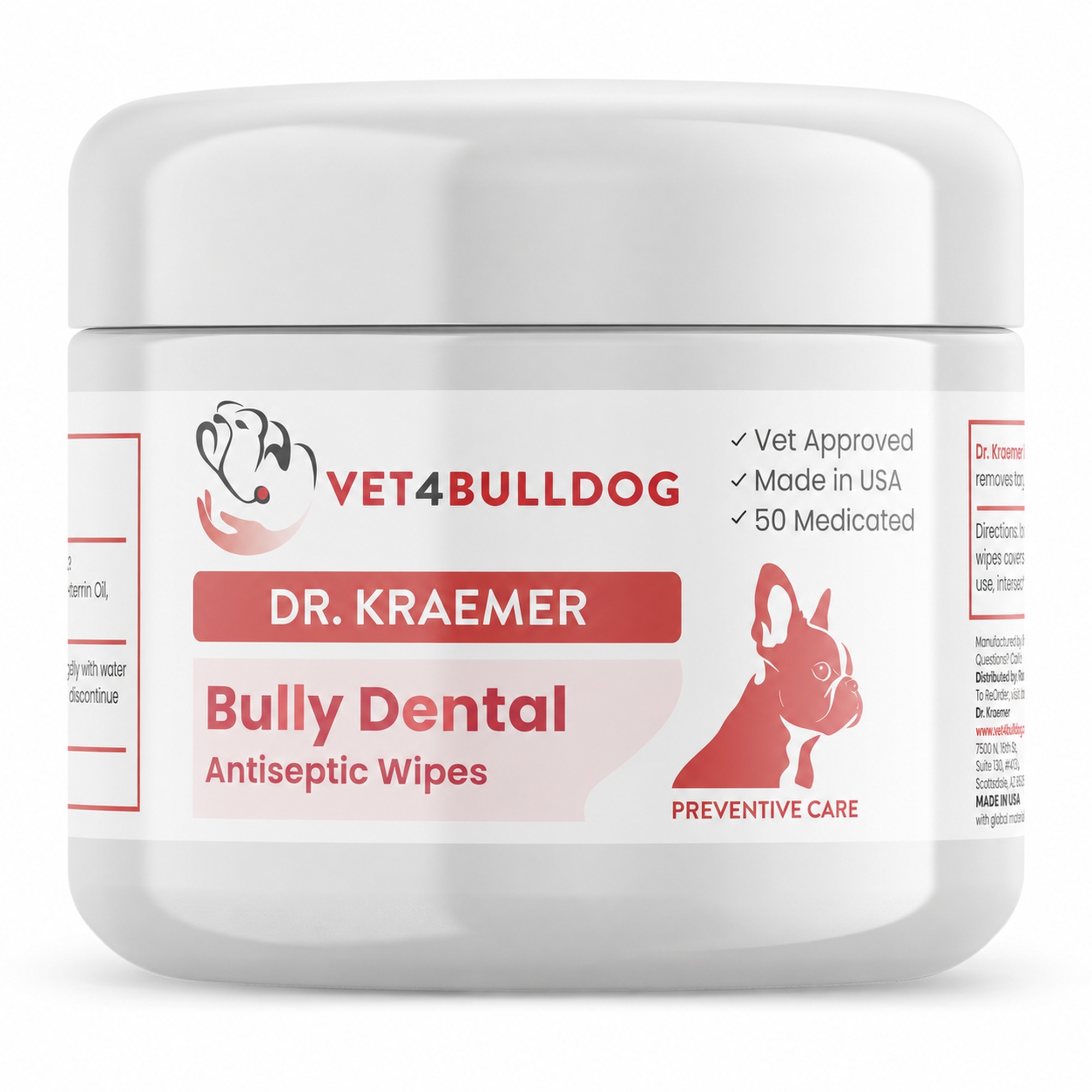
Let me be straight about where this sits. A toothbrush is better, and if you are brushing daily you do not need me to sell you anything. These are topicals, so they belong alongside whatever your veterinarian has advised rather than instead of it, and if your dog already has established gum disease the treatment decision is theirs and not a shopping decision.
What a wipe is genuinely good for is frequency, which is the thing that actually decides this. Plaque reforms within hours, so a mouth wiped every day is in better shape than a mouth brushed properly once a week, and a wipe takes a fraction of the time and co-operation. In a crowded Bulldog mouth it reaches along the gum margin where the trouble starts. If you would rather work on this from several directions, the water additive asks nothing of the dog at all, and the dental chews do a little good through chewing. None of them removes tartar once it has hardened. That part is a cleaning under anesthesia.
To be clear: supplements or topicals are not substitutes for prescribed treatment. If your dog is unwell, is being treated for a condition, or is already on medication, review any supplement or topical with your veterinarian so it fits the plan you are already following. This page is educational and is not a diagnosis or a treatment plan for your own dog.
BULLDOG DENTAL GINGIVITIS PREVENTION:
Gingivitis can be prevented, by regular teeth brushing combined with Dr. Kraemer’s V4B Bully Dental Preventive economic bundles.
This simple, inexpensive practice will help keep your bulldog puppy free of cavities, dental disease, the associated pain, and the related systemic disease.
Reversible: when caught in time, and by providing timely scaling & polishing, gingivitis is reversible.
Bulldog gingivitis: quick answers
Is gum disease in my Bulldog reversible?
Gingivitis is. Periodontitis is not. That distinction is the whole thing. While the inflammation is confined to the gum, consistent plaque removal lets the gum recover fully. Once the destruction has reached the attachment and the bone around the root, you are managing and halting rather than reversing, because that bone does not come back. Nobody can tell you which stage your dog is at by looking in his mouth from the outside, which is why the assessment involves x-rays and probing. The useful attitude is to assume the window is still open and act accordingly.
How often do I really need to brush his teeth?
Daily, and the reason is biology rather than fussiness. Plaque is a living film that re-establishes on a clean tooth within hours, and it hardens into tartar in a matter of days. Brushing daily keeps interrupting it before it sets. Every other day is noticeably less effective. Twice a week is close to decorative. I would far rather you did something quick every single day, a wipe or a rinse, than planned a thorough brushing you manage at the weekend. Frequency beats thoroughness here, and in this breed it beats it badly.
What about anesthesia free dental cleaning? It sounds safer.
I would avoid it, and this is one of the few places I will be blunt. Periodontal disease lives below the gum line, and nothing down there can be cleaned or even assessed in a conscious dog. What the procedure does is scrape the visible surface of the tooth, so you pay for a whiter looking crown sitting on top of a problem that carries on progressing underneath, and the tidy appearance is what delays the treatment that would have helped. It is also unpleasant for the dog, who has to be restrained for it. If the worry behind the question is anesthesia in a flat faced breed, that worry is reasonable and the answer is to choose a practice you trust and ask them directly about their monitoring and their protocol for brachycephalic dogs.
His breath is terrible but his teeth look white. Is he fine?
Not necessarily, and this combination is common enough to be worth explaining. The part of the tooth you can see is the crown, and a crown can look perfectly respectable while the trouble is in the pocket beside the root where you cannot see. Odor is produced by bacteria, and the bacteria that matter in gum disease are the ones living below the margin. So white teeth and bad breath is not a contradiction, it is a fairly typical picture, and it is a reason to have the mouth looked at properly rather than a reason to relax.
Why are Bulldogs so much worse at this than other dogs?
Because the jaw was shortened and the teeth were not. The breed carries a normal complement of teeth in a compressed space, so they crowd, rotate and overlap, and each overlap is a sheltered spot where plaque sits undisturbed by the tongue, by chewing, or by a brush that cannot easily reach it. The undershot bite adds to it. None of this is your fault and none of it is fixable, which is why the advice for a Bulldog is more frequent and more deliberate than the advice for a dog with a long muzzle. It is a maintenance breed in this respect, like the skin folds.
I clean his teeth and the gums still look angry. What am I missing?
Possibly something buried. Bulldogs lick and groom hard, and hair can be worked down under the gum margin where it behaves as a foreign body and keeps inflammation running no matter how well the surface is cleaned. It is a genuinely breed specific problem, it does not show up unless somebody looks for it deliberately, and it is covered on the subgingival hair page on this site. Worth raising by name at your next visit. The other possibilities are tartar that has already hardened below the margin, or a tooth that is further gone than it looks, and both of those need the mouth examined properly rather than cleaned harder.
Does bad gum disease affect the rest of him?
A mouth with established infection is not a sealed compartment, and your dog swallows that material all day and carries bacteria into the bloodstream through inflamed gum tissue. I am going to be careful about how far I take that, because the detail of what it does elsewhere in the body is still argued over in the literature and I would rather not overstate it. What is not in dispute is the local picture: ongoing infection, discomfort, destruction of the bone holding the teeth in, and eventually teeth that are lost. That alone is reason enough to treat it properly, without needing to reach for anything grander.
Recommended by Owners Approved by Bulldogs