
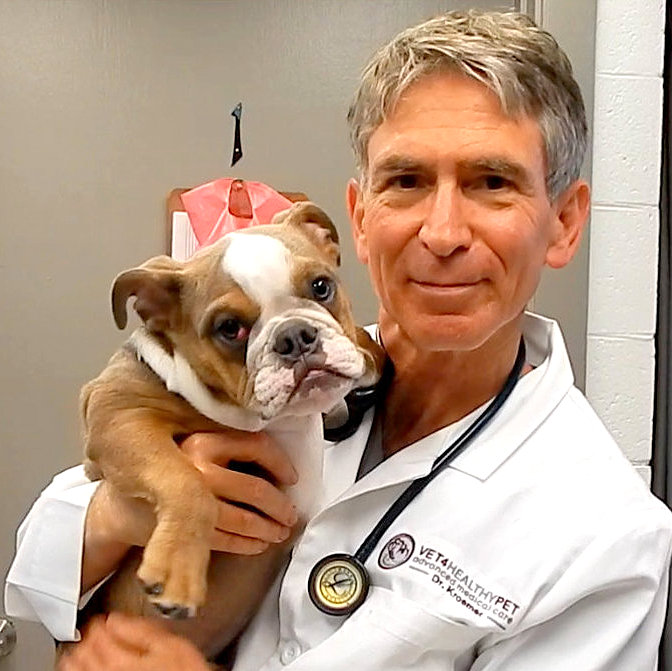


A click plus a slight limp in a Frenchie is MPL until proven otherwise, and you are right that the breed is an exception to the small dog rule. The first thing to establish is not whether she has it but what grade she has, because that is what decides everything. It is a hands on diagnosis: I palpate the knee and feel whether the kneecap can be pushed out, whether it goes out on flexion, whether it is sitting out most of the time, or whether it will not go back at all. That is grades one to four, and from grade 2 upward I would be discussing surgery, preferably early. The reason for early is blunt: every luxation scrapes cartilage, and once arthritic change is established, surgery is much less likely to leave her with a pain free leg. Ask for radiographs of the pelvis, both knees and the tibias, not just the sore side, because MPL is usually bilateral and it very often sits alongside hip abnormality. In the meantime, keep her lean, keep her walking on the flat for muscle tone, get joint and comfort supplements into her daily, and stop the stairs, the sofa jumping and the frisbee. One last thing, and it matters if you were thinking about a litter: this is heritable, and dogs with MPL should not be bred.
Introduction to Medial Patella Luxation (MPL) in French Bulldogs
Medial patella luxation (MPL) is more commonly associated with small breed dogs, but English Bulldogs and French Bulldogs are notable exceptions. Despite not fitting into the small breed category, they are characterized by their distinctive physical appearance, including a broad, squat frame and short legs. They are prone to several orthopedic issues, with MPL being a significant concern.
MOST COMMON BULLDOG ORTHOPEDIC CONDITIONS
Bulldog MPL is frequently diagnosed at a very young age
Bulldog MPL Injuries: 5 X MUST KNOW
- MPL is a kneecap that clicks out of its groove and is often diagnosed in young bulldogs
- MPL has a genetic and a breed conformational origin
- MPL is graded from 1 to 4; grades 2 and above should be repaired surgically
- Treatment includes weight control, joint supplements, pain management, and surgical repair.
- Prevention includes Dr. Kraemer’s Joint and Ligament Care Bundles
Welcome to our “Prevention Over RX” bulldog community

Anatomy of MPL in Bulldogs and French Bulldogs
The patella, commonly known as the “kneecap,” is crucial to your Bulldog’s knee joint mechanics. It is a small sesamoid bone embedded within the tendon of the quadriceps muscle group, located at the front of the thigh. The patella helps facilitate the smooth movement of the knee joint, protects it from injury, and improves the leverage of the quadriceps muscles, which are essential for walking, running, and jumping.
1. BULLDOG MPL EXTENSOR MECHANISM
The primary function of the patella is to increase the leverage of the quadriceps muscle tendon, enhancing the knee joint’s extension ability. This is crucial for normal walking, running, and jumping activities.
- Quadriceps Muscles: These are the large muscle groups at the front of the thigh responsible for extending the knee. Their force is transmitted through the patella and its tendon.
- Patella: The kneecap, or patella, acts as a fulcrum to increase the leverage of the quadriceps muscles, making knee extension more efficient.
- Patellar Tendon: This tendon connects the patella to the tibia (shin bone), allowing the force from the quadriceps to extend the knee.
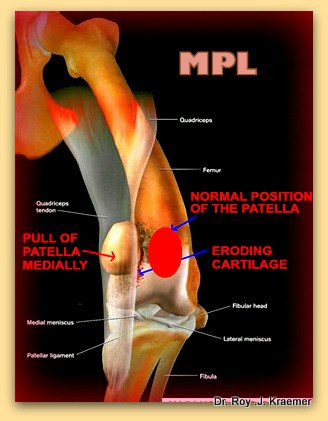
The extensor mechanism, which includes the patella, its tendon, and the quadriceps muscles, is vital for the functioning of your Bulldog’s knee joint. This system enables knee extension, allowing your dog to walk, run, jump, and perform other movements with ease and stability. It ensures smooth, efficient motion by coordinating muscle contraction and joint alignment, making it essential for your dog’s mobility and overall joint health.
2. BULLDOG and FRENCH BULLDOG MPL ALIGNMENT
When the structures of the extensor mechanism are improperly aligned, it can cause significant problems with the function and stability of the knee joint. This misalignment may lead the major thigh muscles, particularly the quadriceps, to exert a pulling force toward the medial (inner) side of the leg. This abnormal tension can compromise the knee joint’s stability and potentially cause the patella to shift medially, leading to
- pain
- skipping
- lameness
- abnormal gait

Bulldogs and French Bulldogs MPL DISEASE PROCESS:
When the patella, or kneecap, of your bulldog puppy, frequently luxates (pops out of place) and then relocates back into its normal position, it disrupts the natural and smooth movement of the knee joint, leading to:
- Interrupted Gliding Motion: When the patella luxates medially (towards the inside of the leg), the smooth vertical groove motion is interrupted, leading to mechanical wear and tear on the joint.
- Cartilage Degradation: Each time the patella pops out of place, it can scrape against the bones of the knee joint, damaging the protective cartilage that covers and cushions the ends of these bones.
- Bone-on-Bone Movement: As the protective cartilage wears away, the underlying bones can come into direct contact during movement. This bone-on-bone friction is not only painful but also exacerbates the degradation of the joint, speeding up the progression of arthritis and Degenerative Joint Disease (DJD).
- Arthritis and DJD: Arthritis is characterized by joint inflammation and pain due to the progressive loss of cartilage, leading to joint pain, stiffness, and reduced mobility. These conditions can significantly impact your Bulldog puppy’s quality of life, causing discomfort and limiting their ability to move and play.

What Causes MPL in Bulldogs and French Bulldogs?
The cause is partially due to genetic predispositions and conformational abnormalities specific to breeds, as well as the breed’s unique skeletal structure
1. BULLDOG GENETICS & CONFORMATIONAL MPL CAUSE
- MPL SHALLOW GROOVE: a trochlear groove that isn’t deep enough.
- WEAK PATELLAR LIGAMENT: The lateral patellar ligament is weakened and elongated, a situation that often stems from the aforementioned shallow groove.
- LOWER ATTACHMENT: The final concern arises when the point where the patellar ligament attaches to the tibia, or shinbone, is positioned too medially (towards the inside).
Bulldog MPL is a multi-factorial condition

2. BULLDOG MPL DUE TO TRAUMA:
Trauma is less common and can happen at any age.
3. BULLDOG MPL DUE TO HIP LUXATION:
Abnormal conformation of the hip joint is common in bulldogs, such as hip dysplasia, hip subluxation, and hip total luxation. 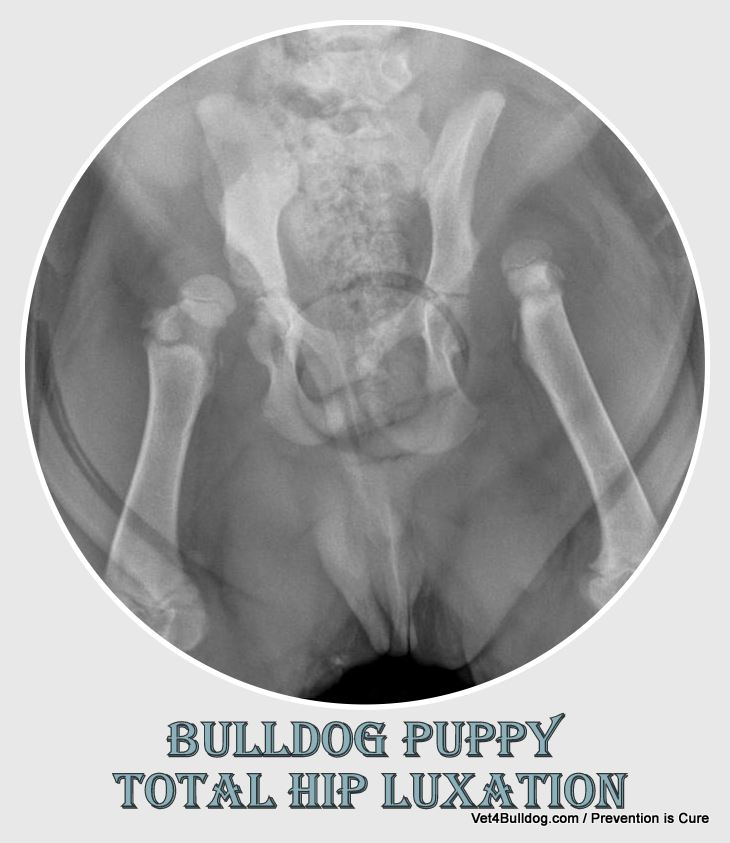
4. BULLDOG MPL DUE TO MALFORMATION
- Malformation of your bulldog’s femur, with abnormal angulation.
- Malformation of your bulldog’s tibia.
5. BULLDOG MPL DUE TO DEVIATION AND TIGHTNESS
- Deviation of your bulldog’s tibial crest, the bony prominence onto which the patella tendon attaches below the knee.
- Tightness/atrophy of your bulldog puppy’s quadriceps muscles, acting as a bowstring.
- A patellar tendon that may be too long or too short.
Medial Patella Luxation in Bulldogs / DIAGNOSIS:

- EXAM: Primarily, bulldog patellar luxation is diagnosed during the orthopedic exam with the help of knee palpation.
- LIMP: favor, non-weight bearing
- SKIPPING & BUNNY HOPPING
- BOW-LEGGED
- IMAGING: Radiographs are usually taken to help evaluate the knees and hips
The “pop” heard, felt, or sensed during the knee palpation is associated with the luxating kneecap
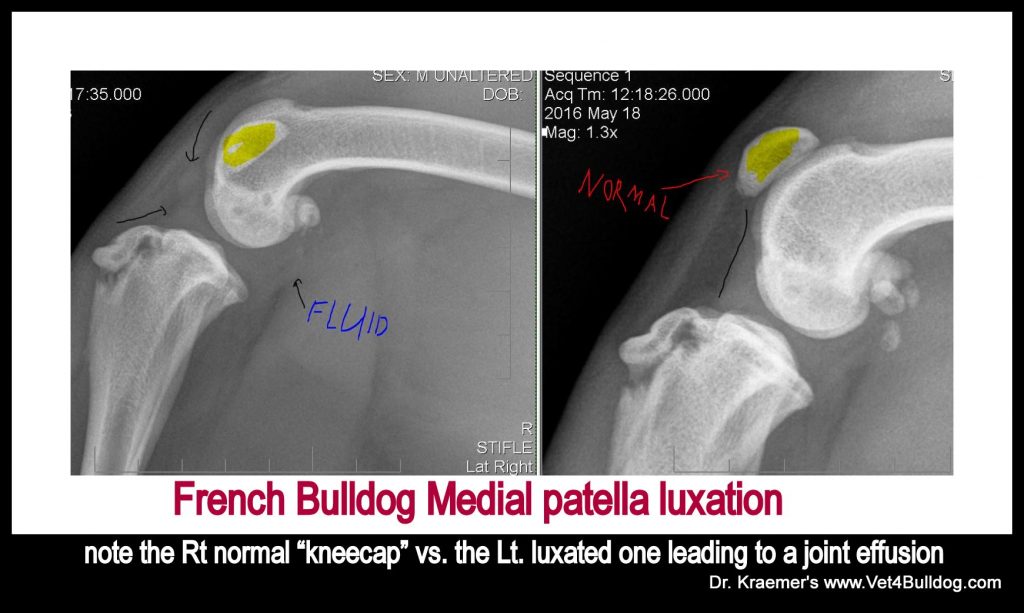
MPL Grading in bulldogs and French bulldog puppies
The severity of medial patella luxation in bulldogs and French bulldogs (MPL) has been graded on a scale of one to four, based on an orthopedic examination
- BULLDOG MPL GRADE 1:Your bulldog puppy’s patella can be manually luxated when the leg is extended and the patella is pushed over, but will go back into place when released.
- BULLDOG MPL GRADE 2:Your bulldog puppy’s patella sits loosely in its normal position but will luxate medially when the leg is flexed. The reduction is possible with manipulation; a “hopping” gait is generally noted in this case.
- BULLDOG MPL GRADE 3:Your bulldog puppy’s patella is displaced medially (to the inside) most of the time, but can be reduced manually when the leg is extended.
- BULLDOG MPL GRADE 4:Grade 4 patellar luxation occurs when your bulldog puppy’s kneecap is permanently displaced medially and cannot be manually repositioned. Dogs with this condition often display a hunched posture, and in some cases, their legs may appear bowlegged.
Surgery is recommended for most bulldog MPL Grade 2 and above.

Medial Patella Luxation in Bulldogs and French Bulldogs: PREVENTIVE & CARE
1. Weight Control:
Keeping your bulldog and French bulldog puppies lean and trim will help prevent these problems from getting worse.
2. Muscle tone:
Encourage walking to maintain a lean body, muscle support, good circulation, and blood supply.
3. BULLDOG THERAPEUTIC SUPPLEMENTS:
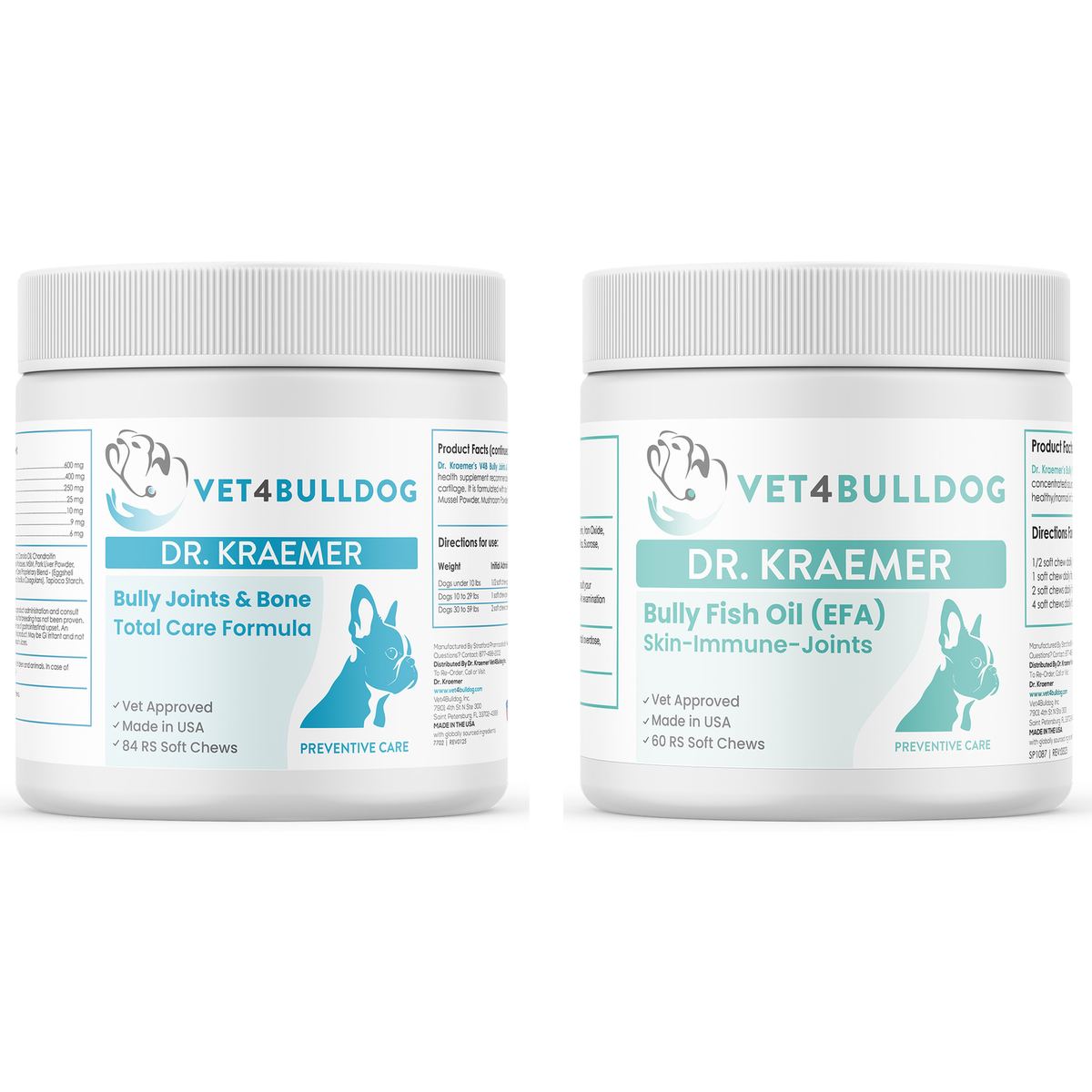
Joint, Bone, & Pain Relief Supplements for Bulldog MPL
- Dr. Kraemer’s V4B Total Joint Care for Advanced Osteoarthritis
- Dr. Kraemer’s V4B Omega-3 Fish Oil for Joints-Immune-Skin
- Dr. Kraemer’s V4B Comfort Plus Extra Strength Formula
These supplements are formulated with natural anti-inflammatory and soothing agents that aid in the healing and repair of injured joints. They are suitable for long-term use and can reduce the reliance on prescription medications and their associated potential side effects.
Avoid daily upstairs climbing, sofa jumping, skateboarding, and frisbee fetching.
We offer a LOW-COST Economic MPL & ARTHRITIS BUNDLES

Medial Patella Luxation in Bulldogs: SURGICAL REPAIR
MOST COMMON BULLDOG ORTHOPEDIC CONDITIONS
Surgery is recommended for Grade 2 MPLs or worse, preferably as early as a few months of age. The course of action that needs to be taken depends on the knee’s structure and how abnormal it is, no two cases are exactly alike.
BULLDOG MPL MOST COMMON SURGICAL REPAIR:
Three surgical procedures are used to treat patellar luxation. One or several of the following strategies may be required to correct your bulldog puppy’s patella luxation:
➡️ MPL RECONSTRUCTION:
Reconstruction of soft tissues surrounding your bulldog’s knee cap to loosen the side toward which the patella is riding and tighten the opposite side.

➡️ MPL DEEPENING:
Deepening of the femoral groove so that your bulldog’s kneecap can sit deeply in its normal position.
➡️ MPL TRANSPOSING:
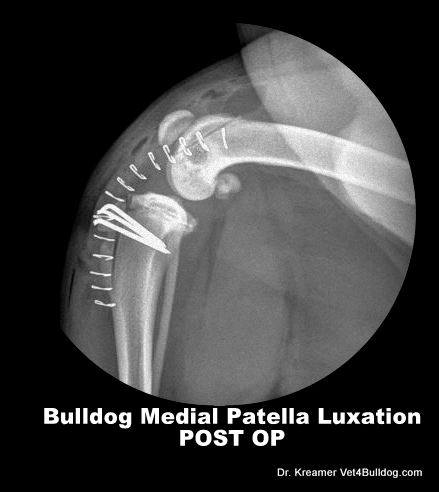
Transposing the tibial crest, the bony prominence onto which the tendon of the patella attaches below the knee. The tibial crest is moved in the opposite direction of the luxation and reattached to the bone with a pin. This will help realign your bulldog’s quadriceps, patella, and tendon. 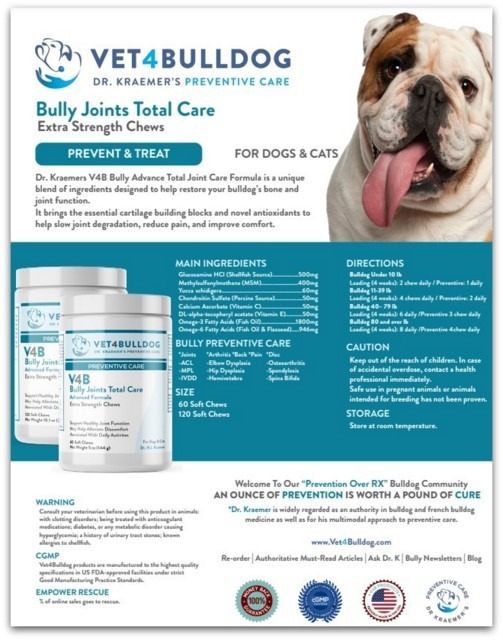
BULLDOG MPL SURGERY TIMING:
🚨Early surgery can prevent the onset of arthritis and other knee injuries

BULLDOG MPL SURGICAL REPAIR PROGNOSIS:
Prognosis is excellent, and your bulldog puppy should regain full use of its legs
Avoid daily upstairs climbing, sofa jumping, skateboarding, and frisbee fetching.
MPL in Bulldogs and French Bulldogs TIPS & WARNINGS:
Below are selected MPL tips and warnings courtesy of Dr. Kraemer
#1 🩺BULLDOG MPL ALTERNATIVE THERAPY TIP:
Alternative therapeutics for healing and pain relief modalities include cutting-edge
- In-house Stem Cell Therapy
- Cryobanking
- Platelet Rich Plasma (PRP),
- Cold Laser Therapy
- Pulse Electromagnetic Therapy (PEMF).
Most of our customers opt to combine one or a few of these non-pharmaceutical, anti-inflammatory, healing, pain relief, and new-age modalities with surgical repair. 
#2 🩺BULLDOG MPL SURGERY TIP:
For the patella not to jump out of its track, the groove (trochlear) must be made deep enough to accommodate and cradle the patella as it moves up and down in the groove.
#3 🩺BULLDOG MPL CONGENITAL TIP:
Bulldogs with medial patella luxation may either have a congenital form of the condition, meaning they are born with it, or they develop it due to a misalignment of the extensor mechanism during their development. These abnormalities collectively influence the shape and contour of the bones as the puppy grows, ultimately impacting the alignment and function of the knee joint.
#4 🩺BULLDOG MPL BOWLEG TIP:
Many bulldogs and French bulldog puppies exhibit a characteristic “bow-legged” stance, where their hind limbs are positioned wider apart. This stance can lead to increased inward pressure on the knee joint, as the muscles of their thighs exert force on the patella, pulling it towards the inside of the knees. This inward load is often exacerbated by the presence of dysplastic hips, which can further contribute to abnormal forces within the knee joint.
#5 🩺BULLDOG MPL HIP PROBLEMS TIP:
The issue in bulldog and French bulldog puppies can originate from the hip, where there may be coxa vara and decreased anteversion of the femoral head and neck. Essentially, this means there is a reduced angle of inclination between the femoral longitudinal axis and the femoral neck, along with a lesser caudal to cranial angle of the femoral neck. These skeletal abnormalities in growing bulldog puppies displace the extensor muscles of the hind limb, primarily the quadriceps group. This displacement of muscles affects the distal femoral physis, also known as the growth plate, leading to impaired growth on the medial side and accelerated growth on the lateral side of the distal end of the femur. The net effect is medial bowing and rotation of the distal extremity femur and the proximal extremity of your bulldog puppy’s tibia.
#6 🩺BULLDOG MPL LAMENESS TIP:
Clinical signs associated with patella luxation vary greatly with the severity of the disease. It might start as just a brief limp for a few steps, and, as the disease progresses in duration and severity, this lameness becomes more frequent.
#7 🩺BULLDOG MPL TRAUMA TIP:
On very rare occasions, patellar problems are the result of direct or strain injuries to the kneecap or accidental trauma to the knee joint that tears the collateral ligaments that keep the patella moving in line.
#8 🩺BULLDOG MPL RADIOGRAPHY:
Most times, the diagnosis of bulldog patella luxation is based on palpation during an orthopedic examination. Nevertheless, radiographs of the pelvis, knee, and tibias are always recommended.
#9 🩺MPL PAIN-FREE WARNING:
Once arthritic changes have developed, surgery is much less likely to produce a pain-free leg.
#10 🩺BULLDOGS BILATERAL MPL:
The luxation is medial (inward) in most cases, and often both knees are affected.
#1 ⚠️ MPL ARTHRITIS WARNING:
Every time the kneecap rides out of its groove, cartilage, which is the lining of bones within joints, is damaged, leading to osteoarthritis and pain.
#2 ⚠️ MPL FEMORAL GROOVE WARNING:
It is our experience that, left alone, the abnormal alignment of the patella may also aggravate the shallowness of the femoral groove and lead to deformation of the leg.
#3 ⚠️ MPL IN BULLDOGS ACL TEAR WARNING:
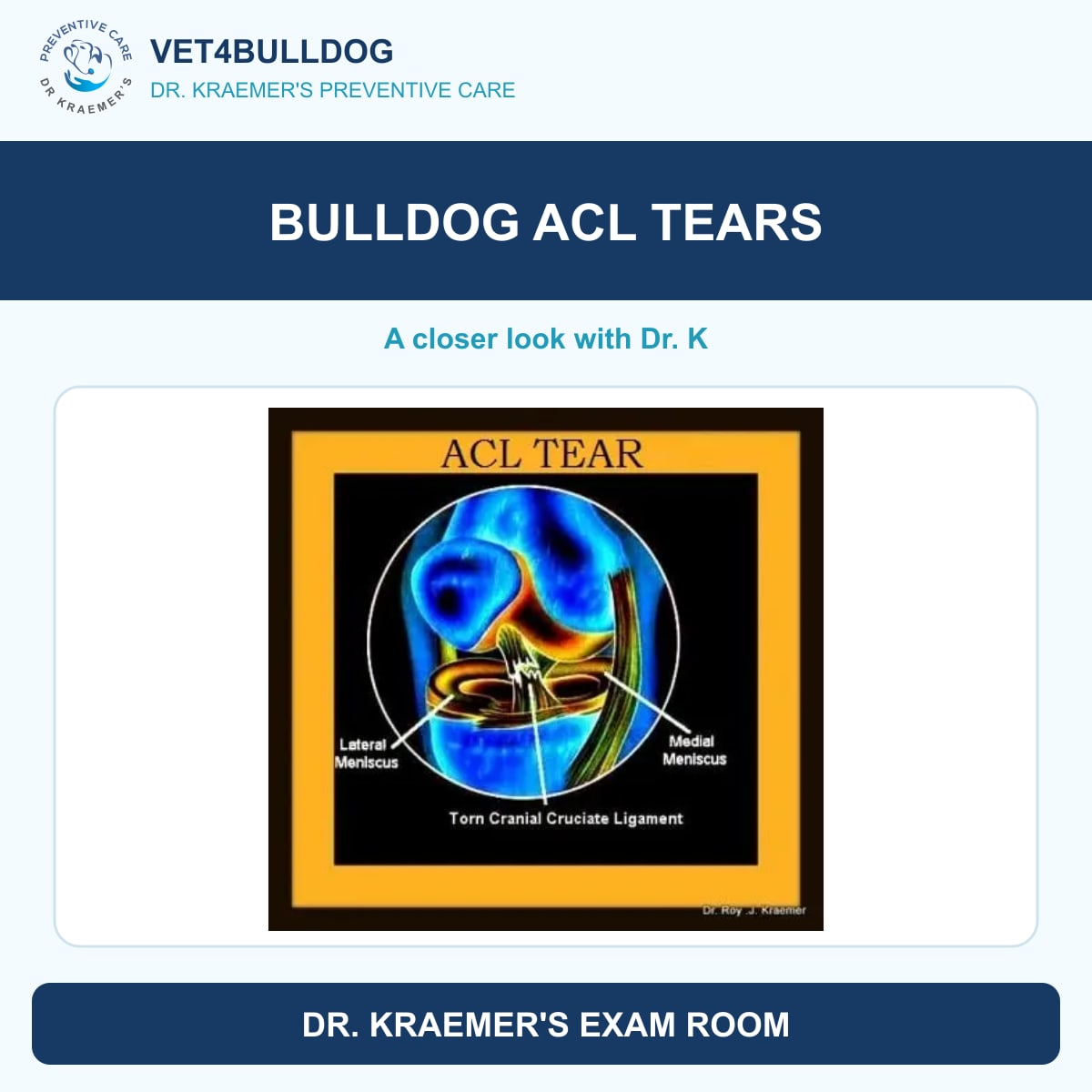
The abnormal positioning of the kneecap destabilizes the knee joint, causing an imbalance in weight distribution and placing increased stress on the inner part of the knee. This imbalance predisposes bulldogs to a rupture of their cranial cruciate ligament (often referred to as an ACL tear). When this ligament is torn, bulldogs typically experience significant discomfort and may stop using the affected limb altogether.
#4 ⚠️ MPL IN BULLDOG BREEDING WARNING:
We know that bulldogs and French bulldogs who have this problem tend to pass it on to their puppies, therefore, it is not recommended to breed those dogs.
Insider tip
What is that clicking and skipping?
Why do Bulldogs get it if it is a small breed problem?
What do the four grades mean?
Does it need surgery?
What happens if we leave it?
Is there a link with ACL tears?
What can I do at home?

Veterinary Care and Supportive Products
MPL is diagnosed by hand, so a proper orthopedic examination is the whole ballgame, with radiographs of the pelvis, both knees and the tibias, because the luxation is usually bilateral and frequently sits alongside hip abnormality. Grade 2 and above should be repaired, and earlier beats later. No supplement realigns a kneecap. What supplements do is slow the cartilage loss and manage the pain in the years either side of that decision.
The Orthopedics Vital Bundle

More Help from Dr. Kraemer
MPL rarely stands alone in a bulldog. These are the conditions it travels with:
- ACL tear in Bulldogs and French Bulldogs
- Hip dysplasia in Bulldogs and French Bulldogs
- Elbow dysplasia in Bulldogs and French Bulldogs
- Bulldog arthritis and arthritic pain
- Stem cell therapy for dogs and cats
- Platelet rich plasma therapy (PRP)
About the Author
Roy Kraemer, DVM, is a veterinarian with extensive clinical experience caring for Bulldogs and French Bulldogs. His educational work emphasizes hands on orthopedic diagnosis, early intervention before arthritis sets in, responsible breeding, and prevention over prescription.
Trusted by Vets ~ Recommended by Owners ~ Approved by Bulldogs
References
- American College of Veterinary Surgeons. Patellar Luxation
- Merck Veterinary Manual. Patellar Luxation in Small Animals
- Orthopedic Foundation for Animals. Patellar Luxation Registry