

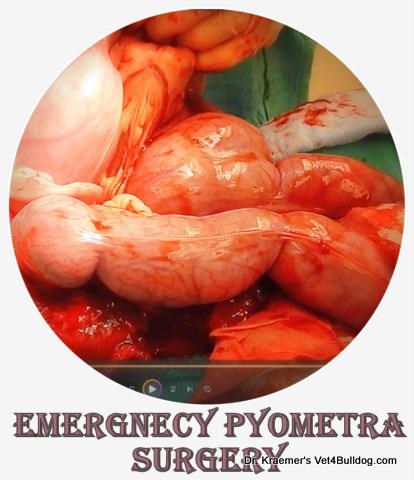
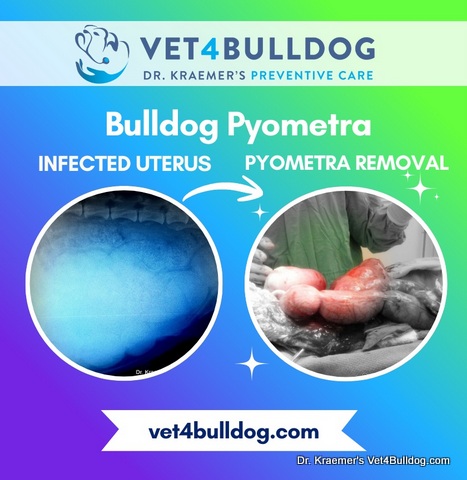
Pyometra Uterus Infection in Bulldogs / CAUSE:
Pyometra is a condition that occurs only in intact (unspayed) females.
Here are the most common causes:
- Urinary Tract Infections (UTIs): While UTIs do not cause pyometra, the bacteria from a UTI can ascend beyond the urinary tract, contributing to the condition.
- Vaginal Skin Fold Dermatitis: Infections can also originate from the area around the vulva or due to inflammation and infection in your bulldog vaginal skin folds, that may eventually reach the urinary tract and uterus.

UTERUS INFECTION AND THE HEAT CYCLE
Pyometra commonly develops about two months after an intact female dog experiences her heat. Pyometra is linked to the pregnancy hormone progesterone; the uterus is most susceptible to infections during peak progesterone.
This susceptibility increases as your bulldog ages, making older, intact bulldogs more at risk.
If pyometra is not promptly addressed, the infection and associated toxins can lead to:
- 1. systemic infection
- 2. sepsis
- 3. organ failure
- 4. tragic death
Uterus Infection Pyometra in Bulldogs / TYPES:
There are two types of pyometra: a milder “open” and a more serious “close” one.
OPEN PYOMETRA UTERUS INFECTION
Open indicates an open cervix, which allows the pus to exit the body and drain out of the uterus. This type is characterized by visible pus draining from the vaginal opening.
The discharge is typically
- thick
- smelly
- sticky and stringy
- yellow pus and sometimes bloody
CLOSED PYOMETRA UTERUS INFECTION
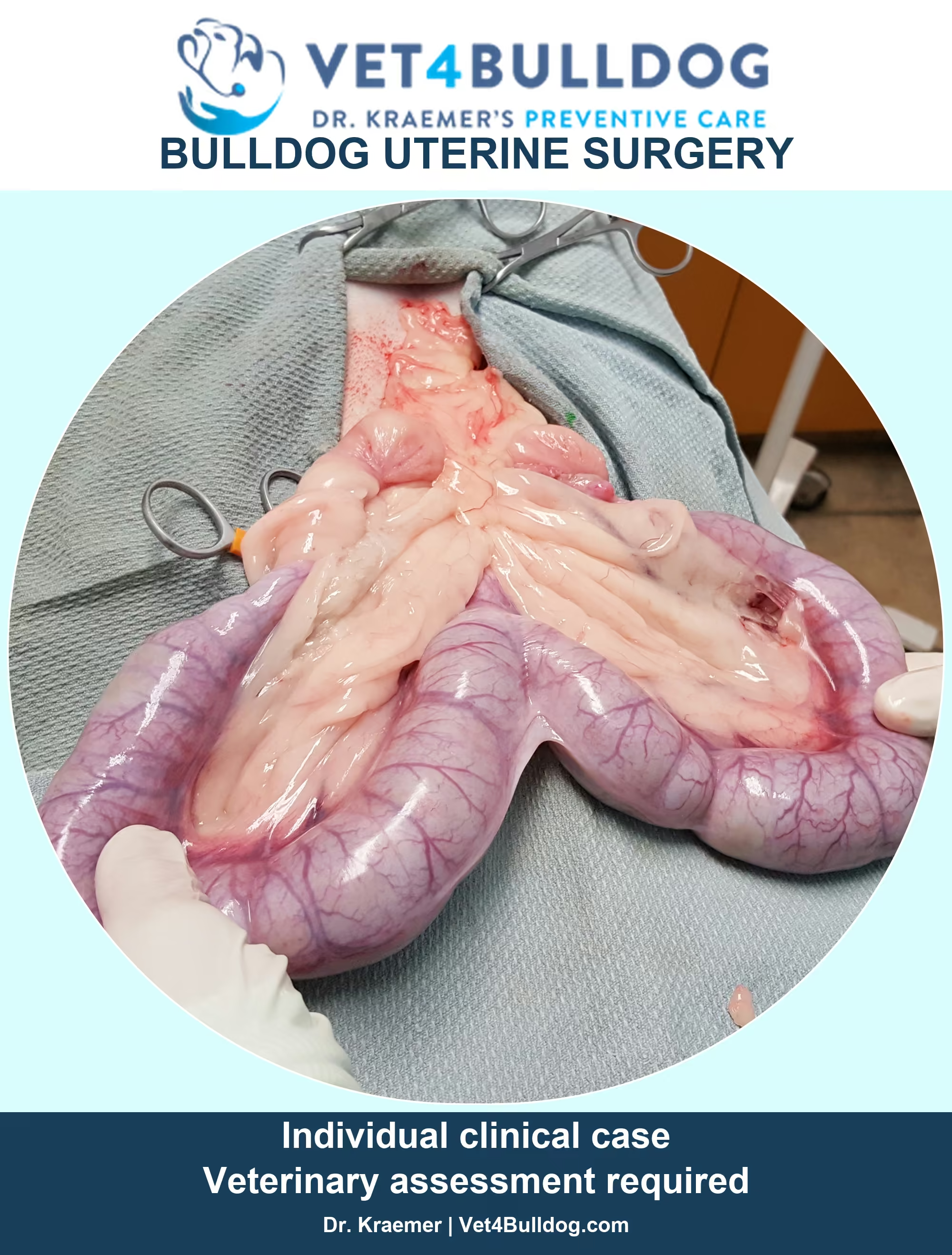
With the cervix closed, no pus drains out, making it harder to detect the infection. This lack of external symptoms means the condition often remains unnoticed until the pet becomes ill. As the disease progresses, pus accumulates, filling the uterus and expanding it to a dangerous size. This toxic, septic buildup not only stretches the uterine walls but also threatens significant damage, compromising the integrity and function of the uterus. The trapped infection increases the risk of systemic illness, making timely intervention crucial to preventing life-threatening complications.
Pyometra Uterine Infection in Bulldogs / DIAGNOSIS
- Dr. Exam:
- Time of last heat
- Vaginal inspection
- Vitals: temperature, heart rate, pulse, etc
- Abdominal palpation: large, tight abdomen in closed pyometra
- Lab Test
- CBC: abnormal WBC count
- Chemistry: liver, kidneys, etc
- Urine
- Imaging:
- Radiograph: closed pyometra will have a large pus-filled uterus
- Ultrasound

From Dr. Kraemer’s exam room
The one that gets missed, and why
If I could put one idea from thirty years of practice onto this page, it would be this. The dangerous version of pyometra is the quiet one.
Owners are sensible people working from sensible assumptions, and the assumption is that a serious infection announces itself. When the cervix is open it often does, and those cases tend to arrive promptly because there is something visible that prompts the phone call. When the cervix is closed there is nothing to see at all. The infection has no way out, the dog looks merely under the weather, and a reasonable owner decides to see how she is in the morning. That decision, made in good faith, is the one that costs.
So I would rather you treated the combination as the alarm rather than any particular sign. Unspayed, recently in season, and suddenly not herself. Those three together earn a telephone call the same day, and a veterinarian would far rather see a dog who turns out to be fine than the alternative.
And if you are reading this having already waited a day or two, do not sit with that. Ring now. What matters is the next hour, not the last one.
Pyometra Uterine Infection in Bulldogs / PREVENTION
Preventing pyometra focuses significantly on proactive measures that eliminate or substantially reduce the risk of this serious condition.
Here are key strategies:
1. ELECTIVE SPAY
Elective spaying (ovariohysterectomy) is the most effective method to prevent pyometra.
2. VAGINAL AND PERIVULVAR HYGIENE
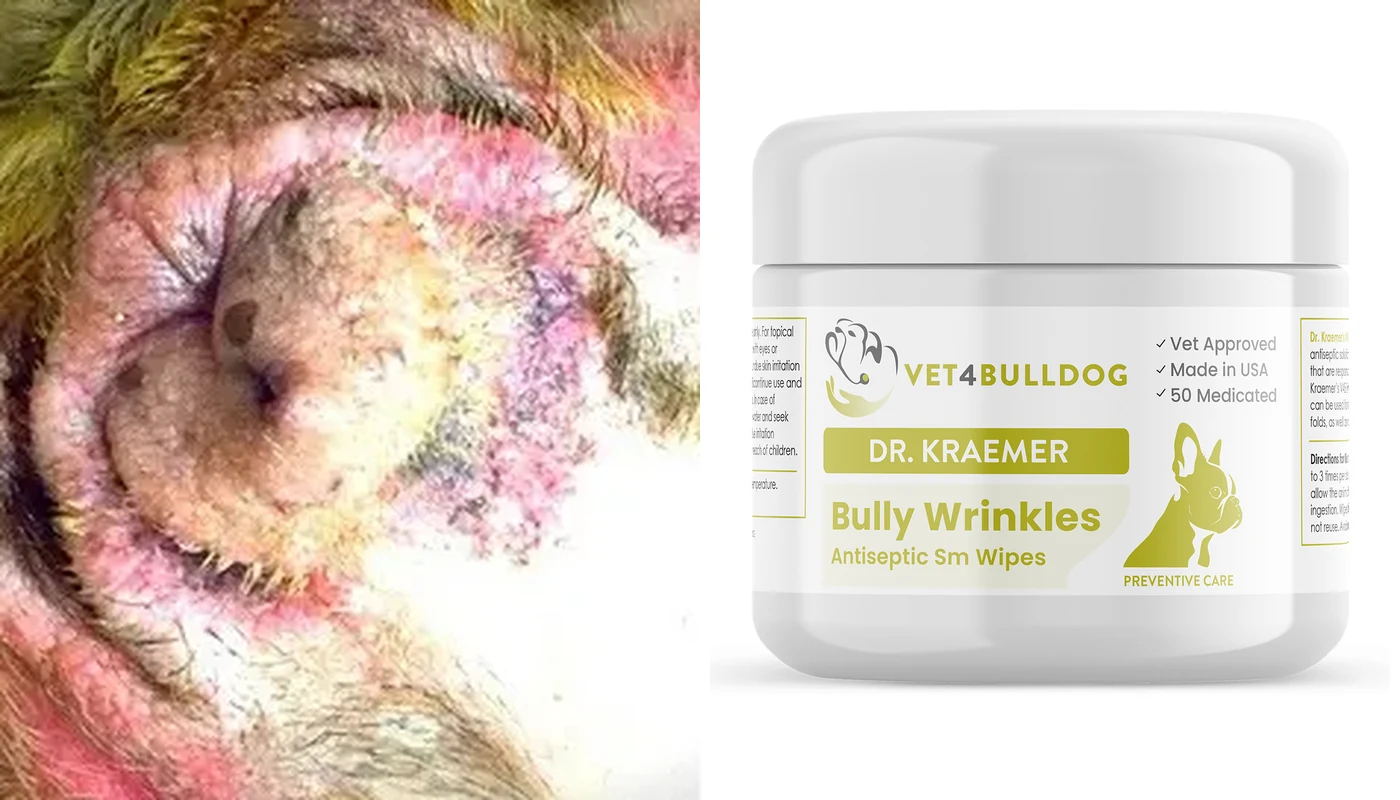
Maintaining cleanliness around the vaginal area may help prevent bacteria from ascending into the uterus. This is particularly important for bulldogs with deep skin folds, hooded vulva, and infected tail pocket, who may be more susceptible to infection. Daily inspection and wiping with bully antiseptic wipes are critical

3. BALANCED NUTRITIOUS DIET
A balanced diet supports overall health and strengthens the immune system. Proper nutrition is crucial for keeping an animal’s defense mechanisms robust against infections.
4. UTERUS INFECTION IMMUNE SUPPORT:
Ensuring your pet’s immune system is strong and managing stress. A healthy immune system can fend off the initial stages of many infections, including those that could lead to pyometra.
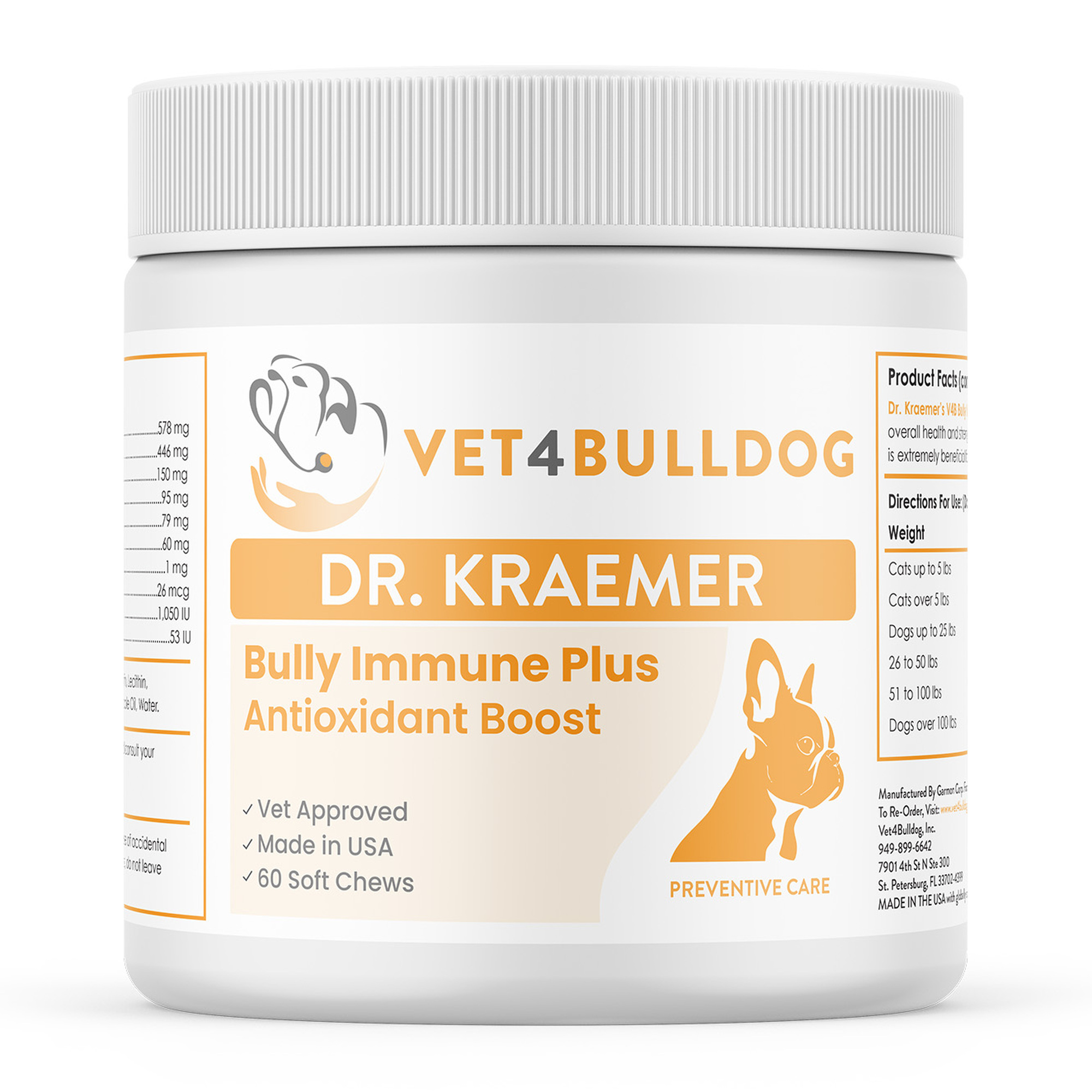
BULLY THERAPEUTIC SUPPLEMENTS PYOMETRA PREVENTION
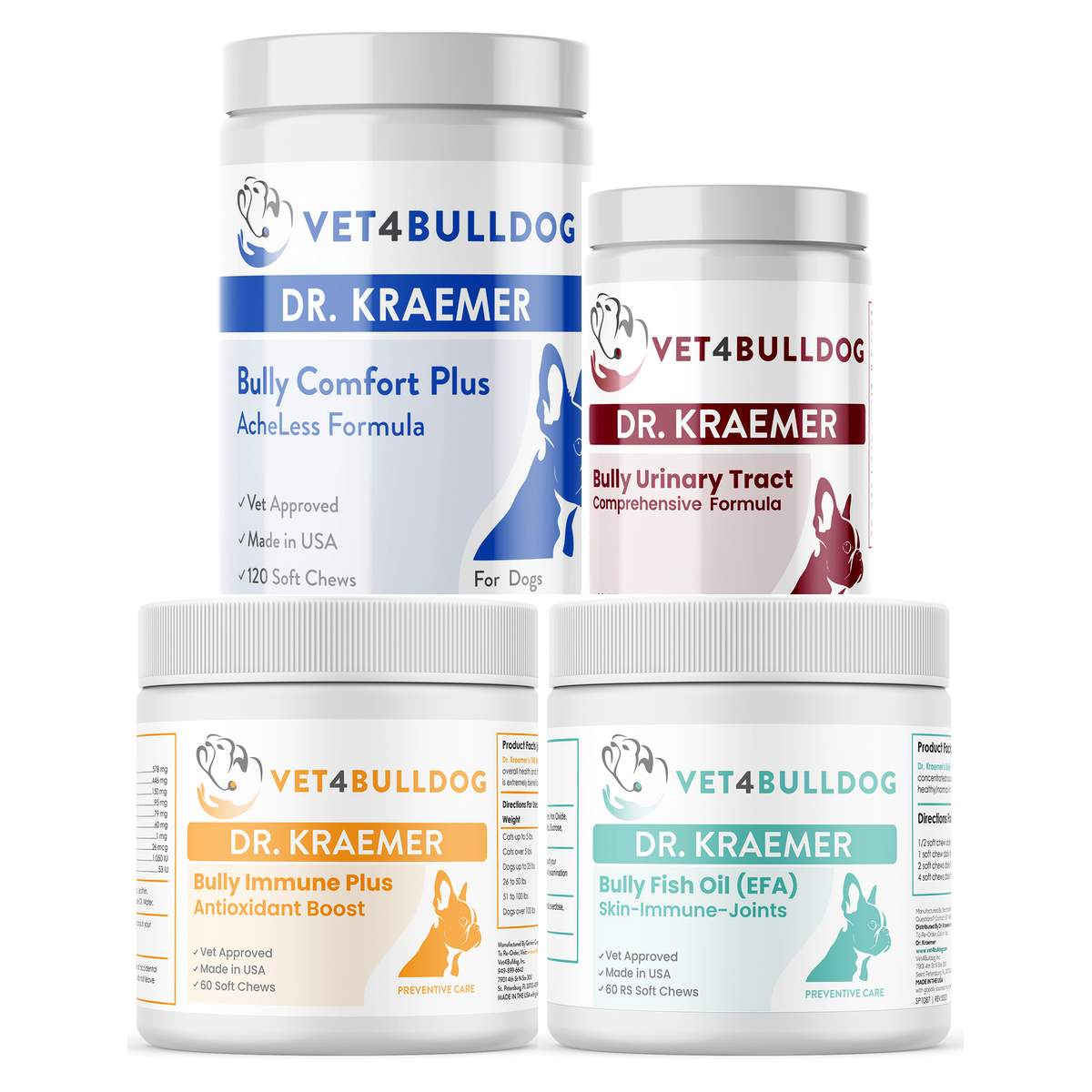
Certain supplements can bolster a dog’s immune system and urinary tract health
- Bully Fish Oil EFA: anti-inflammatory and immune properties
- Bully Probiotics: can support gut health?
- Bully Urinary Health: protect the urinary system from infections
Uterine Infection Pyometra in Bulldogs / TREATMENT
Pyometra in bulldogs is a grave and potentially fatal condition. The most effective standard of care involves surgically removing the infected uterus to eliminate the source of infection and its accompanying dangers.
HORMONAL THERAPY
While hormonal therapy can be tried in bulldogs intended for breeding, it’s generally discouraged due to its limited effectiveness and high risk of the condition recurring.
ANTIBIOTIC TREATMENT
Antibiotics may offer some success in managing open pyometra or when surgery isn’t viable because of the dog’s health issues.
PYOMETRA SURGICAL REMOVAL
The preferred approach to treating bulldog pyometra involves surgically removing the infected reproductive organs along with their toxic contents, significantly mitigating associated risks. However, it’s important to note that, unlike a routine elective spay, the removal of an infected reproductive tract, particularly in cases of closed pyometra, presents a greater challenge and carries numerous risks. These risks include:
- Bleeding: The surgery can lead to significant bleeding. In pyometra cases, the blood vessels of the ovaries and uterus are often engorged, which complicates the process of ligating them and increases the risk of bleeding.
- Contamination: There’s a risk of contaminating the surgical field if the pus-filled uterus leaks during removal. This is especially concerning in closed pyometra, where the uterus is can be large and filled with infection.
- Anesthesia Risks: The illness from pyometra can exacerbate the risks associated with anesthesia. Bulldogs with pyometra are often in a weakened state, dehydrated, ill and sometimes septic; therefore, the stress of surgery can pose additional risks.
- Surgical Challenges: In some instances of closed pyometra, the uterus may occupy almost the entire abdominal cavity, necessitating a wide incision for removal. This not only makes the surgery more complex but also increases the surgical time, recovery time, and risk of complications.
- Compromised Uterine Wall: The wall of the uterus may be compromised, ruptured, or easily torn, raising the possibility of pus leaking into the abdominal cavity and contaminating adjacent organs. This scenario poses a significant risk of peritonitis and can be life-threatening.
Given these challenges, the timing of the surgery, adequate support measures (such as intravenous fluids and antibiotics), and surgical expertise are critical to the success of the treatment. A veterinarian with experience in emergency and critical care surgery as well as bulldog anesthesia protocols is often required to manage the complexities of bulldog pyometra surgery effectively. The collaboration between the pet owner and the veterinary team is essential to navigating these risks and ensuring the best possible outcome for the dog.
The preferred method of treatment is the surgical excision of the reproductive organs (ovariohysterectomy).
RISKS ASSOCIATED WITH PYOMETRA SURGERY SUMMARY:
- bleeding
- anesthesia
- surgical duration
- contamination of the surgical field
- degree of difficulty compared to routine spay
- recovery time
Uterine Infection Pyometra in Bulldogs / PROGNOSIS
When the surgery to treat pyometra is successful, the prognosis is generally excellent, as the source of the problem, the infected uterus, is removed. This surgical intervention not only addresses the immediate threat to the dog’s health but also eliminates the risk of recurrence of pyometra since the reproductive organs that could become infected are no longer present.
Recovery from surgery typically involves post-operative care, including pain management, antibiotics to prevent secondary infections, and careful monitoring for any signs of complications. Most dogs show significant improvement within a few days after surgery, with a return to normal activities and behavior as they recover.

One thing takes pyometra off the table, and it is spaying. No chew, no supplement and nothing marketed for immune support changes whether this happens. On most pages of my site I argue that prevention beats prescription. On this one the prevention is a surgical decision made with your veterinarian, and the honest thing is to say so rather than sell around it.
If she is already unwell, the only useful thing on this page is the telephone. Please act on that rather than on anything in my shop.
Where my range has a real job is afterwards. A dog coming through emergency surgery is often an older girl, usually on antibiotics, frequently off her food and generally knocked about by the whole experience. Support for a gut that antibiotics have been through, something to help her settle, and general support for an older body doing the work of recovery. These may help her through a rough stretch. They treat nothing, they prevent nothing, and they complement what your veterinarian has prescribed rather than replacing any part of it.
If that is what you need, the urinary and reproductive support range is the place to look. Tell your veterinarian what she is on, especially while she is still on medication.
To be clear: nothing here prevents, diagnoses or treats pyometra. Pyometra is a veterinary emergency and both diagnosis and treatment belong with your veterinarian. This page is educational only and is not a substitute for veterinary examination, diagnosis or treatment.
She is spayed. Can she still get this?
Pyometra is a disease of the uterus, so a dog who has had hers removed is not at risk of it in the ordinary sense. Very occasionally a small remnant of tissue is left behind and can cause related trouble, which is something your veterinarian would consider if a spayed dog became unwell in a similar way. For practical purposes, if she is spayed, this is not the thing to worry about.
She seems only slightly off. Is it reasonable to wait until morning?
If she is unspayed and recently in season, I would not wait, and I say that knowing it sounds dramatic for a dog who is only a bit quiet. The whole difficulty with this condition is that it can look mild from the outside while being anything but. A veterinarian would much rather see a dog who turns out to be fine than one who waited. Ring the out of hours service and tell them she is unspayed and recently in season.
Can it be treated with antibiotics instead of surgery?
Medical management exists and is sometimes discussed, usually in particular circumstances such as a valuable breeding animal, and it carries real limitations including the chance of it returning. That conversation belongs with your veterinarian, who knows the individual case. For most dogs, surgery is what resolves it, and it resolves it permanently.
I am frightened of a Bulldog having emergency surgery.
That is a reasonable fear and this breed does carry more anesthetic risk than most, which is exactly why an unwell dog should be seen sooner rather than later. A dog taken to surgery early is in better shape for it than the same dog two days on. Ask the practice directly how they handle brachycephalic patients and how she will be monitored while she wakes. A team used to Bulldogs will have ready answers.
We wanted one litter from her. Does that change the advice?
It changes the conversation, not the facts. If breeding from her is a serious plan with a timescale, say so plainly to your veterinarian and let them help you weigh it, including whether the plan is realistic for this particular dog. What I would discourage is the open ended intention to breed one day, which is how a great many dogs end up unspayed for years and how this condition finds them.
She has had the surgery. What should I expect?
Expect the recovery of a dog who has had major abdominal surgery while unwell, which is slower than a routine spay, and follow the aftercare instructions precisely, particularly the restriction on activity. Her appetite and energy may take a good few weeks to look like themselves. Any concern during that time is a question for the practice that operated on her rather than for the internet.
More Help from Dr. Kraemer
The spay decision connects this page to several others, and the recovery side connects it to the anesthesia page.
- Spaying Bulldogs and French Bulldogs, risk and reward
- Mammary gland tumors, the other reason spaying comes up
- Anesthesia and sedation in Bulldogs, risks and safety
- Urinary tract infection in Bulldogs and French Bulldogs
- Vaginal fold dermatitis and urinary infection in Bulldogs
- Prevention and wellness guide for the adult Bulldog
If you have a question about your own dog, the Exam Room Q and A is where owners send them.
The honest version of prevention here
I spend most of my working life arguing that prevention beats prescription, so it would be convenient for me to tell you that the right supplement reduces the risk of this. It does not, and I am not going to pretend otherwise on a page where getting it wrong could cost a dog her life.
There is exactly one intervention that takes pyometra off the table, and it is spaying. Everything else on this page under the heading of prevention is general good care, and general good care is worth having for its own sake. Hygiene around the vulva, sensible nutrition, keeping her in decent condition, dealing with urinary infections properly rather than hopefully. Those are all genuinely useful. None of them is protection, and treating them as protection is the mistake I would most like you to avoid.
Where my range does have an honest job is after the event. A dog recovering from emergency surgery, often an older one, frequently on antibiotics, sometimes off her food and generally knocked about by the whole business. Support for a disrupted gut, something to help her settle, support for an older body doing the work of recovery. These may help her through a rough fortnight. They are not treatment, and they are not prevention. They are comfort around a job that surgery has already done.
If she is not spayed and you have no firm plan to breed from her, have the conversation at your next appointment. It is the only part of this page that is actually preventive.
Our six year old English Bulldog finished a season about three weeks ago. Since yesterday she has been flat, off her food and drinking a lot more than usual. There is nothing obviously wrong that I can point to, she is just not herself. She has never been spayed. I was going to see how she is in the morning before bothering the vet. Am I being neglectful or overcautious?
Neither. You are being a reasonable person at the end of a long day, and I would like you to stop reading and telephone a veterinarian now, tonight, including the out of hours service if your own practice is closed.
I am not going to tell you what is wrong with her, because I cannot examine her and the honest answer is that several things could produce what you are describing. What I will tell you is why the combination you have given me changes the urgency. An unspayed female, a season that finished a few weeks ago, and a dog who has gone flat and is drinking more. That is a pattern a veterinarian will want to see tonight rather than tomorrow, and the reason is that if it is her uterus, waiting is the thing that does the damage.
The version of this that catches owners out is the one with nothing to see. People quite reasonably expect something obvious to look at, and when there is nothing, they wait. When the cervix stays closed there is nothing to find on the outside at all, and the infection has nowhere to go. That is precisely the situation where the dog looks merely under the weather and is not.
When you ring, lead with the three facts rather than the symptoms: she is not spayed, she finished a season about three weeks ago, and she is suddenly not herself. Those three sentences will move you up the list, and they will tell the person taking the call exactly what they need to rule out. If it turns out to be nothing, you have lost an evening and a consultation fee. That is a trade worth making every time.
References
- Pyometra, American College of Veterinary Surgeons
- Ovariohysterectomy, American College of Veterinary Surgeons
- Cystic Endometrial Hyperplasia and Pyometra Complex in Small Animals, Merck Veterinary Manual
To be clear: supplements or topicals are not substitutes for prescribed treatment. If your dog is unwell, is being treated for a condition, or is already on medication, review any supplement or topical with your veterinarian so it fits the plan you are already following. This page is educational and is not a diagnosis or a treatment plan for your own dog.
Trusted by Vets ~ Recommended by Owners ~ Approved by Bulldogs