


I know that is not what you came here for. You wanted a brand name, and I have watched owners spend years and a frightening amount of money chasing one, hopping bag to bag on the strength of a review, a forum post or a sentence from somebody at the dog park. The chase itself does more harm than most of the foods do.
So let me reframe the question into one that has an answer. Not what is the best food, but how do I tell a good food from a well marketed one, and how do I tell whether this particular bag suits this particular dog. Those two questions I can answer, and the answers are duller and cheaper than the internet would like.
The short version, before the detail. Who made the food tells you more than what is printed on the front of it. The ingredient list is a marketing document and the nutrient profile is the nutrition. And the most reliable test of whether a food suits your dog is not on the label at all, it is in the garden the next morning.
I am going round in circles. My Frenchie is nearly two and I have changed his food four times this year because every group I am in swears by something different, and now somebody has told me the one I settled on is full of fillers and bad for his heart. His stool has been soft for months and I assumed that was just him. I have spent a fortune and I honestly do not know what I am doing any more. What would you feed him?
First, you are not doing badly. You are doing what a conscientious owner does when an industry has deliberately made a simple decision feel complicated. Four changes in a year is the symptom, not the fault.
The detail that jumped out at me is not the brand, it is the soft stool for months. That is the single most useful piece of information in your message and it has nothing to do with which bag you buy. Soft stool for months is not just him. It may be the constant changing, because a gut that never gets more than a few weeks on anything never settles. It may be the food. It may be something that is not food at all. Either way it is worth a conversation with your own veterinarian rather than another bag.
On what I would feed him: a food from a large, long established manufacturer that employs a veterinary nutritionist, runs feeding trials and owns the plants where the food is made. That is a dull answer and it is the one supported by the least marketing and the most evidence. Then I would leave it alone for a good few weeks and judge it on the dog rather than the packaging.
And the heart comment: what the FDA reports actually pointed at was peas and lentils high in the ingredient list, not fillers and not grain. I have written that up properly on the grain free page because the myth has done real damage. Please do not change his food again tonight on the strength of something somebody said in a group.
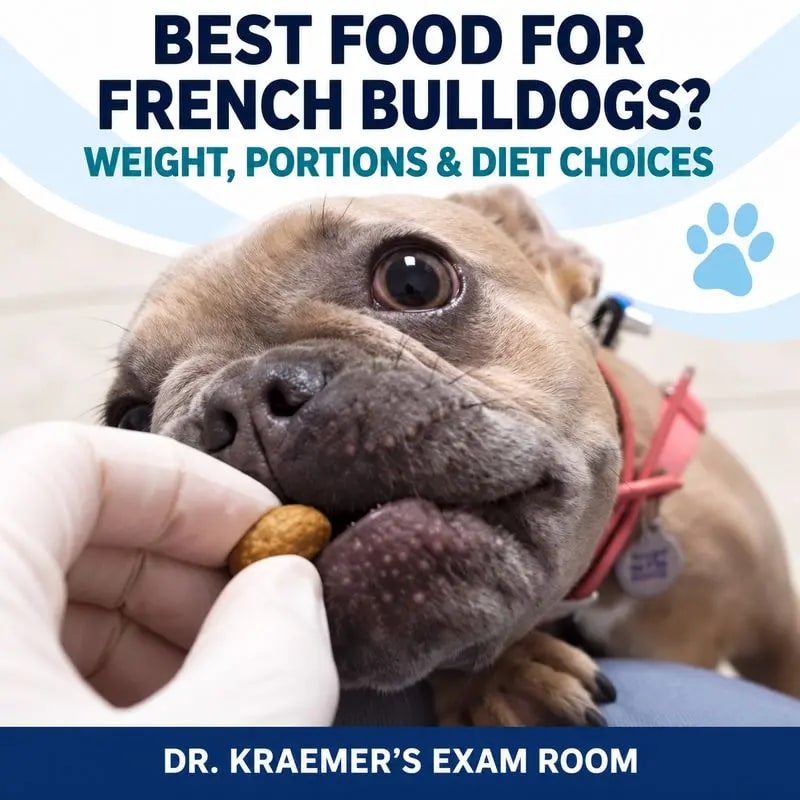
“Dr. Kraemer, what are the best diets and foods for bulldogs and French bulldogs?”🍲 👨⚕️ 🍽️
French Bulldog and Bulldog Best Food Introduction:
Determining the best diet for bulldogs involves considering several factors, including
- Individual nutritional requirements
- Individual food sensitivities
- health status
- lifestyle
- age
- even the dietary preferences of the owners
There isn’t a one-diet-fits-all answer
What Are The Essentials for a Bulldog Balanced Diet?
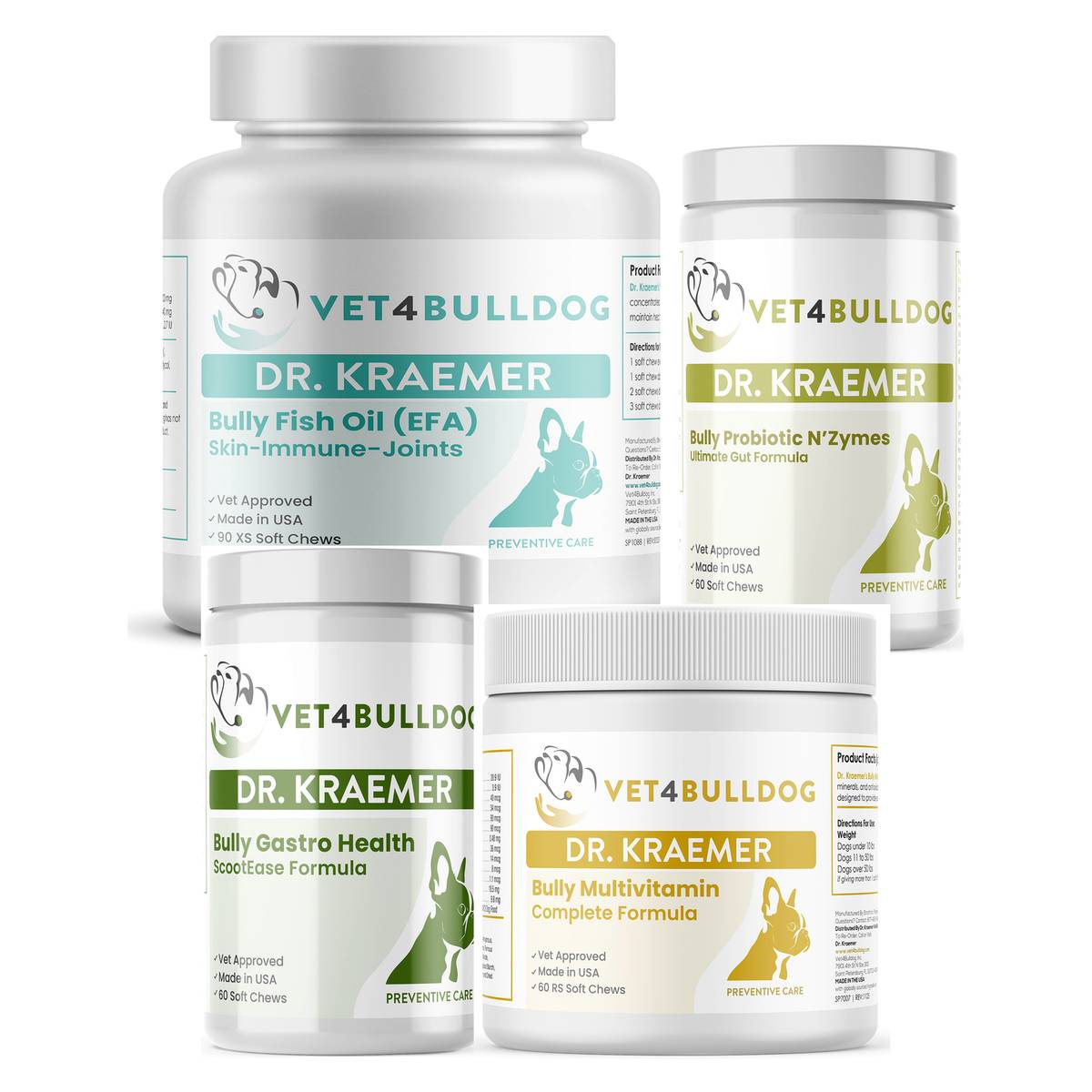
You can divide your bulldog’s diet into three essential macronutrients: proteins, carbohydrates, and fats. Additionally, it’s crucial to include essential amino acids, minerals, vitamins, essential fatty acids, prebiotics, digestive enzymes, and probiotics to ensure a balanced and healthy diet.
- PROTEIN: is mostly from an animal source and is essential for muscle maintenance and overall health.
- meat
- poultry
- fish
- eggs
- soy
- etc
- CARBOHYDRATES: like sweet potatoes and peas. such as
- brown rice
- oats
- barleys
- pea
- sweet potato.
- FATS: are important for bulldogs’ skin and coat health, as well as for providing essential fatty acids. Sources of healthy fats include
- salmon oil
- flaxseed oil
- chicken fat.
- VITAMIN & MINERALS
- ESSENTIAL FATTY ACIDS
- PREBIOTICS, PROBIOTICS, DIGESTIVE ENZYMES
DO BULLDOGS HAVE FOOD SENSITIVITIES?
Some bulldogs have food sensitivities, examples are corn, soy, chicken, and wheat.
FOOD ALLERGY: To learn more about food allergies in bulldogs and French bulldogs click HERE
WHAT FOOD IS POISONOUS TO BULLDOGS?
Caution: Some foods should be avoided as they can be toxic:
- chocolate
- grapes
- raisins
- onions
- garlic
BULLDOG AND FRENCH BULLDOG OWNERS DIETARY PREFERENCES:
While some bulldog owners may prefer to feed their pets
- vegan
- vegetarian diet
- gluten-free
- raw
- frozen
- plant-base
- home-made
- or grain-free
it’s essential to ensure that those special formulation diets meet your bulldog’s nutritional requirements. Consult with a veterinarian or a veterinary nutritionist to help you formulate a balanced diet.
A balanced and nutritious diet is essential for your bulldog’s long-term health and well-being.
The Best Food and Diets for Bulldogs MUST KNOW:
Remember to monitor your bulldog’s weight, energy levels, and overall health.
1. 👨⚕️BEST BULLDOG FOOD / “ONE FITS ALL” MUST KNOW:
There’s no single bulldog diet that reigns supreme for every owner, as it hinges on various factors, including:
- Age
- Sensitivity to certain foods
- Activity level and lifestyle
- Medical background
- Personal tastes and preferences, both yours and your bulldog’s
2. 👨⚕️BEST FRENCH BULLDOG FOOD MUST KNOW / “DUE DILIGENCE” :
When it comes to feeding bulldogs, there is no shortage of opinions, often backed by what appear to be credible references. However, when determining the best food for your bulldog, it’s crucial to undertake thorough research and due diligence.
3. 👨⚕️BET PET FOOD MUST KNOW / MARKETING HYPE”:
Every day, it appears that a food manufacturer declares their diet as the latest and greatest in bulldog nutrition, often touting it as the newfound “holy grail” or the pinnacle of all bulldog diets.
In the competitive realm of market share, these claims and advertisements for the best bulldog foods frequently surface during online searches, on Facebook pages, in Instagram forums, and across various other social media platforms.
It’s important to remember that the majority of these assertions are paid advertisements competing for market dominance.

The Best Diets and Foods for Bulldogs TIPS & WARNINGS:
Below are food and diet tips and warnings courtesy of Dr. Kraemer
#1 🩺 “DIETERAY DO NO HARM RULE” TIP:
Your primary guide when choosing a diet for your bulldog should be to adhere to the “do-no-harm” rule.
A suitable comparison is the question of the “Best Family Car.” For many, the primary considerations when purchasing a family car prioritize safety and reliability over speed and style. Similarly, when it comes to feeding bulldogs, the paramount concern should be their safety and well-being, rather than focusing on flashy packaging and trendy names.
#2 🩺”PET FOOD POOR REGULATION” WARNING :
Pet food manufacturing operates within loose regulations, prompting many bulldog food and diet manufacturers to prioritize seductive packaging, trendy buzzwords, and captivating social media campaigns over providing pet owners with objective nutritional data and scientific facts.
Instead of investing in research-backed nutritional information, these manufacturers often allocate their resources towards alluring packaging and marketing strategies.
Best Bulldog Diet: MYTHS & FACTS
Below are a few common “bulldog best diet” myths, followed by factual information courtesy of Dr. Kraemer
1. BEST PET FOOD BUZZWORDS MYTH & FACT
BUZZWORDS MYTH 🔍 : Bulldog food with the words “natural,” “organic,” “gourmet,” “fresh,” and “premium” printed on its label is superior to other pet diets.
BUAZZOERD FACT 👨⚕️: Those buzzwords often serve to tug at our emotions rather than accurately reflect the true nutritional value of the diet. They’re designed to evoke an emotional response, enticing consumers with promises of superior quality, while the actual nutritional content may not align with these claims.
Look beyond the marketing hype and prioritize understanding the true nutritional value

2. PET FOOD LABEL & INGREDIENTS MYTH or FACT
INGREDIENTS MYTH 🔍: Ingredients such as protein, carbohydrates, and fat listed on your bulldog food bag are the best way to evaluate the quality of your diet.
A. INGREDIENTS FACT 👨⚕️: Ingredients are listed according to “weight as fed.”. The percentage published provides minimal information about the ingredient’s quality. The ingredients listed are not directly correlated with the diet’s true nutritional value or the quality of the manufacturing process.
B. LABEL FACT 👨⚕️: Pet bulldog food manufacturers’ labeling of legal requirements is minimal and often lacks transparency, it’s nearly impossible for you to select an OTC diet based on the “ingredient list.”
You should not evaluate the quality of a bulldog diet based on the “ingredient list”
3. BEST BULLY FOOD “GUARANTEED ANALYSIS” MYTH or FACT
GUARANTEED ANALYSIS MYTH 🔍: Pet food guaranteed analysis helps assess
- digestibility
- palatability
- and bioavailability.
A. GUARANTEED ANALYSIS FACT 👨⚕️: Pet food guaranteed analysis does little to help measure digestibility, palatability, and/or bioavailability.
B. GUARANTEED ANALYSIS FACT 👨⚕️:Recent findings suggest a link between English bulldogs and French bulldogs Grain-free diet and heart disease, To learn more, click HERE
3. “GRAIN-FREE” BULLDOG DIET MYTH
GRAIN-FREE MYTH 🔍:
- Grain-free diets are carbohydrate-free
- Grain-free bulldog food is known to eliminate food allergies
- Grain-free food is much healthier
GRAIN-FREE FACT 👨⚕️: The grain-free bulldog diet replaces one carb with another, most of which are legume-loaded.
Grain-free is not carbohydrate-free!

4. PET FOOD “CARBOHYDRATES and OBESITY” MYTH
CARBO MYTH 🔍: The carbs in my bulldogs’ diet are the leading cause of obesity
CARBOHYDRATE FACT 👨⚕️: It is not the carbohydrates that make your bulldog overweight, but rather the calories and lack of exercise. A Calorie from a Fat or Protein diet is equal to a calorie from Carb

5. “HOMEMADE PET FOOD” MYTH
HOMEMADE DIET MYTH 🔍: Homemade diets are best because they are fresh, organic, and low-fat.
HOMEMADE DIET FACT 👨⚕️:A homemade diet might be beneficial but you should always consult a veterinary nutritionist
HOMEMADE BULLDOG AND FR BULLDOG FOOD TIPS:
- “CERTIFIED NUTRITIONIST”: Have a board-certified nutritionist help you formulate the meals, you can reach one here
- “FOOD SAFETY”: To be safe, consider mixing it with one of the veterinary RX diets (prescription therapeutic diet)
- “DIET MONITORING”: If you opt for a bulldog homemade diet, I recommend an exam and blood test every 6 months.
- “LAB ANALYSIS”: Send your recipe to an independent lab for a review and nutritional analysis.
- “HOMEMADE TREATS” Last, even if you feed your bulldog regular dog food, you can still add some “homemade” treats.
Most fresh produce are safe and healthy for your pet, but before you start please get a list of the few unsafe/poisones ones.

6. Best Pet “RAW FOOD” Myth
RAW DIET MYTH 🔍: Bulldog raw diets are superior to other pet diets and are safe to feed
RAW DIET FACT 👨⚕️: The Bulldog raw diet might have benefits but also drawbacks. For bulldogs, raw diet MUST KNOW, DO & DONT, and much more, click HERE
PET RAW FOOD POSSIBLE BENEFITS:
- Digestibility: A raw diet might be more digestible
- Hypoallergenic: Raw diet might have limited ingredients, which can reduce food allergy
- Palatability: A raw diet might be more palatable
- Digestablity: A raw diet might improve elimination.
- Healthier: A raw diet might appear to have more energy, a better coat, and appear “healthier.”

PET RAW FOOD POSSIBLE DRAWBACKS:
- EXCESS: Some bulldog raw diets have a higher fat content
- DEFICIENCIES: Bulldog raw diet often has an abnormal calcium/phosphorus ratio
- BAD BACTERIA: Raw diet (non-pasteurized meals) have a higher risk of harboring and passing deadly contaminants.
- PUBLIC HEALTH: Your family is also at risk from those contaminated (more so kids and immune-suppressed adults)
BULLDOG AND FR BULLDOG RAW DIET TIPS
Bully raw diet: important tips courtesy of Dr. Kraemer
- TIP # 1 “AFFCO”: Look for an official AAFCO label. Some manufacturers post a misleading AAFCO-like label
- TIP #2 “PERSONAL SAFETY”: Always wash your hands after handling raw food
- TIP #3 “KIDS SAFETY”: Don’t let kids or immune-suppressed adults handle raw food.
- TIP #4 “IMPROVE SAFETY”: Cook the outside of the raw food and buy freeze-dried or flash pasteurized.
For more information about best raw diet for bulldogs visit the Centers for Disease Control and Food safety

The Best Diets and Food for Bulldogs RULE OF THUMB
Below is a rule of thumb list courtesy of Dr. Kraemer:
1 🩺 “THE DO NO HARM” PET FOOD SAFETY:
Like our family car analogy, I recommend that your bulldog’s diet’s main focus begins with Safety & Reliability
2 🩺“THE LARGE & REPUTABLE” PET FOOD SAFETY:
However, this doesn’t discount the possibility of niche diets that could be equally or even superior. Unfortunately, most of us lack adequate tools and knowledge to tell
Therefore, I often default to our “do-no-harm” bulldog diet principle, prioritizing safety and well-being above all else.

3 🩺 “THE RX FORMULATED PET DIETS” SAFETY:
Prescription pet diets, formulated for specific medical conditions, typically undergo stringent formulation processes and adhere to higher quality control standards compared to over-the-counter (OTC) boutique exotic diets.
Despite being labeled as “prescription,” many veterinary prescription diets can be used as everyday food replacements for off-the-shelf ones.
4 🩺 BEST BULLDOG FOOD “POOP-TEST”:
If your bulldog’s new diet results in healthy-looking stools that are smaller in volume and less frequent compared to their previous diet, it is likely that the new diet offers improved nutritional digestibility and bioavailability.
Dr. Kraemer’s Best Food for Bulldogs FINAL ADVICE
- Adhere to the “do-no-harm” bulldog diet rule
- Ignore emotionally charged pet food marketing schemes
- Stick to the nutritional facts of the pet diet.
- Consider staying with a reputable pet food manufacturer or even upgrading to one of their prescription diets.
PET FOOD OTC DO NO HARM ADVICE
If you opt for a niche pet diet, you can still take the “do no harm” initiative by doing the following:
Contact the bulldog food manufacturer and ask them the following questions (published by WSAVA):
- CERTIFIED NUTRITIONIST: Do you have a board-certified nutritionist? name and qualifications.
- FORMULATION: Who formulated your pet’s diet, and what are their credentials?
- AAFCO CERTIFIED: Is your pet’s diet tested and formulated by AAFCO standards?
- AAFCO ANALYSIS: Does your pet’s diet meet AAFCO nutrient profiles by analysis?
- QUALITY CONTROL: What specific quality control do you implement?
- NUTRIENT ANALYSIS: Ask for a complete nutrient analysis of the diet
- CALORIES: What is the caloric value per cup?
- PEER REVIEW: What product research was done on this pet diet and is it published in a peer-review paper?
BULLDOG & FRENCH BULLDOG BEST DIET SUMMARY:
Pet food manufacturers should be willing to provide you with a response to those questions. If they are not able or willing to do so, be cautious and consider avoiding feeding their diet to your pet.
BULLDOG AND FRENCH BULLDOG AAFCO PET FOOD:
Association of American Feed Control Officials (AAFCO). It’s important to recognize that while AAFCO provides recommendations for states to consider as they update state feed laws, AAFCO does not regulate or inspect pet food.
Regulations and enforcement of pet food labeling are done mostly at the state level by state feed control officials; not by AAFCO, though they generally follow AAFCO recommendations.
Who made it matters more than what is in it
This is the part that surprises owners most, and it is the part I would want you to take away. The ingredient list on the front of the bag is written by a marketing department. It tells you what went in, not what the food delivers, and the order can be manipulated by splitting one ingredient into three or by using a wet ingredient that weighs heavy before cooking. A beautiful ingredient list is not a nutritional claim, it is a design choice.
What actually predicts a good food is duller. Does the company employ a qualified veterinary nutritionist. Does it run feeding trials rather than only formulating on paper. Does it own and control the plants where the food is made, or is it a brand name contracted out to whoever quoted lowest this year. Will it answer those questions if you telephone and ask, because the good ones will and the boutique ones often cannot.
That is why the big, boring, long established companies tend to win on the evidence while losing on the packaging. They have the nutritionists, the trials and the quality control, and they put their money into that rather than into a photograph of a wolf on a mountain. I have no commercial reason to tell you that, and plenty of reason not to, since I sell supplements rather than food.
The practical version, if you want one sentence to take shopping: buy the food made by the company that could answer a nutritionist’s questions, and ignore everything printed on the front of the bag.
The poop test beats the ingredient panel
Every owner wants a lab test for this and the test already exists, it is just undignified. Give any new food a good few weeks and then judge it on the dog rather than the label. Formed, consistent stool you can pick up without a sense of adventure. A coat with some shine that is not shedding in sheets. Weight holding steady where your veterinarian wants it. Energy that fits the dog’s age. Enthusiasm at the bowl, because a nutritionally perfect food he refuses to eat is not a good food for him.
If all of that is true, the food suits your dog and the brand on the bag is a detail. If one of them is off, that is the thing worth taking to your vet, and the information is far more useful than the name of the food.
The mistake I saw constantly was judging too fast. A gut takes a good few weeks to settle onto anything new, so an owner who changes food every three weeks is permanently measuring a gut in transition and concluding that nothing works. Slow transitions, then patience, then judge. Four changes in a year guarantees you learn nothing from any of them.
One caveat worth saying plainly, because this page is about healthy dogs. A dog with a diagnosed condition, on a prescription diet, or being worked up for something, is a different conversation entirely, and that one belongs with the veterinarian who knows the case rather than with a web page or a pet shop.
Let me be straight about the order of things. The food does the heavy lifting, and if the food is wrong then no capsule, chew or powder from this site or any other fixes that. Getting the diet right first is free. Everything below is a margin.
Where a supplement may have a reasonable place is the transition. A Bulldog gut takes change badly, and the stretch just after a food change is exactly when owners lose their nerve and switch again, which is how the circle starts. A probiotic may help steady things while the new food beds in over a good few weeks, which buys the food a fair trial rather than doing anything clever itself.
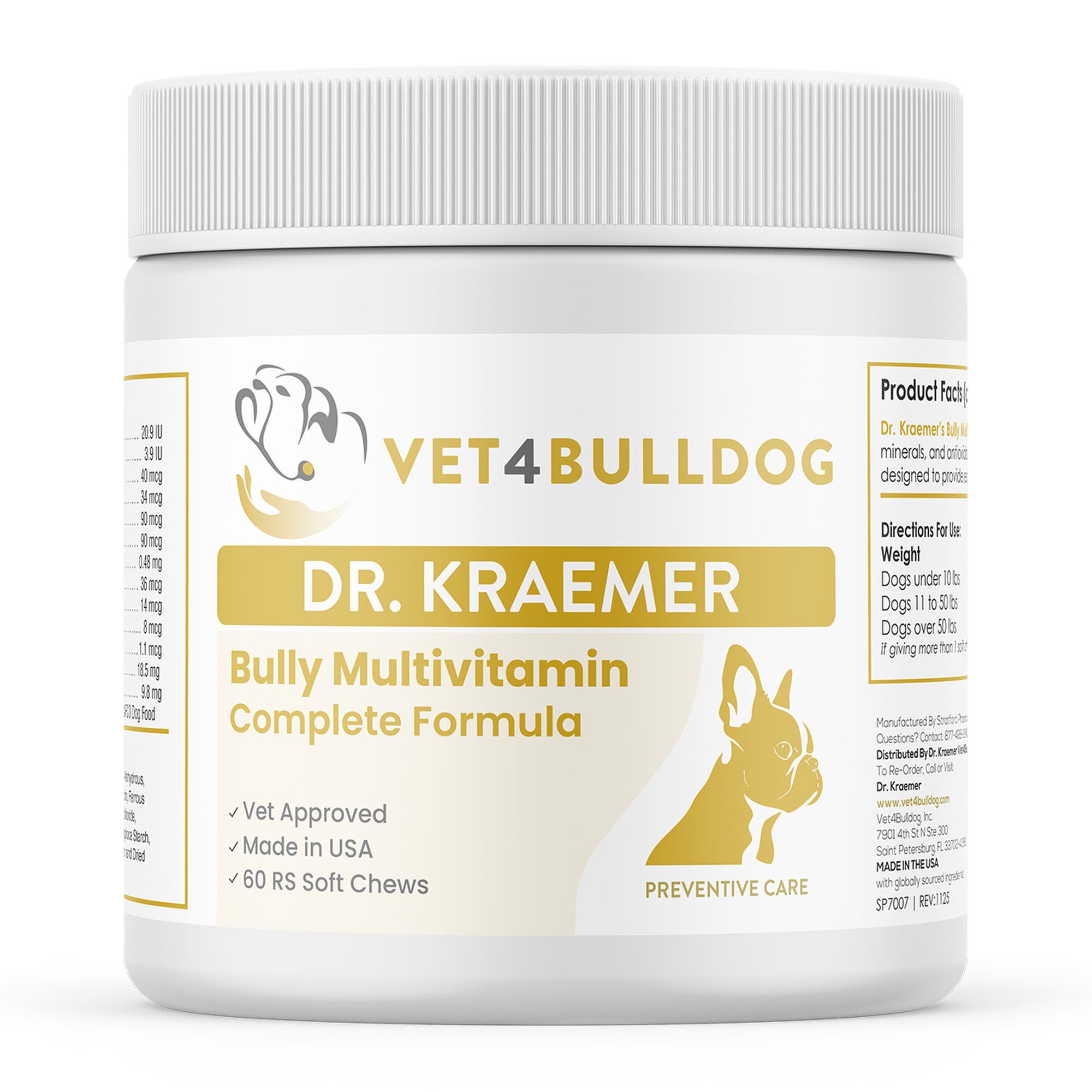
The other honest case is a home prepared diet, where recipes tend to come out short on a predictable handful of nutrients. A daily multivitamin may help cover that gap, and it is a patch rather than a plan. If you are cooking for your dog long term, get the recipe formulated properly by someone qualified.
If your dog has a sensitive gut or you are mid change, the adult range is the wider selection.
To be clear: supplements are not a diet, not a treatment and not a substitute for veterinary examination, diagnosis or treatment. This page is educational only.
Just tell me the best food. What do you feed?
I understand the frustration and I am not dodging. There is no single best food because dogs are not identical, and the honest answer is a description rather than a name: a complete, balanced food from a large established manufacturer that employs a veterinary nutritionist, runs feeding trials and controls its own manufacturing, fed in the right amount, that your individual dog does well on. Several brands fit that description. If somebody gives you one brand name for every Bulldog on earth, ask what they sell.
Should I avoid by-products, corn and fillers?
Those three words have done more marketing work than almost anything else in this industry. By-products include organ meats, which are nutrient dense and which a wild dog would eat first. Corn is a digestible source of energy and some useful nutrients, not sawdust. Filler is not a regulatory term at all, it is an insult. None of that means every food is equal, it means the ingredient list is the wrong place to look. Nutrients, not ingredients, and the company behind them.
How often should I change his food? I have heard about rotation.
Less often than you probably are. There is a popular idea that rotating foods broadens tolerance, and for most dogs it mainly broadens the number of weeks their gut spends unsettled. A Bulldog gut in particular does not enjoy novelty. If a food is working, leave it alone. If you do need to change, go slowly, a quarter new at a time over a good stretch, and drop back a step rather than giving up if the stool turns loose.
Is the expensive boutique brand better than the supermarket one?
Often not, and occasionally worse. Price buys packaging, a story and exotic ingredients, and none of those three has been shown to make a dog healthier. What the premium rarely buys is the thing that matters, which is nutritionists and feeding trials. Several of the brands that turned up in the FDA heart reports were exactly this sort: boutique, exotic and expensive. I would rather see an owner spend that difference on dental care, where it reliably buys something.
Can I cook for him instead?
Yes, and do it properly or not at all. Home prepared diets assembled from recipes found online come out unbalanced far more often than owners expect, and the gaps are not the sort you notice for months. If you want to cook, have the recipe formulated by a veterinary nutritionist once, which costs less than most owners assume, and follow it rather than improvising. Where I would push back hardest is a growing puppy, because a growing skeleton is unforgiving about getting the minerals wrong.
How do I tell whether a food actually suits him?
Give it a good few weeks and then look at your dog instead of the bag. Formed consistent stool, a coat with shine, steady weight where your vet wants it, energy that fits his age, and genuine interest at the bowl. If those are all true you have your answer regardless of what the label says. If one of them is off, that is worth mentioning at your next appointment, and it is far more useful information than the brand name. The garden tells you more than the ingredient panel ever will.
Trusted by Vets ~ Recommended by Owners ~ Approved by Bulldogs
More Help from Dr. Kraemer
Diet questions in this breed rarely stay about diet, so these are the pages I would read next.
- Grain Free Diets for Bulldogs and French Bulldogs
- Raw Diets for Bulldogs and French Bulldogs
- Food Allergy in Bulldogs and French Bulldogs
- Weight Control and Exercise in Bulldogs and French Bulldogs
- Inflammatory Bowel Disease in Bulldogs and French Bulldogs
- Pancreatitis in Bulldogs and French Bulldogs
About the Author
Roy Kraemer, DVM, is a veterinarian with extensive clinical experience caring for Bulldogs and French Bulldogs. His educational work emphasizes prevention, early recognition, appropriate at-home care, responsible medication use, and veterinary evaluation when disease is persistent or severe.
References
- Nutritional Requirements of Small Animals, Merck Veterinary Manual
- Feeding Practices in Small Animals, Merck Veterinary Manual
- Questions and Answers: FDA’s Work on Potential Causes of Non-Hereditary DCM in Dogs, U.S. Food and Drug Administration
- Tips for Safe Handling of Pet Food and Treats, U.S. Food and Drug Administration