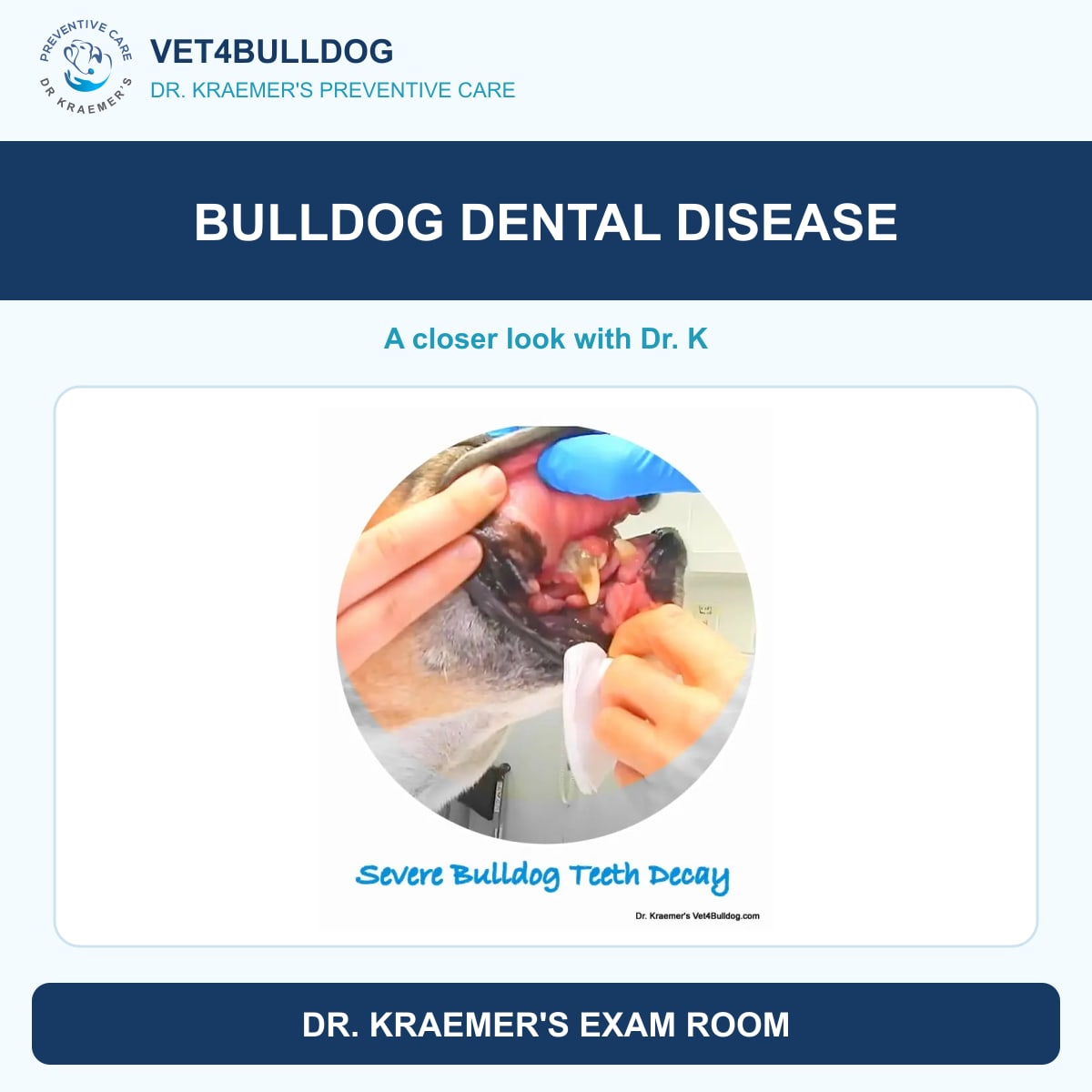



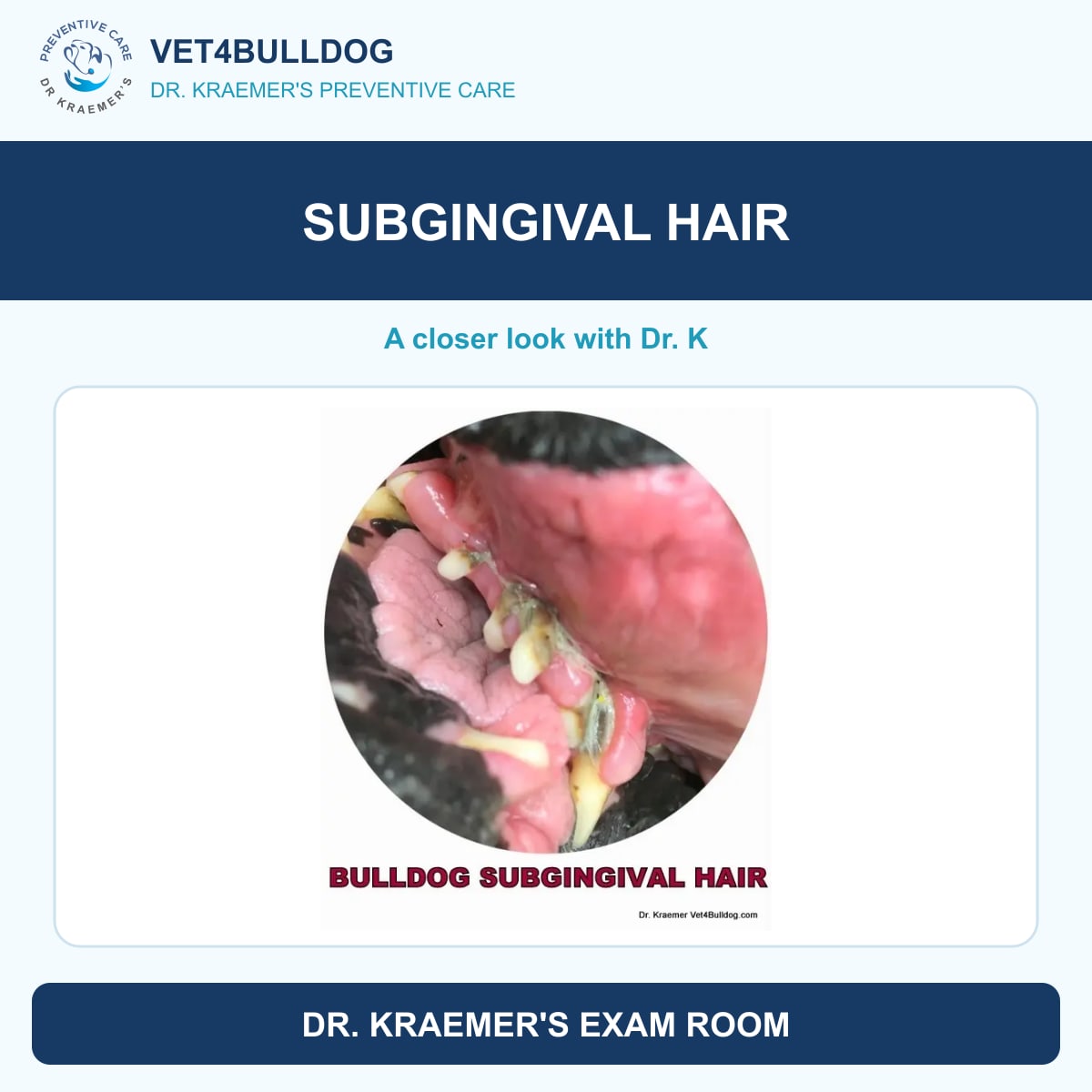
Subgingival hair means exactly what it says: individual hairs worked down under the gum margin, where they sit as foreign bodies. The body cannot break hair down, so it cannot resolve the problem on its own. The gum simply keeps reacting, for as long as the hair is there, no matter how clean the tooth above it is.
The hair comes from the dog himself. Bulldogs lick and chew their own feet, their folds and their flanks, usually because something itches, and they carry hair into the mouth every time they do it. The crowded, rotated teeth this breed is built with then give that hair somewhere to lodge. So the condition is the collision of two ordinary Bulldog facts, and that is why it is so much more common here than in dogs with longer muzzles and calmer skin.
It is missed constantly, because nothing about it is visible from the outside. The teeth can look respectable while the gum beside them is inflamed, and an owner doing everything right gets told to brush more. The hair only turns up when somebody examines the gum margin deliberately, with the dog properly asleep and the area magnified.
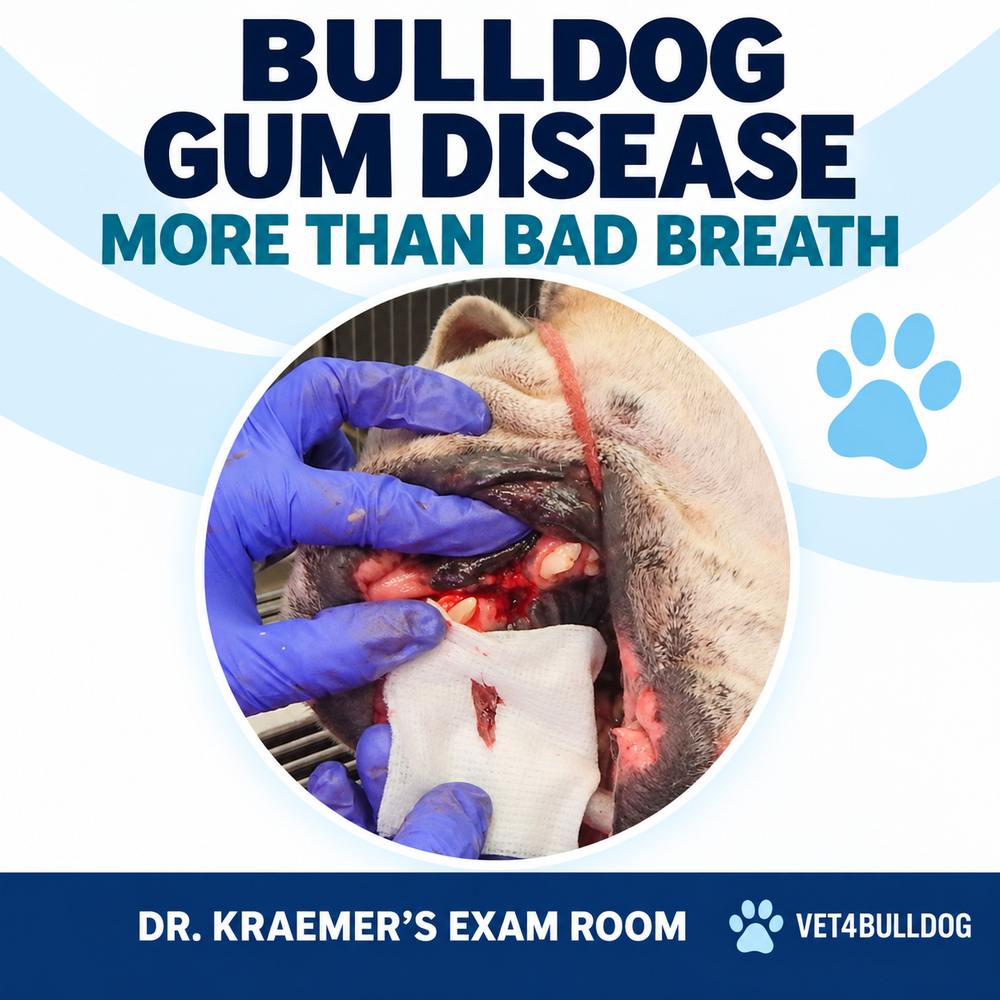
Subgingival Hair in Bulldogs and French Bulldogs is the medical term for hair stuck in the gums, or hair packed between the teeth, and at times hair implanted in your bulldog’s hard palate tissue.
WARNING: Many bulldog owners and surprisingly many veterinarians are unaware of this condition thus overlook it.
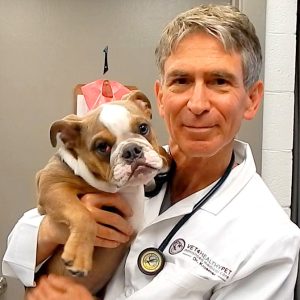
Your brushing is not the problem and you are not doing it wrong, so let me take that off the table first.
In this breed, gums that stay inflamed at the front when the teeth look respectable very often have hair buried under the gum margin. Not hair lying on top of it. Hair worked down into the little gap between the tooth and the gum, where it sits like a splinter. The body treats it exactly like a splinter too: it walls it off, it stays inflamed, and no amount of brushing shifts it because a brush cannot reach into that space. That is also where the smell comes from.
The paw licking is not a separate thing, and I am glad you mentioned it, because that is where the hair comes from. A dog who licks and chews at himself is running hair through his mouth all day. Some of it ends up in the gum line. The hair is the symptom. The licking is the cause, and in a Bulldog the licking is usually itch, often allergy, sometimes mites, occasionally anxiety.
So the plan has two halves and neither works alone. The hair has to come out, which is a job under anesthetic with proper instruments, because it is below the gum and he is not going to hold still for that. Then the reason he licks has to be dealt with, or the hair simply goes back in over the following months and you repeat the procedure next year.
What you can do alongside: keep brushing, because it is doing real good above the gum line. Our dental rinse and wipes work at the margin and sit alongside whatever your veterinarian does rather than instead of it. If the licking turns out to be itch, the skin and allergy support may help over a good few weeks. Mention the paw licking out loud at the next appointment, because it is the part that connects the two ends of this.
Subgingival Hair in Bulldogs and French Bulldogs Presentation
A tuft of hair: The most common location is hair stuck between the incisors and canine teeth of the upper jaw (mandible).
Redness & Periodontitis: rosy discoloration of the gums.
Draining tracts: at times, the deep tracks that lead to the nasal cavity
Swell & Inflammation: The gums will be puffed, red-purple, and inflamed.
Periodontal Disease: infection and abscessation.
Decay & Lose Teeth: Left untreated, the teeth and their supporting ligaments and bones will disintegrate.
Pain: chronic subgingival hair will lead to advanced dental disease, a condition associated with intense pain.
TIP: to find the subgingival hair, you must pick the upper gum
Subgingival Hair in Bulldogs and French Bulldogs Cause
The hair found impacted in your bulldog gums and palate is secondary to licking and grooming of hair body parts
There are several medical and emotional bulldog medical conditions that can lead to excessive obsessive licking and grooming, I listed below the most common ones:
Bulldog gingival hair excessive grooming & licking
Bulldog excessive grooming, licking, and biting of the paws or/and other hairy body parts can be due to:
Bulldog subgingival hair due to skin mites
- Bulldog demodex red mite: can lead to excessive itching.
- Bulldog Sarcoptic Mange: those mites are less common but cause severe pruritis.
Bulldog and French Bulldog subgingival hair due to itching allergies
Some of the most common bulldog and French bulldog allergies are listed below
- Bulldog Atopic Itch Allergic Dermatitis
- Bulldog Flea Allergy
- Bulldog Food Allergy
- Bulldog Contac Allergies
Bulldog and French Bulldog gingival hair due to anxiety
As in humans, depression, stress, and anxiety can lead to a wide range of medical problems and abnormal behavior.
- Separation Anxiety bulldogs: anxiousness can lead to abnormal grooming activity
- Boarding & Daycare: both can be stressful and frightening experiences that lead to nervous grooming activity
- Boredom: lack of exercise and playtime can lead to anxiety to boredom, which could trigger excessive compulsive grooming.
TIP: BULLDOG COMPULSIVE OBSESSIVE BEHAVIOR: often lead to excessive grooming.
The hair is the symptom. The licking is the cause.
This is one of those conditions I would never have thought to look for if the breed had not taught me, and I want to describe the picture that should make you suspect it, because the picture is distinctive once you know it. An owner who is genuinely doing the dental care, a set of teeth that look reasonable, and a band of gum that stays red and swollen regardless. Everybody concludes the brushing is not good enough. The brushing is usually fine. There is something under the gum that a brush was never going to touch.
Hair cannot be digested, dissolved or absorbed. Once a strand is down in that space the body has no way of removing it, so the inflammation does not run its course and settle, it simply continues. That is the whole mechanism and it explains why the problem outlasts every reasonable attempt to clean it away. Antibiotics will quiet it while they are being given and it returns when they stop, which is a pattern worth recognizing because it sends people round the same loop more than once.
Where the hair comes from matters more than the hair itself. These dogs are licking and chewing something, and in my experience it is almost always because something itches or hurts. Feet are the commonest source, which is why this condition and interdigital cysts turn up in the same dogs so often. Folds, flanks and tail pockets supply the rest. So when I found hair under a gum, my next question was never about the mouth, it was what is making him work at himself like that.
Then the crowding does the rest. A Bulldog carries a normal number of teeth in a jaw that has been shortened, so the teeth lean, rotate and overlap, and each overlap is a pocket that catches and holds what a well spaced mouth would simply shed. The same anatomy that makes this breed prone to ordinary gingivitis is what makes it prone to this. Two problems, one cause, and they frequently sit on top of each other in the same mouth.
On getting it out: this is not a home job and I would not want anybody trying. The hairs are fine, they are below the gum line, and finding them takes a proper examination under anesthesia with magnification and probing of each tooth. Removing them is fiddly and the gum has to be treated afterward as well. If your veterinarian has found this, they have almost certainly earned the finding, because it is not something you stumble over casually.
And here is the part that decides whether you do this once or repeatedly. Clear the hair, treat the gum, change nothing about the licking, and the dog will put more hair back in the same place. I have seen a mouth cleared beautifully and looking like the original picture again within months because nobody addressed the itch at the other end of the dog. So the treatment plan that actually works is two plans: the dental work to deal with what is there, and whatever it takes to stop him chewing himself, which usually means taking the allergy seriously. The food allergy page covers one of the commonest reasons behind it.
Subgingival Hair in Bulldogs and French Bulldogs Diagnosis
TIP: An exam is critical, lab tests and imaging are usually not necessary.
Bulldog gingival dental exam
PHYSICAL EXAM BY YOU: Pick the upper gums and visually examine the incisors, canines, and the gingival section between them.
DENTAL EXAM WITH SEDATION: often sedation is required for proper exam and evaluation because the hair might be in areas that is difficult to observe. Also, your bulldog might be painful and unwilling to open his/her mouth.
Once sedated, the mouth can be wide open, allowing hair to be found even when embedded deep in the gums, hidden behind the teeth, or stuck in the palate tissue in the roof of your bulldog mouth.
DENTAL PROBING: A probe can be used to evaluate and measure pocks and areas under the gum line but it usually requires sedation.
DENTAL RADIOGRAPHS: dental radiographs might be necessary to evaluate the health of your bulldog teeth and view diseased sections under the gumline (bone, pulp). Again, this procedure is performed under anesthesia
BULLDOG NASAL DISCHARGE: chronic sinusitis and purulent nasal discharge primarily localized to one naris should be a red flag suggesting a possible draining tract.
When a draining tract is connected to the nasal cavity, the flushing of the oral tract with a colored antiseptic solution will leak out of the respective naris.
Subgingival Hair in Bulldogs and French Bulldogs Prevention
Bulldog Subgingival Hair is a secondary disease thus you must prevent the primery condtion.
Bulldog gingival hair allergy control
Preventing biting, itching, and licking due to allergies should always begin with nonpharmaceutical, nonprescription, topicals and supplements therapeutics.
Medicated shampoo & conditioners
BULLY ITCH RELIFE TOPICALS:
- V4B BULLY ITCH RELIEF SHAMPOO & CREAM RINSE CONDITIONER
- V4B BULLY ITCH RELIEF SPRAY
- V4B BULLY OATMEAL ALOE SHAMPOO & CREAM RINSE CONDITIONER
Bully antiseptic shampoo & gel
- V4B BULLY ANTIBACTERIAL & ANTI YEAST MEDICATED SHAMPOO
- V4B BULLY MEDICATED WATERLESS ANTISEPTIC YEASTY GEL
- V4B BULLY ANTISEPTIC XS SHAMPOO
Bully itch & allergy relief supplements
- Dr. Kraemer’sBULLY FISH OIL OMEGA-3 EFA CHEWS
Bully anxiety & stress relief supplements
- Dr. Kraemer’s V4B BULLY STRESSLESS CHEWS
- Dr. Kraemer’sV4B BULLY HEMP CALM CHEWS
Bully anxiety & stress relief
- EXERCISE: proper activity helps relieve stress
- PLAY: sufficient play & love will reduce stress and anxiety
Bully dental exam & prophy
- ROUTINE EXAMS HOME: pick the lips, check the gums and teeth
- BRUSHING: teeth wiping and brushing may help remove hair and maintain healthy gums
- ROUTINE DENTAL PROPHY: preventive dental scale & polish, dental exam, and dental radiographs should be done once annually or every 2-3 years (depending on the pet)
Bully dental rinse & wipes
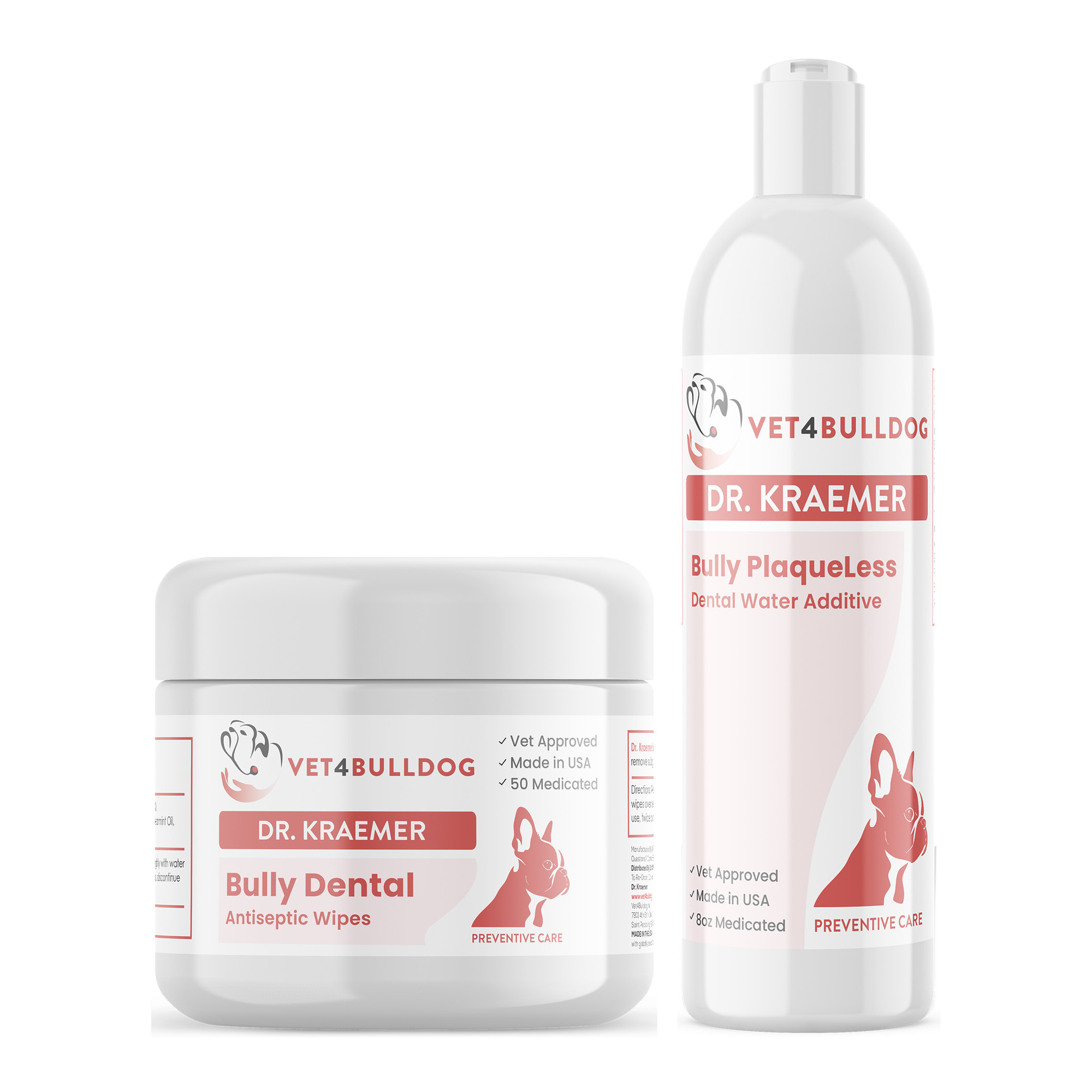
- Dr. Kraemer’s V4B BULLYAQUA WATER ADDITIVE & RINSE
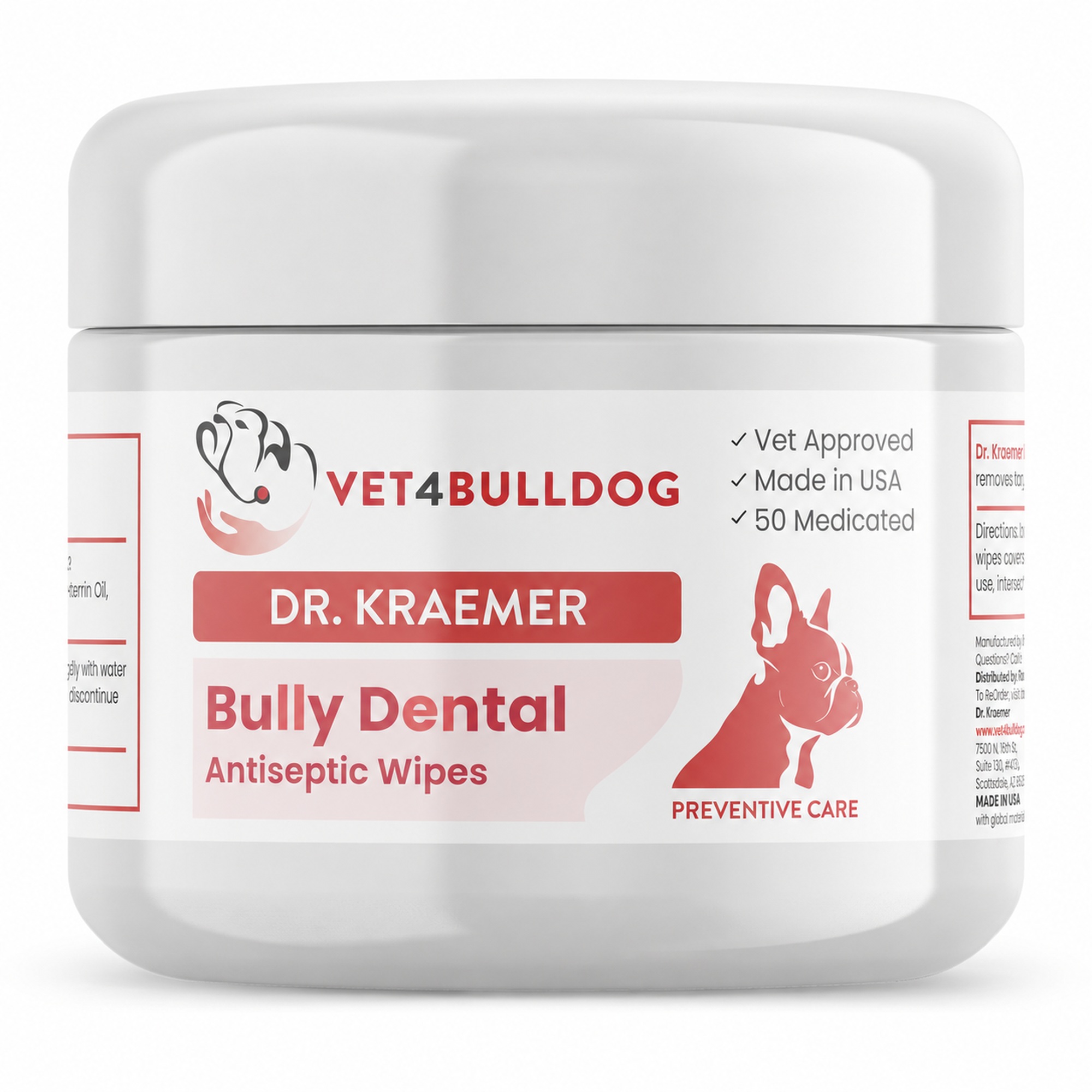
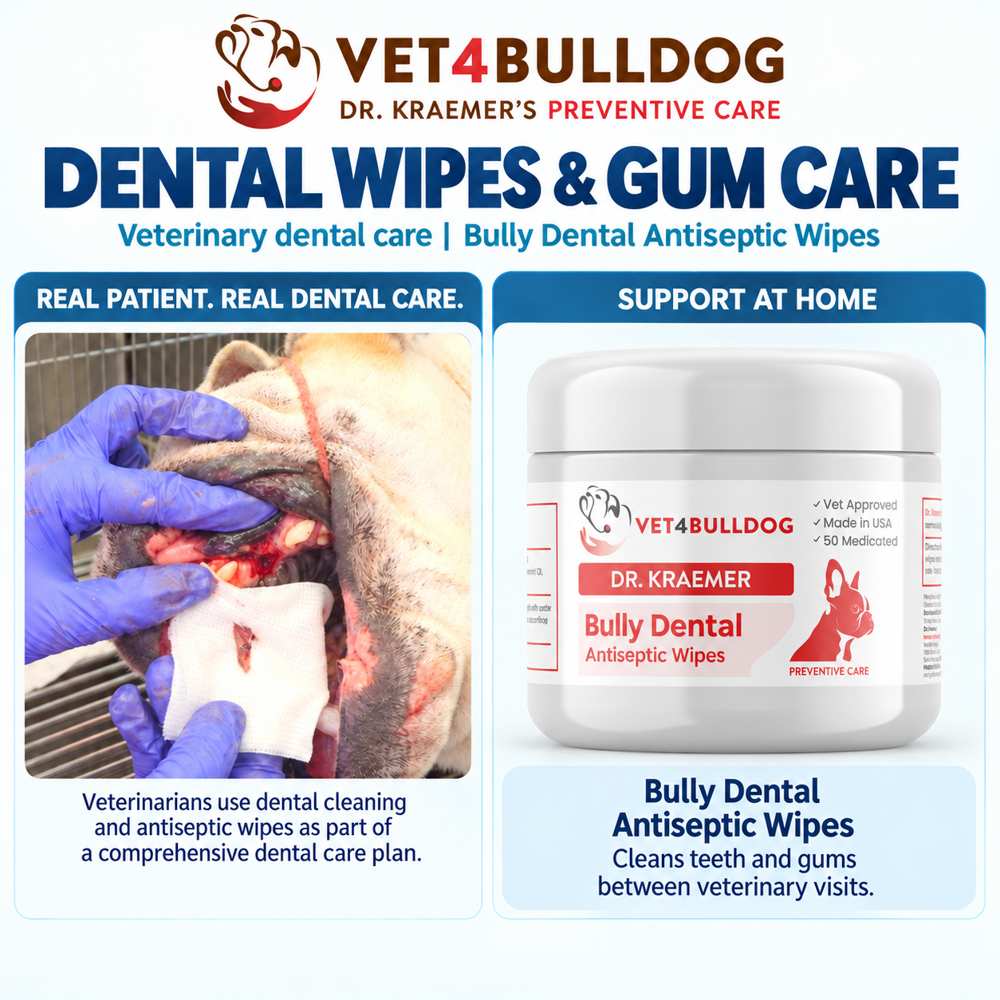
- Dr. Kraemer’s V4B BULLY DENTAL WIPES
Wipe and rinse the gums daily, to help remove any trace of hair and debris from the teeth and gums.
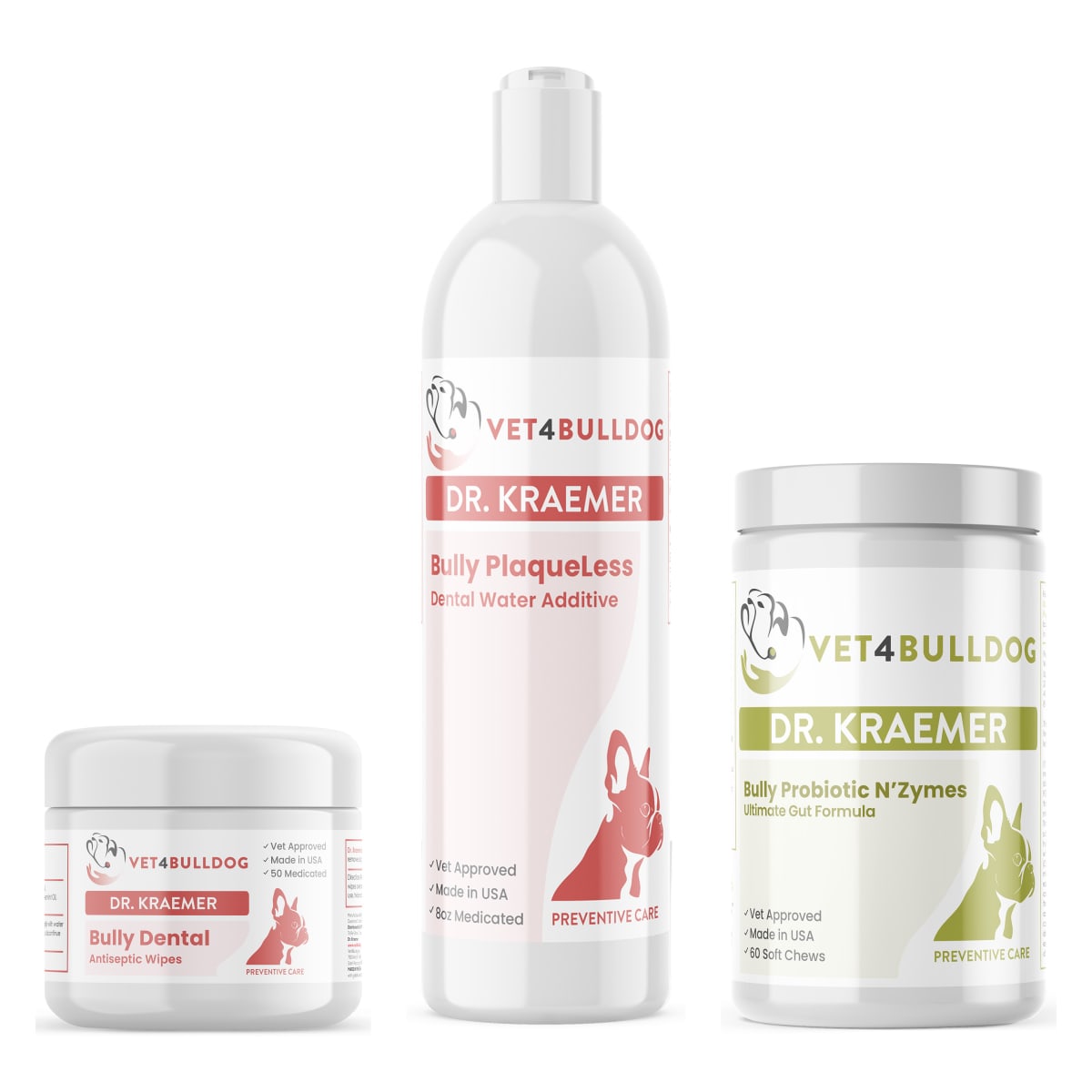
Let me be exact about this, because on this page a vague claim would be worse than useless. Nothing in the range gets a hair out from under a gum. That is an examination under anesthesia and it belongs to your veterinarian. If this condition has been diagnosed, the product decision is not the one that matters.
What the dental range is genuinely for is the ordinary gum disease that almost always sits alongside it in a Bulldog mouth, and the maintenance afterward once the hair is out. These are topicals and chews, so they sit alongside whatever your veterinarian has advised rather than in place of it. The antiseptic dental wipes are the practical daily option on a crowded mouth, and the water additive asks nothing of the dog at all.
If you take one buying decision from this page, though, make it the other end of the dog. The hair arrives in the mouth because he is chewing his feet and his folds, so the ItchLess range and keeping the folds genuinely clean and dry do more to prevent a recurrence than anything you put on his teeth.
To be clear: supplements or topicals are not substitutes for prescribed treatment. If your dog is unwell, is being treated for a condition, or is already on medication, review any supplement or topical with your veterinarian so it fits the plan you are already following. This page is educational and is not a diagnosis or a treatment plan for your own dog.
Bulldog and French Bulldog Gingival Hair Dental Care Drugs
- RX ITCH CONTROL: there is a wide range of oral and injectable medications such as Convinia, Apoquel, Cyclosporins, Antihistamines, and Steroids
- RX ANTISEPTICS: oral and injectable medication for secondary bacteria and yeast dermatitis
- RX ANTI ANXIETY: Benzodiazepines, Tricyclics, and SSRI
Nobody finds this with the lip lifted
Here is why owners in your position are so often told the mouth looks fine, and why it is not anybody being careless.
Subgingival hair is, by definition, under the gum. At a conscious examination a veterinarian lifts the lip and looks at what is on show: the crowns, the color of the gums, the tartar. Buried hair does not show at that angle. What shows is a band of inflammation at the gum margin, which looks like ordinary gingivitis, and ordinary gingivitis is what gets written down.
It is a splinter under a fingernail. You can see that the finger is angry. You cannot see what is in it until something goes underneath.
Finding it takes a dog who is asleep, a probe, and somebody who knows this is a Bulldog thing and goes looking for it. Once you are there it is usually obvious, and removing it is straightforward.
So the useful thing you can do is ask the question out loud: this is a Bulldog with gums that stay inflamed and he licks himself, could there be hair under the gum line. That single sentence moves it from a routine clean to somebody actually looking. And while the mouth is being examined under anesthetic, that is also the moment for dental x-rays, because the two problems live in the same place and both are invisible from the outside.
Subgingival Hair in Bulldogs and French Bulldogs Treatment
DENTAL PROPHY: performed under general anesthesia and includes a scale, polish, and radiographs.
HAIR REMOVAL: manual removal that often requires instrumentation.
ANTIBACTERIAL: topical and oral
PAIN RX: NSAID anti-inflammatory and other analgesics might be required.
EXTRACTION: irreversible damage to the ligaments, bones, and teeth requires an extraction
How does hair get under the gum in the first place?
I clean his teeth every day and his gums are still red. What am I doing wrong?
Can I get the hair out myself?
Why does my vet need anesthesia just to look?
It was removed and it has come back. What am I doing wrong?
Is this a real recognized condition or just a Bulldog quirk?
What is the one thing that stops it coming back?
More Help from Dr. Kraemer
This one sits between the mouth and the skin, so both ends matter:
- Dental disease in Bulldogs
- Gingivitis and gum disease
- Paw licking, red paws and pododermatitis
- Itchy skin and allergy in Bulldogs
- Demodex mites, one reason a dog chews at himself
- Anxiety and the licking that comes with it
References
- Merck Veterinary Manual. Periodontal Disease in Small Animals
- Merck Veterinary Manual. Oral Inflammatory and Ulcerative Disease in Small Animals
- Merck Veterinary Manual. Dental Disorders of Dogs
- AAHA. Dental Care Guidelines for Dogs and Cats
Trusted by Vets ~ Recommended by Owners ~ Approved by Bulldogs