

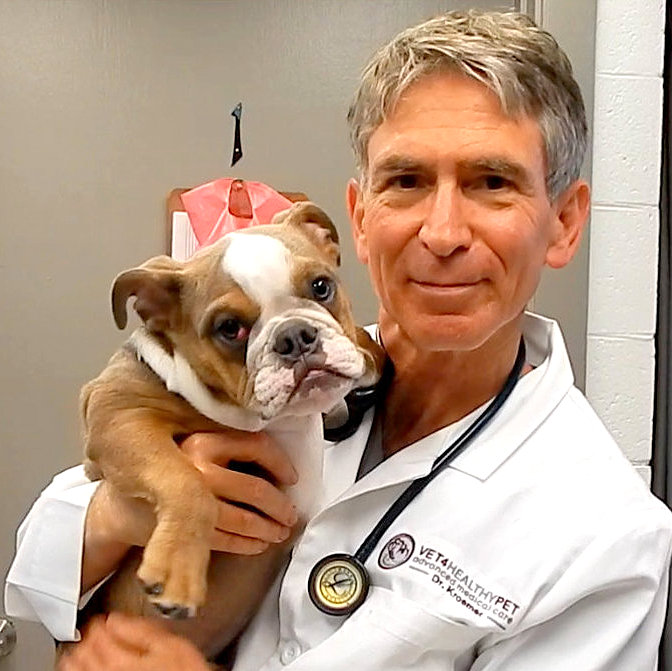


At eight, spondylosis is a fair guess, and the lower back is exactly where it lives. But I would not let anyone settle on it without ruling out the others first, because several bulldog problems produce back pain and they are managed very differently. The diagnosis I care about is the one that explains the pain, not the one that shows up on the film. A physical exam should work through IVDD, vertebral malformation, hip dysplasia, an ACL injury, ordinary arthritis and a luxating patella before spondylosis gets the credit. That matters because spondylosis is frequently subclinical: plenty of bulldogs have obvious bony bridging on radiographs and no symptoms whatsoever, so finding it does not prove it is the source of Sunny’s discomfort. If it does turn out to be the cause, treatment is symptomatic rather than surgical. Get the weight off him, keep him moving for muscle support and blood flow, use an NSAID or an analgesic such as gabapentin when he needs it, and keep joint and comfort supplements going daily. Cold laser, PEMF and stem cell therapy all help with pain and inflammation without adding another drug.
Bulldog spondylosis is a form of vertebral arthritis characterized by chronic degeneration of the spinal column and tends to occur more frequently in the lower part of the spine.
Bulldog Spondylosis Vertebral Arthritis 5 X MUST KNOW
- Spondylosis in bulldogs is often subclinical and diagnosed during unrelated routine X-rays.
- Like common arthritis, it is often caused by degeneration due to chronic bone-on-bone injury
- Spondylosis is more common in the lower vertebra (lumbar-sacral)
- Treatment often requires pain and anti-inflammatory medication
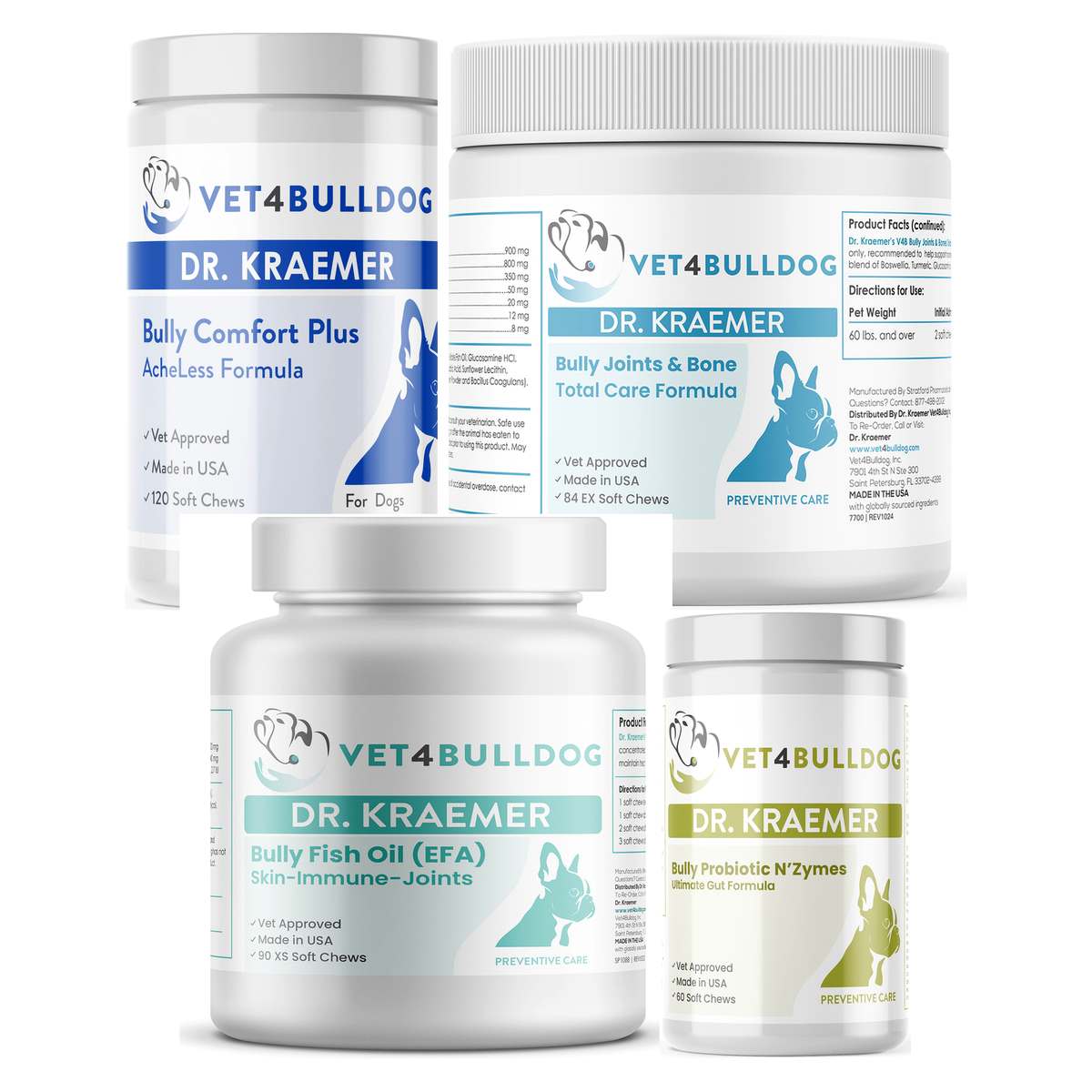
- Prevention and care include weight management and Dr. Kraemer’s Bulldog Spondylosis and Back Care Bundles.
Members of this bulldog community prefer prevention over RX
Spondylosis Vertebral Arthritis / CAUSE:
The exact cause of spondylosis in bulldogs is not well understood, but it is believed to be related to aging and the natural degeneration of the spinal discs. Factors that may contribute to the development of spondylosis include:
- CHRONIC INJURY: Similar to osteoarthritis in other joints, vertebral spondylosis is attributed to repeated injury, typically in areas of the vertebrae that undergo the most movement, leading to “bone on bone” friction.
- GENETIC: There might be a genetic underlining.
- CONFORMATION
Spondylosis Vertebral Arthritis AGE
Spondylosis vertebral arthritis in bulldogs is a chronic condition more common in middle-aged and older senior bulldogs. Younger bulldogs can also be affected, especially if they have a predisposition due to genetics or if they’ve experienced spinal trauma. 
Vertebral Arthritis in Bulldogs and French Bulldogs SYMPTOMS
Many bulldogs and French bulldogs with spondylosis do not show any symptoms, especially in the early stages. When symptoms do occur, they can include:
- Stiffness or reduced mobility
- Pain in the back and hip area
- Difficulty standing up, lying down, or climbing stairs
- Limping or changes in gait
- Visible discomfort when the spine is touched
Vertebral Arthritis in Bulldogs / DIAGNOSIS:
Vertebral arthritis in bulldogs is frequently subclinical, meaning it doesn’t always show obvious symptoms and is discovered incidentally during routine spinal radiographs intended for other purposes. Diagnostic tests are needed to recognize spondylosis deformans and to help exclude other diseases. Tests may include:
- EXAM: a physical exam should be conducted to help rule out other back and orthopedic problems, such as
- IVDD
- Vertebral Malformation
- Hip Dysplasia
- ACL Injuries
- Arthritis
- MPL: medial patella luxation
- IMAGING: Radiographic
- OTHER IMAGING:
- myelogram
- CT
- JOINT TAP: for analysis, cytology, and culture

BULLDOG AND FRENCH BULLDOG VERTEBRAL ARTHRITIS LOCATION
The arthritic fusion resulting from vertebral arthritis can occur in a single location, most frequently affecting the lower lumbar vertebrae or the lumbar-sacral region. However, it’s common for multiple vertebrae to be involved in the condition.
BULLDOG AND FRENCH BULLDOG VERTEBRAL ARTHRITIS BONE SPURS:
Vertebral arthritic changes often entail the development of bone spurs, medically referred to as “osteophytes.” These spurs can form along the edges of the vertebrae. Additionally, the condition can lead to the fusion of adjacent vertebrae across the intervertebral space, a process aimed at stabilizing the affected area but which can also contribute to pain and limited mobility.
Vertebral Arthritis in Bulldogs and French Bulldogs PREVENTION:
- WEIGHT CONTROL: lean body weight
- EXERCISE AND ACTIVITY: for muscle support and blood flow
- BULLY THERAPEUTIC SUPPLEMENTS
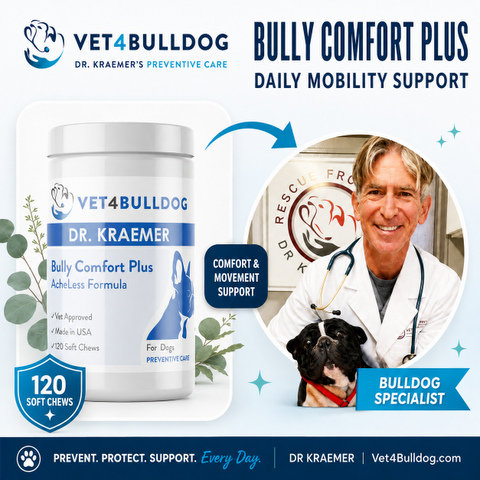
- V4B Bully Comfort Plus AcheLess
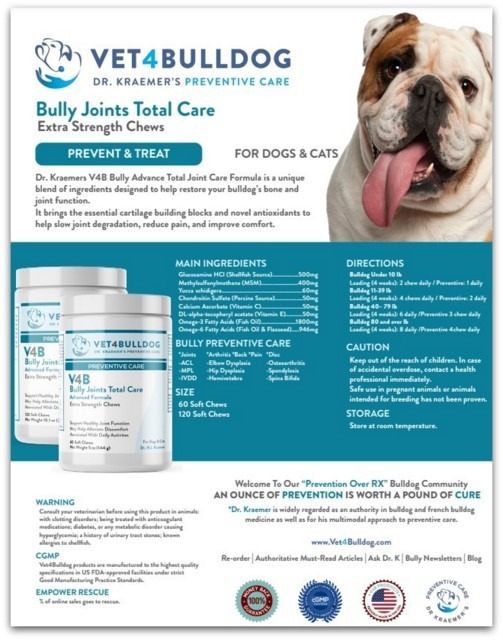
- V4B Bully Joint and Bone Total Care
- V4B Bully Arthritis Pain and Ache Basic Bundle
- Stem Cell Therapy and Cryobanking
Vertebral Arthritis Spondylosis in Bulldogs: TREATMENT
Treatment is mostly symptomatic pain control, surgery is rare.
- ANALGESICS:
- Gabapentin
- Tramadol
- ANTI-INFLAMMATORIES: Nonsteroidal anti-inflammatory drugs (NSAID)
- STEM CELL THERAPY
- LASER THERAPY
- PEMF: pulse electromagnetic field therapy
- THERAPEUTIC SUPPLEMENTS:
Insider tip
What is spondylosis, in plain terms?
The X-ray looks terrible. Is my bulldog in pain?
What causes it?
Where in the spine does it occur?
What signs would I actually see?
How is it told apart from other back problems?
How is it treated?

Veterinary Care and Supportive Products
Spondylosis on a radiograph is a finding, not a diagnosis. If your bulldog is genuinely sore, the examination matters more than the film, because IVDD, hip disease, a cruciate injury and a luxating patella all produce back and hind end pain and all need different handling. No supplement reverses bony bridging. What supplements do is manage the inflammation and pain, and support the muscle that takes the load off the spine.
The Disc, Back and Nerve bundles, 59lb and under

- Disc, Back and Nerves Basic Care Bundle
- Disc, Back and Nerve Essential Bundle
- Disc, Back and Nerve ULTIMATE Bundle
The Disc, Back and Nerve bundles, 60lb and over

- Disc, Back and Nerves Basic Care Bundle
- Disc, Back and Nerve Essential Bundle
- Disc, Back and Nerves ULTIMATE Bundle
More Help from Dr. Kraemer
These are the conditions I rule out before I let spondylosis take the blame:
- IVDD and disc disease in Bulldogs
- Vertebral malformation back problems
- Hip dysplasia in Bulldogs and French Bulldogs
- ACL tear in Bulldogs and French Bulldogs
- Medial patella luxation (MPL)
- Bulldog arthritis and arthritic pain
About the Author
Roy Kraemer, DVM, is a veterinarian with extensive clinical experience caring for Bulldogs and French Bulldogs. His educational work emphasizes examining the dog rather than the radiograph, ruling out treatable causes first, weight and mobility management, and prevention over prescription.
Trusted by Vets ~ Recommended by Owners ~ Approved by Bulldogs
References
- Merck Veterinary Manual. Spondylosis Deformans in Animals
- American College of Veterinary Surgeons. Lumbosacral Disease
- American Animal Hospital Association. 2022 AAHA Pain Management Guidelines for Dogs and Cats
To be clear: supplements or topicals are not substitutes for prescribed treatment. If your dog is unwell, is being treated for a condition, or is already on medication, review any supplement or topical with your veterinarian so it fits the plan you are already following. This page is educational and is not a diagnosis or a treatment plan for your own dog.