


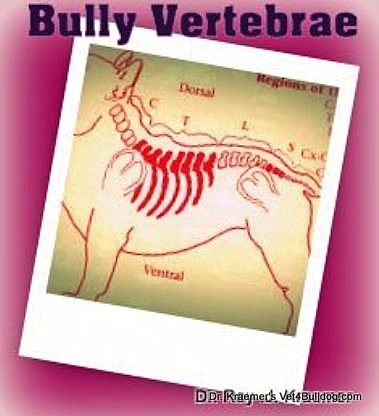
Spinal Vertebral Abnormalities in Bulldogs and Fr. Bulldogs Butterfly hemivertebrae is a congenital (“at birth,” “born with”) malformation of the vertebrae seen most often in short-faced, screw-tailed breeds like our bulldogs. Most dogs and breeds normally have from 49 to 53 vertebrae, while the screw-tailed bulldog might have 10 to 15 fewer, depending on the tail formation. In bulldogs, those tail vertebrae are usually deformed. Normally, the vertebral bodies are differentiated into:
- 7 Cervical
- 12 or 13 Thoracic
- 7 Lumbar
- 3 Sacral
- Several coccygeal (tail) vertebrae.
Bulldogs and French bulldogs are predisposed and have a high probability of incomplete development of their vertebrae.
Four months with a gait change is the age this presents, so I understand the fear. Two things will tell you most of what you need to know. First, how many vertebrae are involved. A single butterfly or wedge vertebra very rarely causes problems, and finding one is common in this breed. Several together produce more curvature, and that is where clinical trouble comes from. Second, and this is the one I would hold on to: neurological signs from this condition generally plateau at around 9 months, when the vertebrae stop growing. If he is stable at his first birthday, the prognosis is favourable and I would not expect new problems to appear later. The important caveat is that a hemivertebra on a film does not prove it is causing the signs. Even in a dog with neurologic deficits, hemivertebrae are still likely to be incidental, so I would want myelography, MRI or CT to confirm the cord is genuinely compressed before anyone acts on that assumption. Meanwhile, keep him lean, and tell me straight away if you see the hind end weaken further, muscle waste on the back legs, or any loss of bladder or bowel control.
Dr. Kraemer’s Bulldogs Butterfly RULE OF THUMB
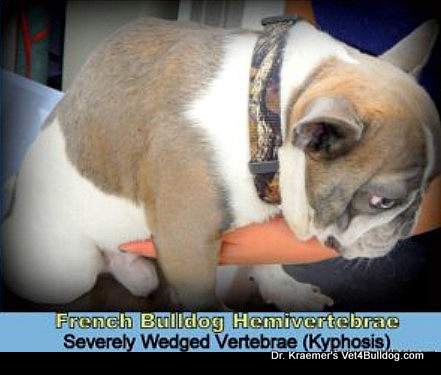
Hemivertebrae form when the right and left halves of the developing vertebral body fail to fuse, producing a body that resembles a butterfly when seen from above. The two unfused bulldog vertebral halves often grow unequally, producing a wedge-shaped vertebral body. 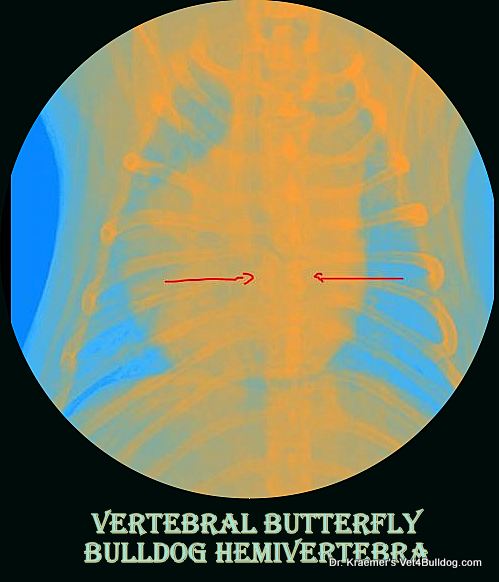 Depending on which way the broad side of the wedge is directed, this may cause a dorsal (top) curvature (kyphosis) or a lateral (side) curvature (scoliosis). As the backbone is bent, it can start affecting the spinal cord, compressing it, and/or its blood supply. If the function of the spinal cord is impaired by direct compression or by vascular problems, the animal may manifest:
- PAIN & SENSATION LOSS: Pain and/or loss of sensation are due to the interruption of the sensory circuits.
- MOTOR & MOBILITY: If motor nerve circuits in the cord are affected, weakness or paralysis, especially of the hind limbs, will result.
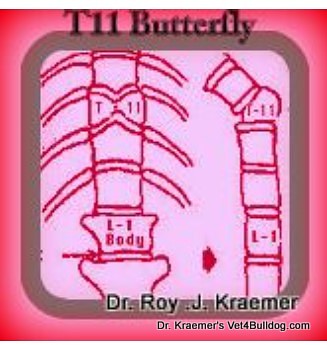
Any body part receiving its nerve supply from the part of the cord posterior to the damaged area may be affected. The vertebrae most often involved are the 9th to 11th thoracic vertebrae. Most times, only a single vertebra is involved, showing no clinical problems. Thus, the malformation is detected only accidentally when back radiographs are taken, if at all. If more than one vertebra is involved, the probability of clinical problems increases due to the greater degree of curvature. In those rare cases where the dog does show some clinical signs, the outlook is grave. 
Spinal Vertebral Abnormalities in Bulldogs Butterfly PREVENTION
Most often, symptoms begin at the age of 3 to 4 months with a sudden onset of hind limb weakness, which is often preceded by a gait abnormality. In bulldog pups who do show such symptoms, hind limb paralysis generally worsens over time, along with muscle wasting and often a loss of bladder and bowel control.
Fortunately, in most cases, any neurological abnormalities related to this condition will plateau at age 9 months as the vertebrae stop growing. Thus, no additional or new clinical problems are expected.
If your beloved bulldog’s condition is stable at their first birthday, the prognosis is favorable.
SUPPLEMENTS FOR BULLDOG BACK PROBLEMS: Various supplements can be provided to help improve comfort, arthritis, and inflammation:
Bulldog Back Problem COMFORT:
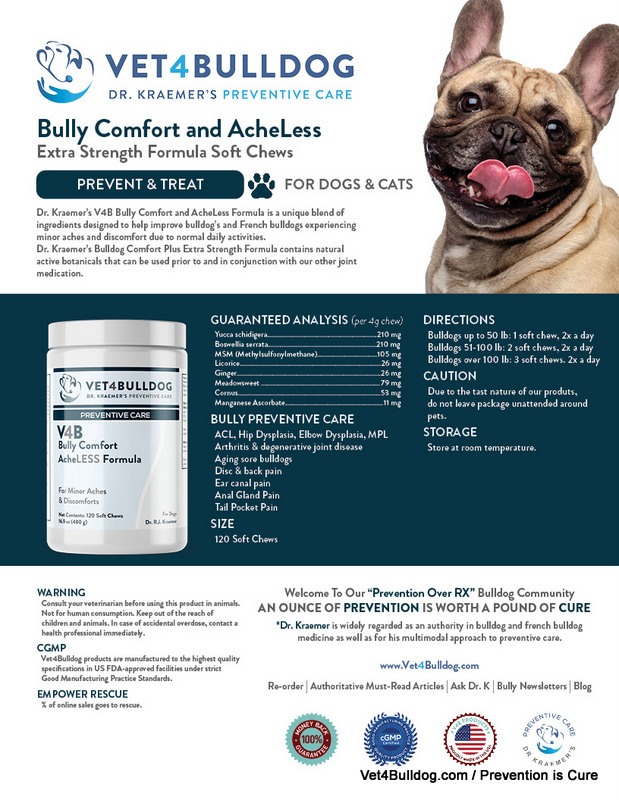
Bulldog Back Problem: ARTHRITIS

Bulldog Back Problem INFLAMMATION:

WEIGHT MANAGEMENT: Keep your bulldog lean NON-RX THERAPIES: for comfort and healing Cold Laser Therapy Class 4 PEMF Stem Cell Therapy and cryobanking 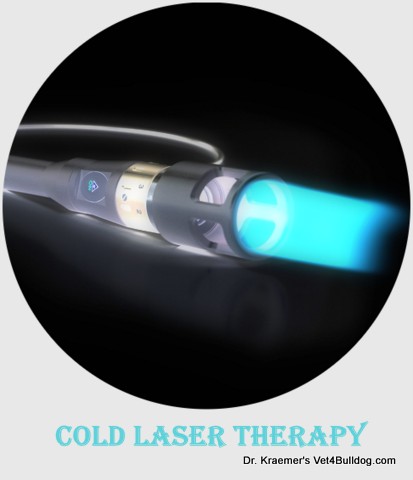 RX:
RX:
- Steroidal
- Non-Steroidal (NSAID)
- Analgesics
- etc.
Spinal Vertebral Abnormalities in Bulldogs TIP & WARNINGS:
Below is a selective, short list of bulldog vertebra tips and warnings courtesy of Dr. Kraemer
BULLDOG SPINE RADIOGRAPH TIP
The abnormality might be only detectable radiographically. Most are incidental findings on a radiograph and are not associated with clinical signs.
BULLDOG VERTEBRA RIB CAGE TIP
Due to the curvature of the last few thoracic vertebrae, secondary changes in the rib cage may be produced.
FRENCH BULLDOG WEDGE VERTEBRA TIP
Both the wedge-shaped and butterfly-shaped types are very common in Frenchies, but when only a single one is present, it very rarely causes problems.
BULLDOG HEMIVERTEBRA TIP
The most common area for problematic hemivertebrae is around the upper back at the 8th (out of 13) thoracic vertebrae.
BULLDOG BACK PAIN AND STEROID INJECTIONS TIP:
Rest and possibly corticosteroid injections during flare-ups may be adequate to treat a mild case; more severe cases might require surgery. 
BULLDOG BACK PROBLEMS SYMPTOMS WARNING
Should abnormal pressure on the spinal cord be present, the following signs can be seen:
- A weakness of the rear limbs
- Fecal incontinence
- Urinary incontinence
BULLDOG VERTEBRAL ABNORMALITIES TESTING WARNING:
It is important to understand that usually the presence of hemivertebrae is of no significance and is just an interesting finding on a radiograph. If they are present in a dog with neurologic deficits, they are still likely to be incidental findings only, and further testing is likely to be needed before assuming the hemivertebra is the cause. This kind of testing commonly involves special imaging (myelography, MRI, or CT imaging) to see if the spinal cord is compressed by the hemivertebrae.
Insider tip
What is a butterfly vertebra?
Why does the wedge matter?
How many vertebrae should a bulldog have?
Which vertebrae are usually involved?
When do symptoms start, and do they get worse?
Does a hemivertebra on the X-ray explain my dog’s signs?
What can be done for it?

Veterinary Care and Supportive Products
A hemivertebra found by chance in a bulldog with no symptoms needs nothing but awareness. A bulldog with hind limb weakness, muscle wasting or loss of bladder or bowel control needs a neurological workup, and advanced imaging to prove the cord is genuinely compressed at that segment before the malformation gets the blame. No supplement reshapes a vertebra. What supplements do is address comfort, arthritis and inflammation, which is the part of this you can actually influence.
The Disc, Back and Nerve bundles

- Basic Care Bundle, 59lb and under
- Essential Bundle, 59lb and under
- ULTIMATE Bundle, 59lb and under
- Basic Care Bundle, 60lb and over
- Essential Bundle, 60lb and over
- ULTIMATE Bundle, 60lb and over
More Help from Dr. Kraemer
Related reading on the bulldog spine:
- Vertebral malformation back problems
- Spina bifida in Bulldogs and French Bulldogs
- IVDD and disc disease in Bulldogs
- Spondylosis, arthritis of the spine
- Bulldog arthritis and arthritic pain
- Stem cell therapy for dogs and cats
About the Author
Roy Kraemer, DVM, is a veterinarian with extensive clinical experience caring for Bulldogs and French Bulldogs. His educational work emphasizes separating incidental radiographic findings from clinical disease, confirming a cause before treating it, responsible breeding, and prevention over prescription.
Trusted by Vets ~ Recommended by Owners ~ Approved by Bulldogs
References
- Merck Veterinary Manual. Congenital and Inherited Anomalies of the Nervous System
- American College of Veterinary Internal Medicine. Hemivertebrae in Screw Tailed Breeds
- WSAVA. Hereditary Disease Guidelines for Brachycephalic Breeds