
 68 asked 3 years ago
Can My French Bulldog Puppy Eat Chicken?

Question from Stitch’s family:
My wife and I have a 7-month-old French Bulldog named Stitch. His breeder told us that French Bulldogs should not eat chicken, and now we are nervous about feeding him any food that contains it.

Could chicken be causing his hair loss?
Stitch also has several small areas of hair loss. His veterinarian performed a skin scraping and found mites that looked like tiny organisms with long tails under the microscope. We were told these are Demodex mites, and he is currently being treated with ivermectin.
Is chicken generally safe for a French Bulldog puppy? Could a chicken allergy be contributing to his hair loss, or is the Demodex a separate problem?
Thank you,
Stitch’s concerned family 🐾
 Dr. Roy Kraemer Staff answered 3 years ago
Can French Bulldog Puppies Eat Chicken? The Quick Answer
Dear Stitch’s family, yes, most French Bulldog puppies can eat chicken. Chicken is not automatically harmful to Frenchies, and a breeder’s general “no chicken” rule does not apply to every dog.
The safest approach is to feed a complete and balanced puppy food appropriate for growth. If chicken is offered separately, it should be fully cooked, plain, boneless, and given only in a small amount. Stitch’s Demodex hair loss is a separate medical issue and is not caused by eating chicken.
Chicken-Based Puppy Food Is Different From Feeding Chicken Alone
A reputable commercial puppy food that lists chicken can provide complete nutrition because the final diet is formulated with the correct balance of protein, fat, vitamins, minerals, and other nutrients. The ingredient list alone does not tell you whether a food is nutritionally complete or well made.
Look for a nutritional adequacy statement showing that the food is complete and balanced for growth. Plain chicken by itself is not a complete puppy diet and should never replace Stitch’s regular food. Treats and table foods together should stay below about 10% of his daily calories.
How to Offer Chicken Safely
- Cook it thoroughly: avoid raw or undercooked chicken because it can carry harmful bacteria.
- Remove every bone: cooked bones can splinter and injure the mouth, esophagus, stomach, or intestines.
- Keep it plain: skip fried chicken, fatty skin, sauces, salt, onion, garlic, and heavy seasoning.
- Start small: introduce a small amount and watch for vomiting, diarrhea, itching, ear trouble, or paw licking.
- Protect the balanced diet: use chicken as a small treat or topper unless a veterinary nutritionist formulates a complete home-cooked recipe.
Can a French Bulldog Be Allergic to Chicken?
Yes. Chicken can be a food allergen for an individual dog, just as beef, dairy, or another protein can. That does not mean chicken is unsuitable for the breed as a whole.
Possible food-allergy signs include year-round itching, recurrent ear or skin infections, paw licking, and sometimes vomiting or diarrhea. These signs also occur with fleas, environmental allergies, mites, and infections, so symptoms alone cannot identify chicken as the cause.
The reliable way to diagnose a food allergy is a strict veterinarian-supervised elimination diet using a prescription hydrolyzed or carefully selected novel-protein food, usually for 8 to 12 weeks, followed by a controlled food challenge. Changing among over-the-counter foods for a few days does not provide a reliable answer.
Learn more in Dr. Kraemer’s guide to food allergies in Bulldogs and French Bulldogs.
Stitch’s Hair Loss and Demodex
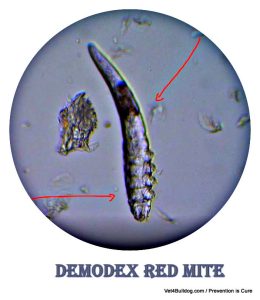
Demodex mites live in hair follicles. Puppies with localized demodicosis often develop a few small, well-defined bald or scaly patches with little itching. Many localized cases resolve as the immune system matures, while generalized disease, secondary infection, or worsening lesions require active treatment and follow-up skin scrapings.
Modern isoxazoline flea-and-tick medications have become the preferred treatment for many dogs with generalized demodicosis. Ivermectin is used extra-label and can cause neurologic toxicity, so its dose should never be started, stopped, or adjusted without the prescribing veterinarian.
Contact Stitch’s veterinarian promptly if he develops weakness, stumbling, tremors, marked sleepiness, disorientation, unusual pupil changes, excessive drooling, or any sudden decline while receiving ivermectin.
Read Dr. Kraemer’s overview of Demodex in Bulldogs and French Bulldogs.
A Practical Plan for Stitch
- Confirm that his main food is complete and balanced for puppy growth.
- If he is not beginning an allergy diet trial, introduce plain cooked chicken only in a small amount.
- Keep all treats and toppers below about 10% of daily calories.
- Photograph the bald areas weekly and attend the scheduled recheck for repeat skin evaluation.
- Ask whether the Demodex is localized or generalized and whether secondary bacterial or yeast infection is present.
- If persistent itching, ear disease, or digestive signs raise concern for food allergy, use a structured prescription elimination trial instead of random food changes.
Dr. Kraemer’s Exam Room Takeaway
Stitch can eat chicken unless his own history and a proper diet trial show that he does not tolerate it. Choose a complete puppy diet, keep extra chicken plain and modest, and manage his Demodex as a separate veterinary problem.
Helpful Vet4Bulldog Resources
- How to choose a Bulldog diet
- Bully Hypoallergenic Skincare Basic Bundle for veterinarian-approved daily skin support
Good luck, Stitch.
Dr. Kraemer, Vet4Bulldog
Trusted by Owners, Approved by Bulldogs
Trusted by Vets ~ Recommended by Owners ~ Approved by Bulldogs
Important: this answer is educational and is not a diagnosis or a treatment plan for your own dog. It is not a substitute for a veterinary examination, diagnosis or treatment.