


Vertebral Malformation Back Problems in Bulldogs and French Bulldogs are common in both breeds. The bulldog skeleton is supported by a spinal column that is composed of two main parts: VERTEBRAE: Multiple vertebrae (cervical, thoracic, abdominal, sacral, and tailbone). DISC: Soft, pasty, spongy discs (the dark space/line between the vertebras seen on radiographs) that cushion those bony vertebrae and allow a range of motion.
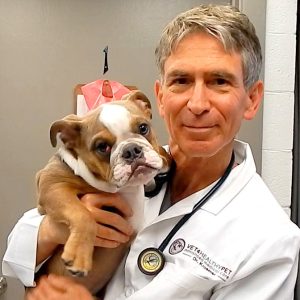
That is the most common way this gets found, and in a dog with no symptoms it is usually not a problem. Many bulldogs and French Bulldogs carry at least one vertebral malformation and only a few ever show pain or neurological signs. What decides it is whether a wedged vertebra is pressing on the spinal cord, and in this breed the spot to watch is around the eighth thoracic vertebra. Since he is seven months old, you are close to the useful milestone: once the vertebral growth plates fuse, at roughly 9 to 10 months, clinical signs generally plateau. So what I would do is watch, not worry. The things I would want to hear about are weakness in the back legs, a wobble through the hind end, muscle wasting on the hind limbs, or any loss of bladder or bowel control. If any of those appear, MRI or CT is how we confirm whether the malformation is actually the cause. In the meantime keep him lean, because weight control matters for every back problem, and joint, comfort and omega 3 support is sensible in a breed built like this. One thing to be clear about if you were considering breeding him: selecting for the screwtail also selects for hemivertebrae elsewhere in the spine, and those are the ones that compress cords.
Vertebral Malformation in Bulldogs and French Bulldogs / CAUSE:
Vertebral Malformation is a congenital (born with) spinal condition. Most congenital malformations related to the bulldog spine are due to abnormal development or fusion of the primary ossification centers of their vertebra.
Bulldog’s and French bulldog’s vertebral malformations include:
- Bulldog and French Bulldog Hemivertebrae
- Bulldog Block Vertebrae
- Bulldog Transitional Vertebrae
- Bulldog and French Bulldog Spina Bifida
Vertebral malformations in Bulldogs and French Bulldogs are frequently identified incidentally during routine radiographic examinations.
Although many bulldogs are diagnosed with at least one form of vertebral malformation, only a few will exhibit pain or clinical issues.
BULLDOG & FR BULLDOG WEDGE VERTEBRAE:
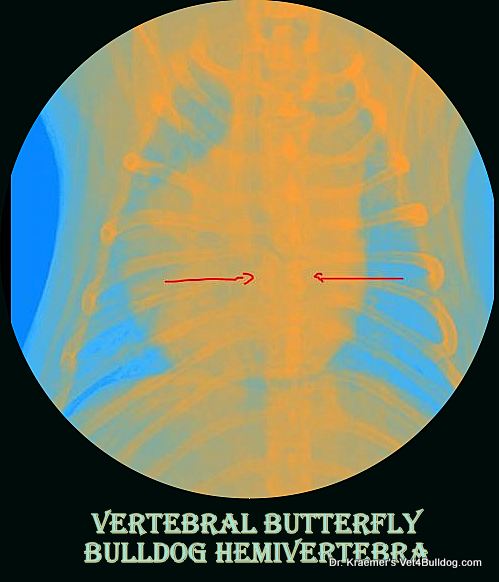
Bully vertebral malformations are due to abnormal development of their “vertebral body” that matures into a wedge-shaped body instead of the normal elongated vertebral body. Occasionally, this bulldog’s malformed, wedged vertebrae will compress the spinal cord. Depending on location and severity, the compressed spine could result in pain and a wide range of neurological problems. 
BULLDOG & FR BULLDOG VERTEBRAL SCREW TAIL:
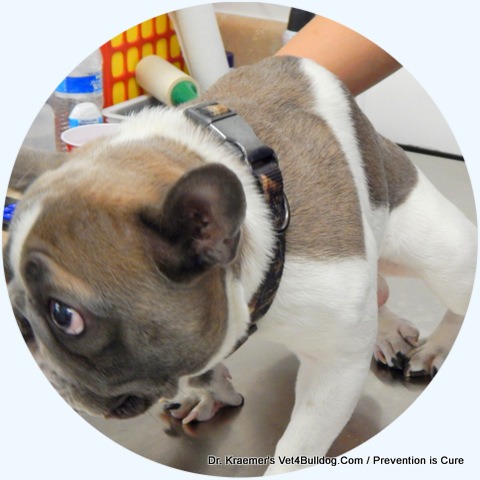
The corkscrew tail, common to English bulldogs, French bulldogs, and other brachycephalic breeds like Boston terriers, is also due to a vertebral malformation. 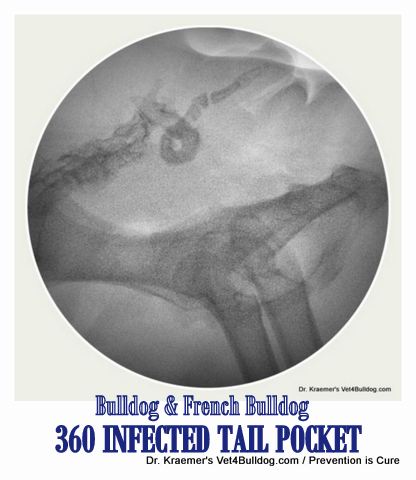 Fortunately, the spinal cord ends before the tail begins. Thus, there are usually no neurological problems associated with bulldog tail malformation.
Nevertheless, Bulldog and French bulldog tail malformations (i.e., corkscrew) are often associated with bully tail skin folds and moist dermatitis.

This bully skin-fold condition can lead to an infected, painful tail that could be prevented and must be managed diligently with daily antiseptic & antifungal wipes like Dr. Kraemer’s V4B Bully Antiseptic Extra Large Medicated SkinFolds Wipes 
BULLDOG AND FR BULLDOG VERTEBRAL WEDGE COMPRESSION:
The most common area for bulldog hemivertebrae malformations is around the 8th thoracic vertebrae (the upper back) and when the wedging starts compressing the spinal cord, the following signs can be observed and noted:
- A weakness of the rear limbs
- The wobbling of the hind end
- Fecal incontinence
- Urinary incontinence
- Hind leg muscle atrophy
Dr. Kraemer’s Bulldog Vertebral Malformation RULE OF THUMB:
In most cases, once the vertebral body growth plates fuse, at about 9 to 10 months of age, any clinical signs associated with the condition should plateau.
Vertebral Malformation in Bulldogs and French Bulldogs TIPS & WARNINGS:
Bulldog Back Disease BREEDING WARNING: Selective breeding for a bulldog or French bulldog screwtail hemivertebra can also be selected for hemivertebrae of other spinal vertebrae (cervical, thoracic, abdominal, and sacral). In contrast to the tail vertebrae, wedging of those other vertebrae can lead to a compressed spinal cord and the associated pain and neurological deficits. Bulldog Vertebral Malformation DIAGNOSIS WARNING : If your bulldog or French bulldog presents with neurological problems and pain associated with their back, additional testing with more advanced imaging (MRI and CT) might be required to confirm that they are related to the malformation. Tip DIAGNOSIS: Most of the time, the diagnosis of a bulldog or French bulldog hemivertebrae is an incidental finding.
Bulldog Vertebral Malformation PREVENTION &TREATMENT:
REST & CONFINEMENT: Acute cases can often benefit from and improve with rest and confinement. WEIGHT MANAGEMENT: Weight control is critical for all back problems.
BULLDOG BACK SUPPLEMENTS:
Natural pain relief, joint support, and anti-inflammatory supplements might help to prevent and manage bulldog back problems.
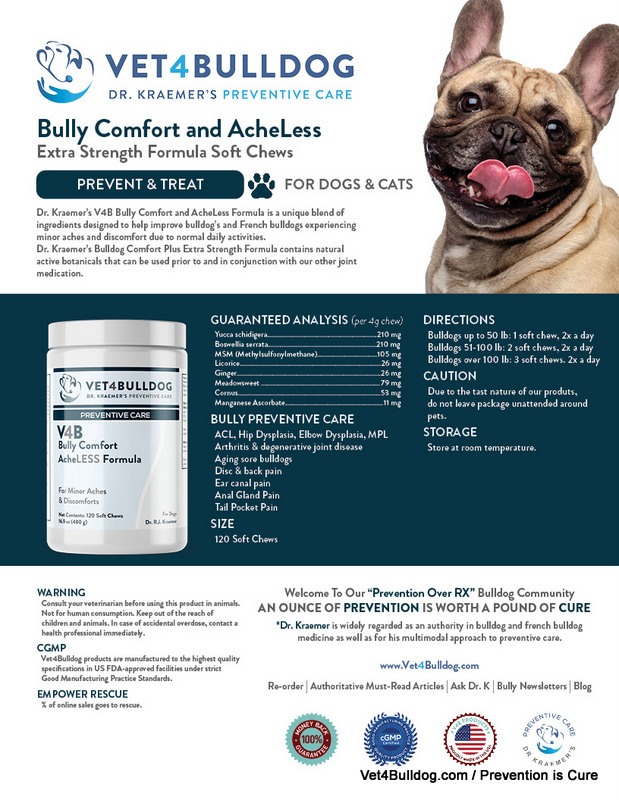
- V4B Bully Comfort Plus AcheLess chews
- V4B Bully StressLess & Calm
- V4B Bully Joint and Bone Total Care
- V4B Bully Fish Oil Immune-Skin-Joint
BULLDOG VERTEBRAL & BACK RX/STEROIDS:
Corticosteroid injections or NSAIDs might be recommended, as well as muscle relaxants.
Non-RX: cutting-edge, non-Rx modalities for pain management and healing are now available.
- Stem Cell Therapy
- PRP
- Cold Laser Therapy
- PEMF
In more severe cases, back decompression surgery might be required.
Insider tip
What are the different malformations?
Is a corkscrew tail the same condition?
Should I be worried if it was found by chance?
What is a wedge vertebra, and when does it matter?
What signs would compression cause?
Will it get worse as he grows?
How is it treated?

Veterinary Care and Supportive Products
An incidental malformation in a bulldog with no symptoms usually needs watching rather than treating. Weakness, a hind end wobble, muscle wasting or any loss of bladder or bowel control changes that, and advanced imaging with MRI or CT is then how we confirm whether the malformation is genuinely the cause. No supplement reshapes a vertebra. What supplements do is manage pain and inflammation and support the muscle around a spine that was built at a disadvantage.
The Disc, Back and Nerve bundles

- Basic Care Bundle, 59lb and under
- Essential Bundle, 59lb and under
- ULTIMATE Bundle, 59lb and under
- Basic Care Bundle, 60lb and over
- Essential Bundle, 60lb and over
- ULTIMATE Bundle, 60lb and over
More Help from Dr. Kraemer
Related reading on bulldog backs and the conditions that look like this one:
- Hemivertebrae and butterfly vertebrae
- Spina bifida in Bulldogs and French Bulldogs
- IVDD and disc disease in Bulldogs
- Spondylosis, arthritis of the spine
- Tail pocket and skin fold dermatitis
- Hip dysplasia in Bulldogs and French Bulldogs
About the Author
Roy Kraemer, DVM, is a veterinarian with extensive clinical experience caring for Bulldogs and French Bulldogs. His educational work emphasizes distinguishing incidental findings from clinical disease, responsible breeding, weight and mobility management, and knowing which signs warrant advanced imaging.
Trusted by Vets ~ Recommended by Owners ~ Approved by Bulldogs
References
- Merck Veterinary Manual. Congenital and Inherited Anomalies of the Nervous System
- American College of Veterinary Internal Medicine. Hemivertebrae in Screw Tailed Breeds
- WSAVA. Hereditary Disease Guidelines for Brachycephalic Breeds